A life-sized carved eagle owl, attributed to the Ruef Brothers of Brienz, Switzerland, circa 1880, standing 28 inches high. The bird is carved in linden wood and perched upright on a cut branch rising from a rocky outcrop, the whole cut from a single block with a turned circular base. Ear tufts raised, wings folded, talons gripping the branch, it fixes the viewer with yellow glass eyes set into deeply carved facial discs.
What distinguishes this owl is the treatment of the plumage. Every feather is carved individually and then worked with a heated iron, the edges and barring scorched into the wood so that the graduated breast, the mottled crown, and the darker flight feathers read in tone as well as relief. This burning of the surface is the technique most closely associated with the Ruef workshop, whose birds of prey were a specialty of the Brienz trade, and the attribution rests on that handling together with the composition and the scale. The piece is unsigned.
The head is made separately and lifts off at the neck, a construction the carver has concealed within the ruff of feathers at the throat. It is not hinged, and the body is not hollowed out for use as a tobacco jar or humidor, which is consistent with the piece's size. The separate head allowed the carver to work the face and the body from blocks of different grain, and it is a feature worth knowing when a piece of this model is examined.
Carving of this ambition came out of Brienz in the Bernese Oberland, where the Ruef Brothers worked alongside Johann Huggler, Hans Huggler-Wyss, and Walter Mader in the decades when the international exhibitions at Vienna, Philadelphia, Paris, and Chicago carried Swiss carving to an American and English clientele. We discuss the Ruef workshop and the scorching technique in our article on the masters of the Black Forest, and in the reference we co-authored on the subject, Swiss Carvings: The Art of the Black Forest, 1820 to 1940.
A life-sized carved eagle owl, attributed to the Ruef Brothers of Brienz, Switzerland, circa 1880, standing 28 inches high. The bird is carved in linden wood and perched upright on a cut branch rising from a rocky outcrop, the whole cut from a single block with a turned circular base. Ear tufts raised, wings folded, talons gripping the branch, it fixes the viewer with yellow glass eyes set into deeply carved facial discs.
What distinguishes this owl is the treatment of the plumage. Every feather is carved individually and then worked with a heated iron, the edges and barring scorched into the wood so that the graduated breast, the mottled crown, and the darker flight feathers read in tone as well as relief. This burning of the surface is the technique most closely associated with the Ruef workshop, whose birds of prey were a specialty of the Brienz trade, and the attribution rests on that handling together with the composition and the scale. The piece is unsigned.
The head is made separately and lifts off at the neck, a construction the carver has concealed within the ruff of feathers at the throat. It is not hinged, and the body is not hollowed out for use as a tobacco jar or humidor, which is consistent with the piece's size. The separate head allowed the carver to work the face and the body from blocks of different grain, and it is a feature worth knowing when a piece of this model is examined.
Carving of this ambition came out of Brienz in the Bernese Oberland, where the Ruef Brothers worked alongside Johann Huggler, Hans Huggler-Wyss, and Walter Mader in the decades when the international exhibitions at Vienna, Philadelphia, Paris, and Chicago carried Swiss carving to an American and English clientele. We discuss the Ruef workshop and the scorching technique in our article on the masters of the Black Forest, and in the reference we co-authored on the subject, Swiss Carvings: The Art of the Black Forest, 1820 to 1940.

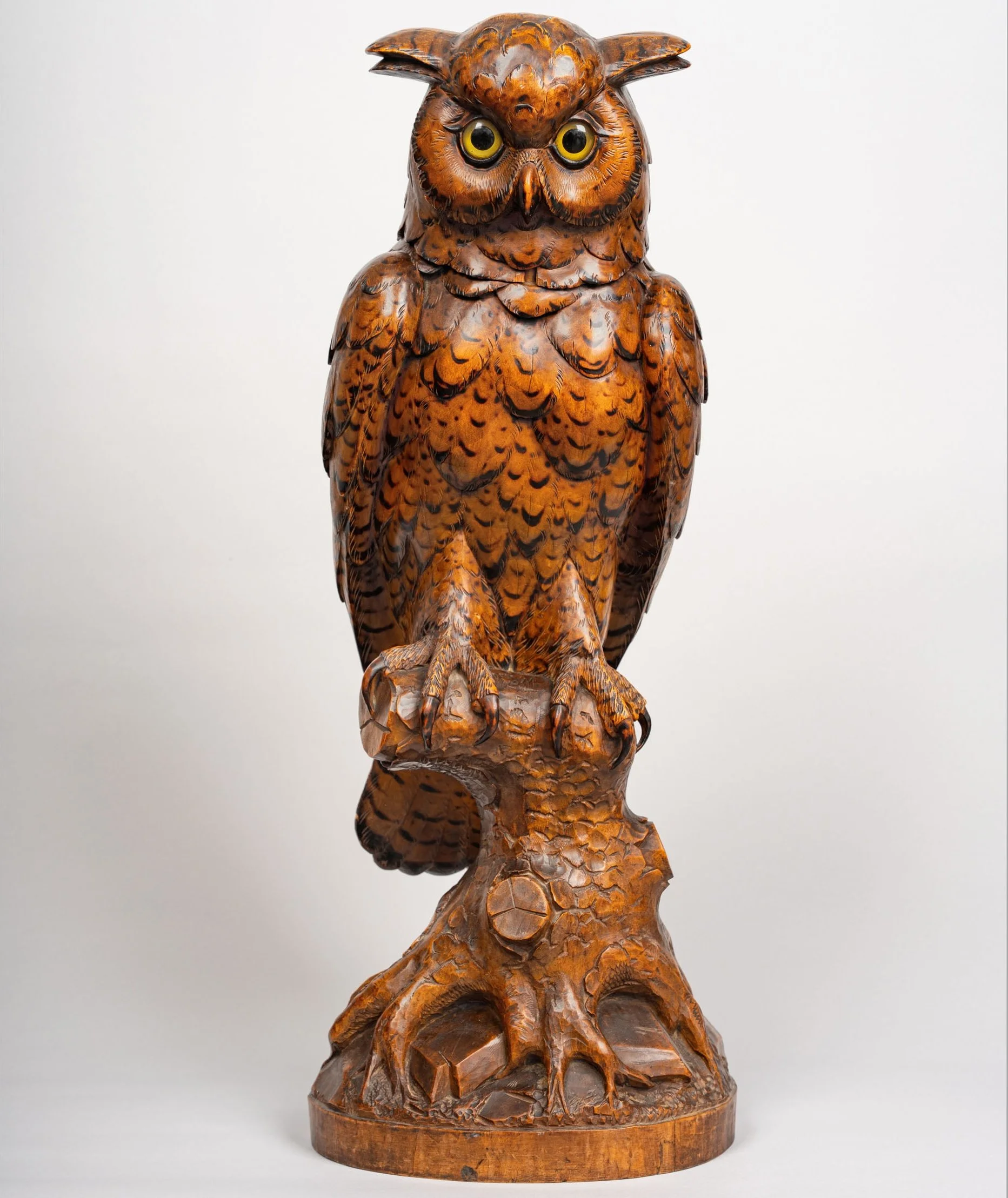 Image 1 of 2
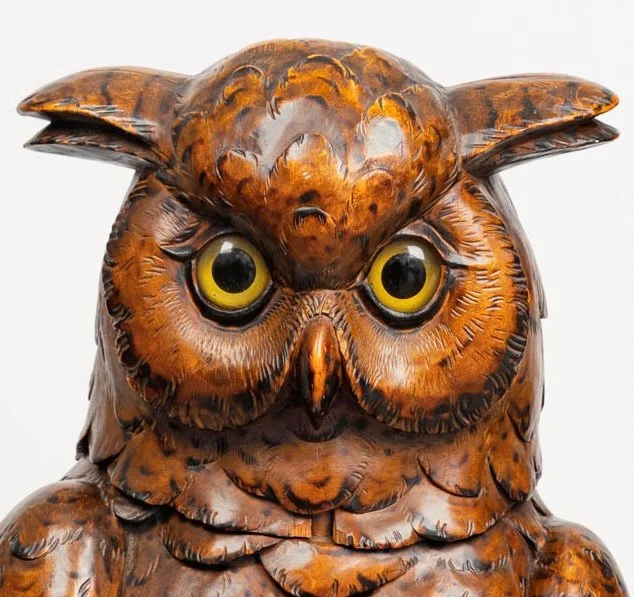 Image 2 of 2