
 Image 1 of 4
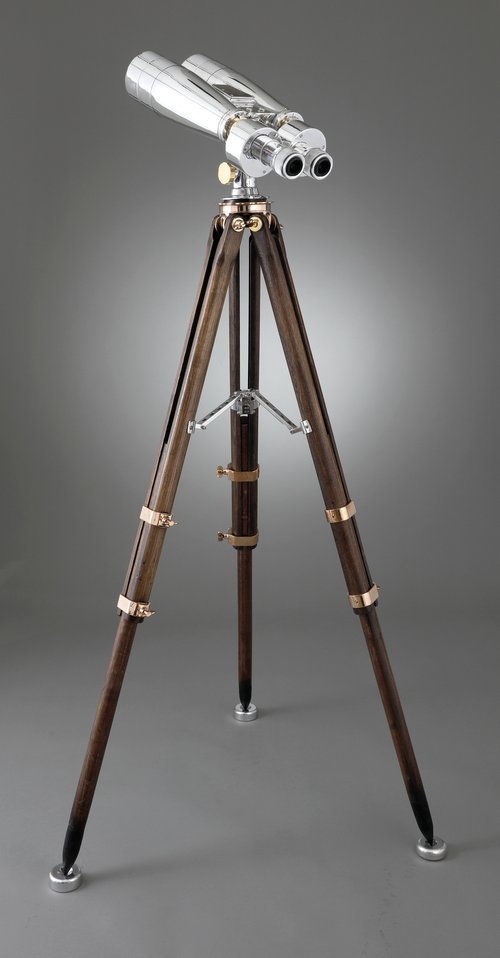 Image 2 of 4
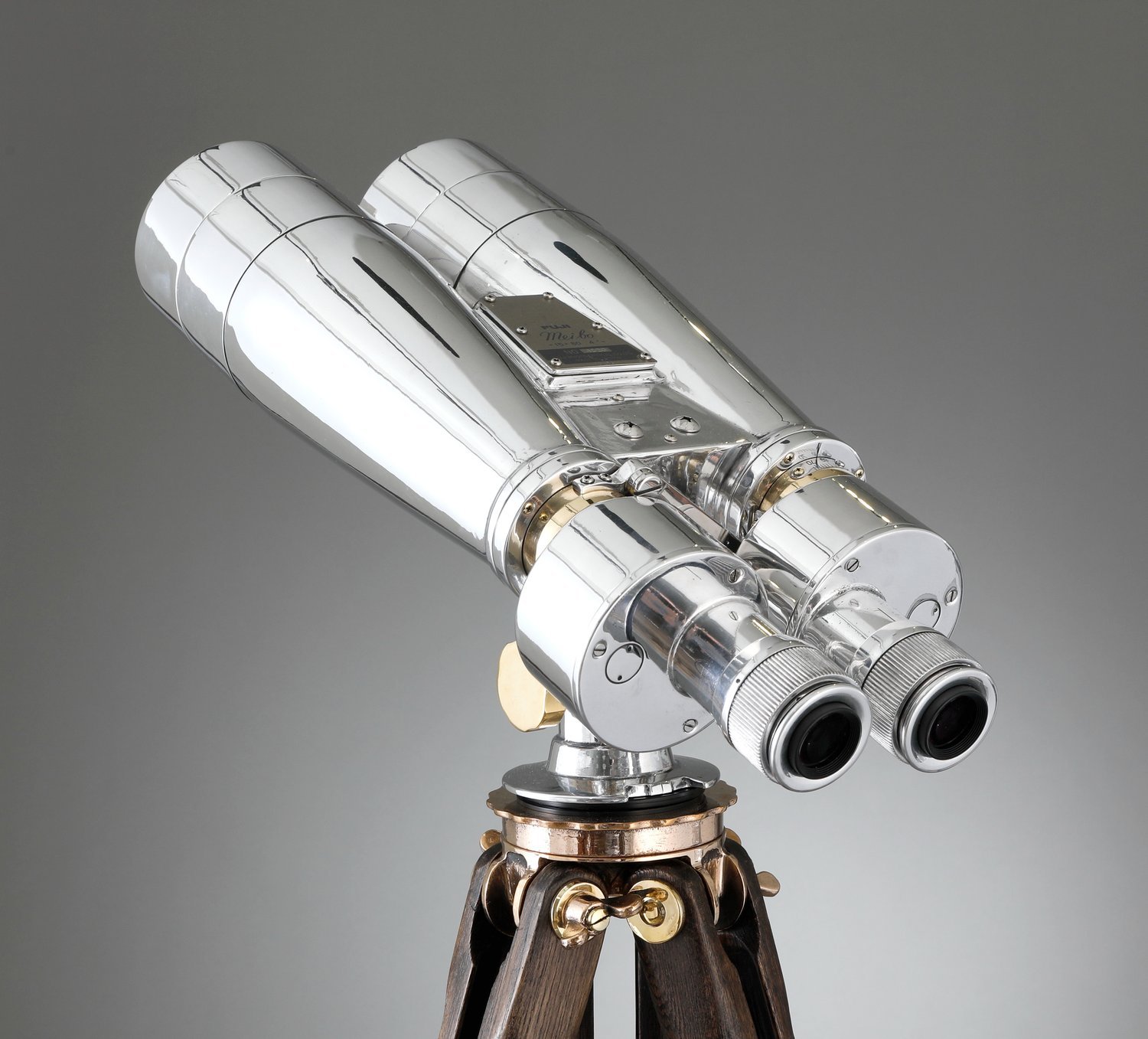 Image 3 of 4
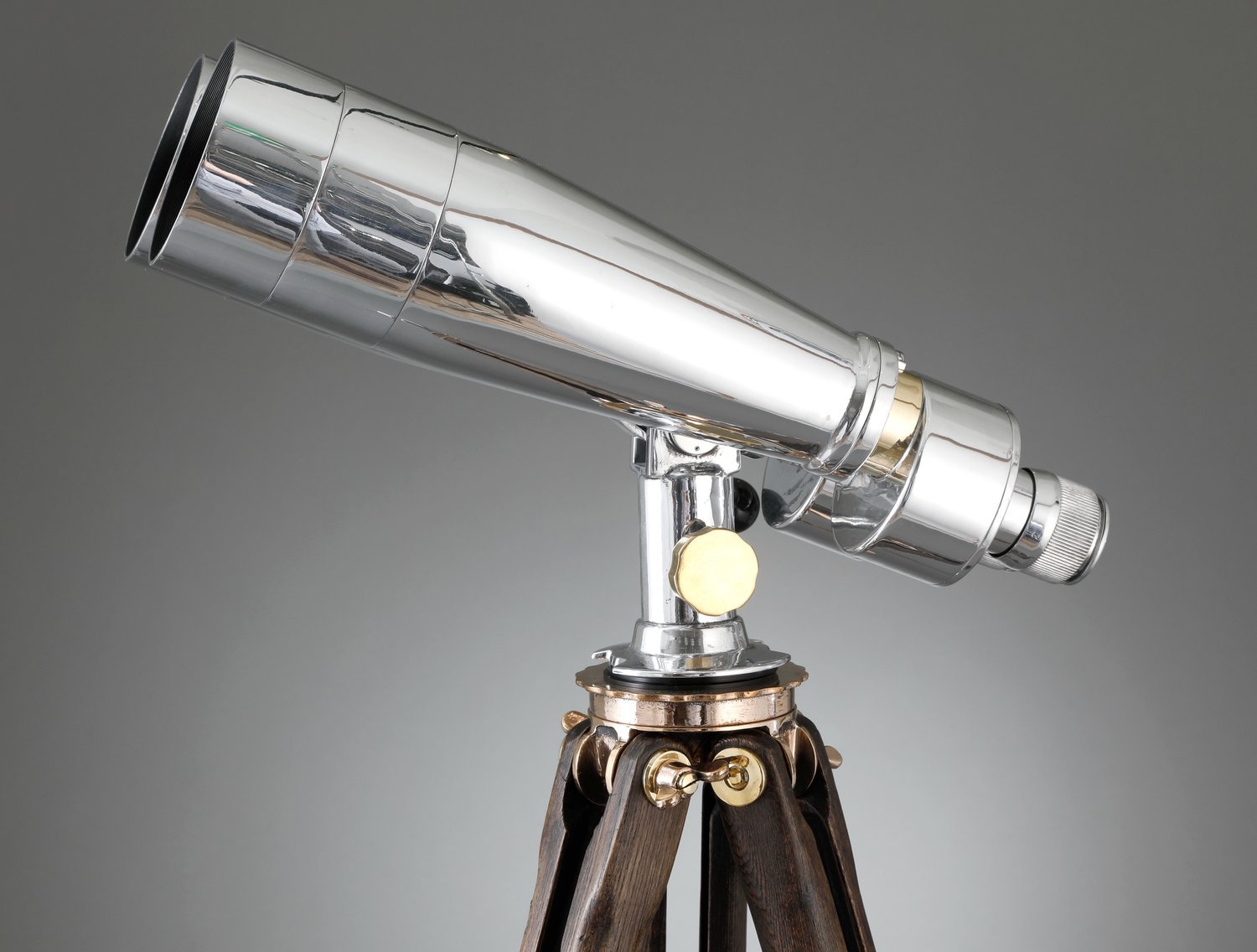 Image 4 of 4
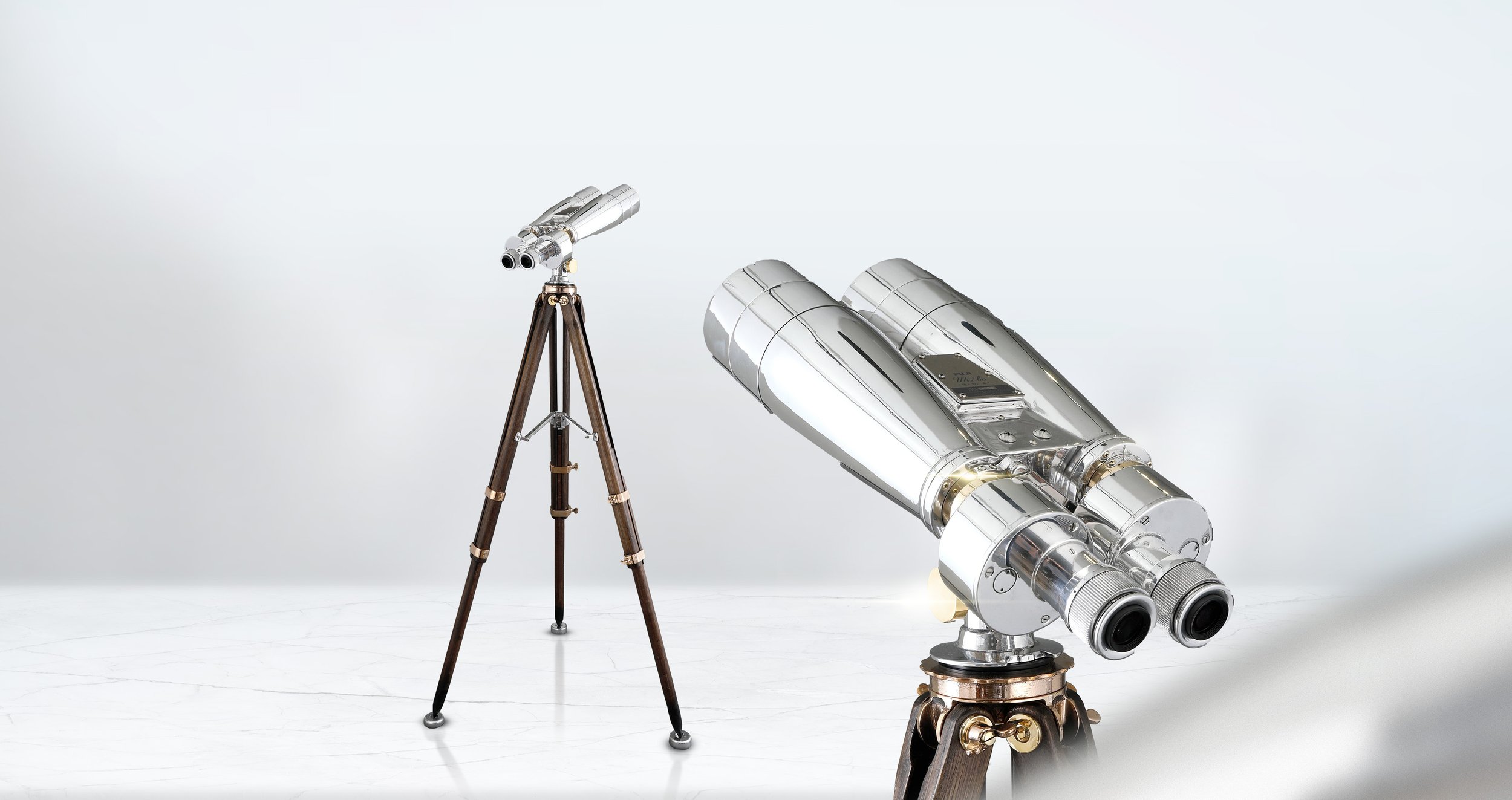
Fuji Meibo 15×80 Big Eye Naval Binoculars, Japan, c.1970s, on Dark Wood and Brass Field Tripod
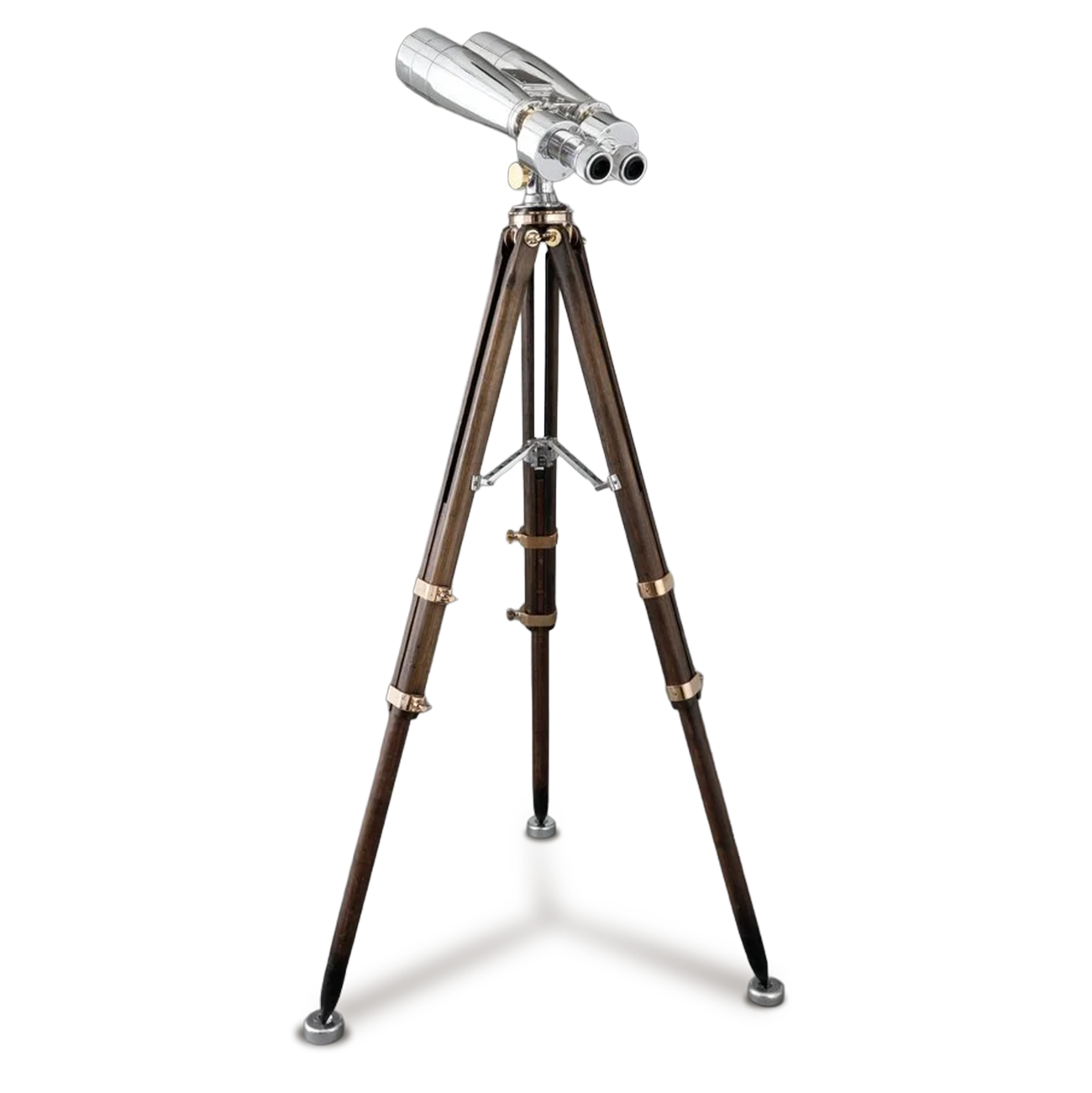
A 15×80 big eye naval binocular telescope by Fuji Photo Optical Co., Ltd., produced in Japan in the 1970s for naval service. With 80-millimeter objectives and fifteen times magnification, the Fuji Meibo 15×80 was the standard large-aperture observation instrument of the Japanese naval service — compact relative to the 25×150, yet delivering a quality and quantity of light gathering far beyond any conventional binocular.
The sand-cast aluminum body has been hand-polished to a mirror finish, preserving all original casting details and the Fuji Meibo nameplate throughout. Presented on a dark wood field tripod with polished brass collar bands, the warm tones of the brass provide a striking contrast to the mirror finish of the instrument above. The optics are in exceptional condition.
The Fuji Meibo 15×80 represents the final evolution of Japan's Big Eye program — the remarkable story of how Imperial Japan developed the most powerful naval binoculars of the Second World War. For the full history, see our essay Japanese Big Eyes: The Imperial Navy's Giant Optics.
A 15×80 big eye naval binocular telescope by Fuji Photo Optical Co., Ltd., produced in Japan in the 1970s for naval service. With 80-millimeter objectives and fifteen times magnification, the Fuji Meibo 15×80 was the standard large-aperture observation instrument of the Japanese naval service — compact relative to the 25×150, yet delivering a quality and quantity of light gathering far beyond any conventional binocular.
The sand-cast aluminum body has been hand-polished to a mirror finish, preserving all original casting details and the Fuji Meibo nameplate throughout. Presented on a dark wood field tripod with polished brass collar bands, the warm tones of the brass provide a striking contrast to the mirror finish of the instrument above. The optics are in exceptional condition.
The Fuji Meibo 15×80 represents the final evolution of Japan's Big Eye program — the remarkable story of how Imperial Japan developed the most powerful naval binoculars of the Second World War. For the full history, see our essay Japanese Big Eyes: The Imperial Navy's Giant Optics.
Browse the Collection
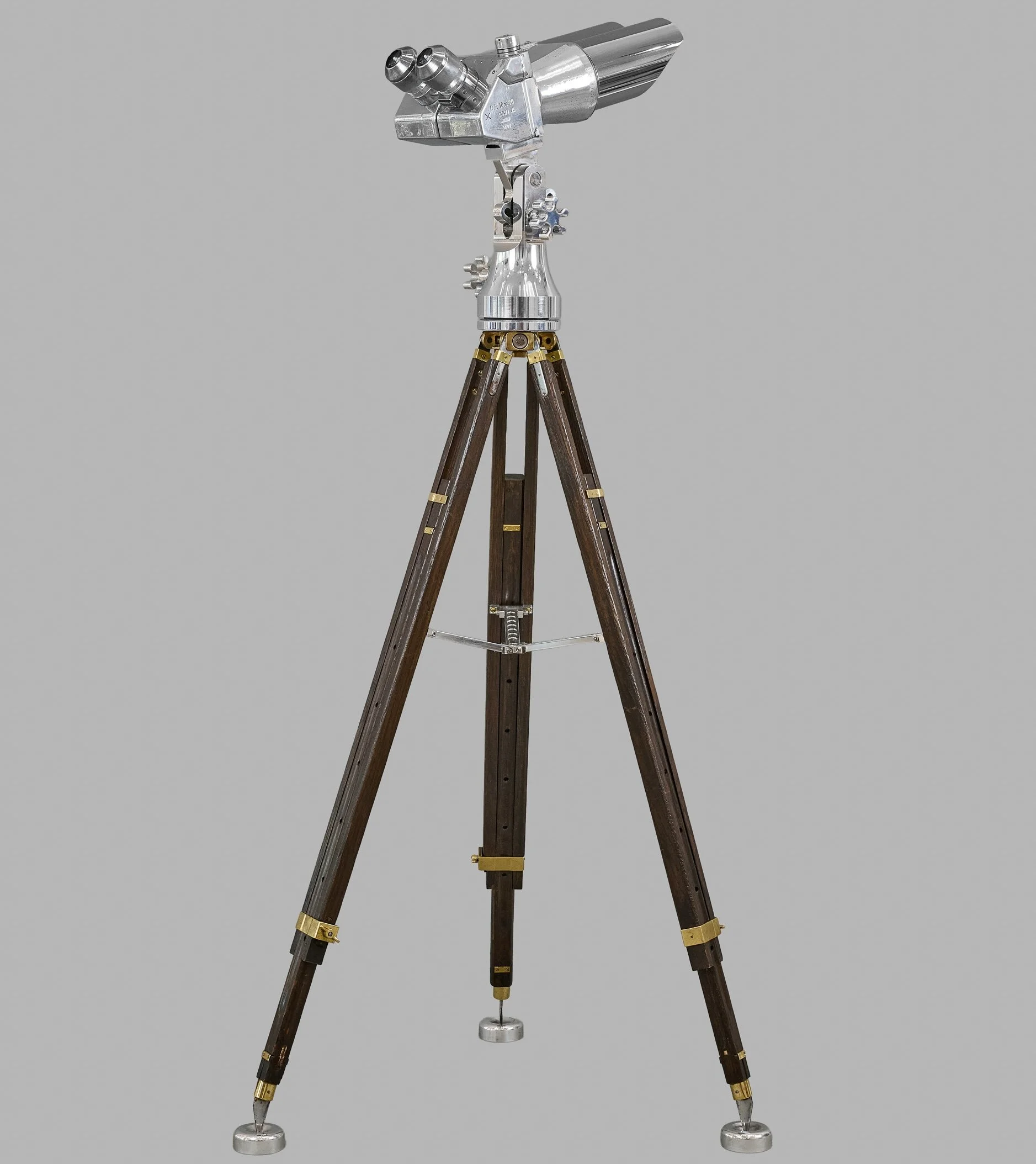
An exceptional example of the 10×80 Doppelfernrohr — the anti-aircraft Flak binocular that became the defining observation instrument of the German armed forces in the Second World War. Developed following competitive trials in the early 1930s, the type was selected from designs submitted by Emil Busch, Moeller Wedel, and Ernst Leitz. Busch's prototype was chosen for its superior field of view and reduced weight, with production subsequently distributed among six manufacturers under wartime contract.
Engineered with a distinctive 45° inclined binocular head for prolonged observation of both terrestrial and aerial targets, the 10×80 was indispensable for coordinating artillery fire, anti-aircraft defense, and strategic surveillance. Originally designated the searchlight director, it became the standard observation glass of the Flak arm, deployed on every front from the Western Desert to the Eastern Front.
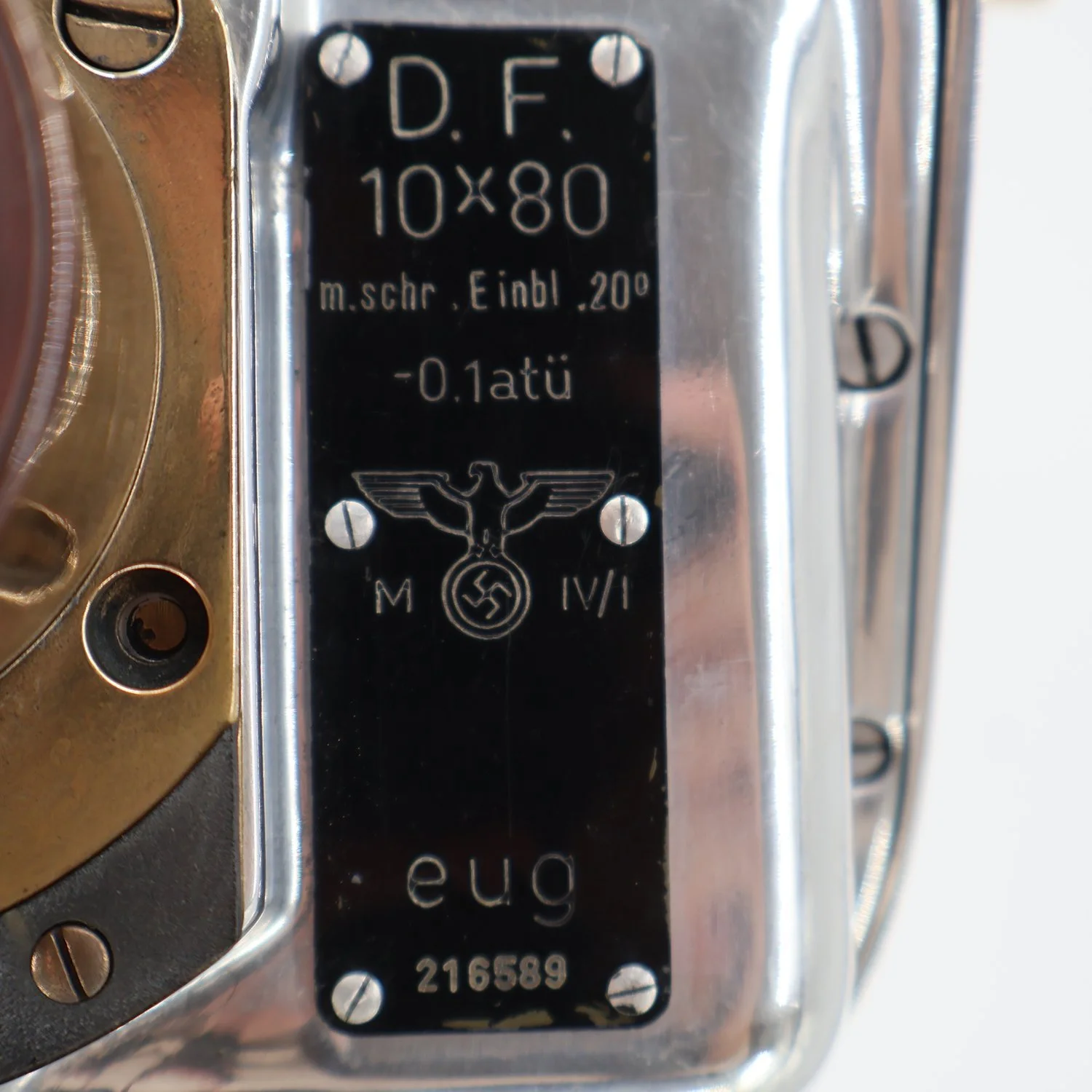
The present example bears the wartime code cxn, denoting manufacture by Emil Busch AG, Optische Industrie, Rathenow — the firm responsible for the original design and the largest share of total production. The body is sand-cast aluminum, hand-polished to a mirror finish, the engraved markings D.F. 10×80 / △ cxn crisp and fully legible. Mounted on a period hardwood-and-brass field tripod with extending legs, brass ferrules, chrome-capped feet, and full 360° rotation via the original star-wheel locking mechanism. The optics are in excellent condition.
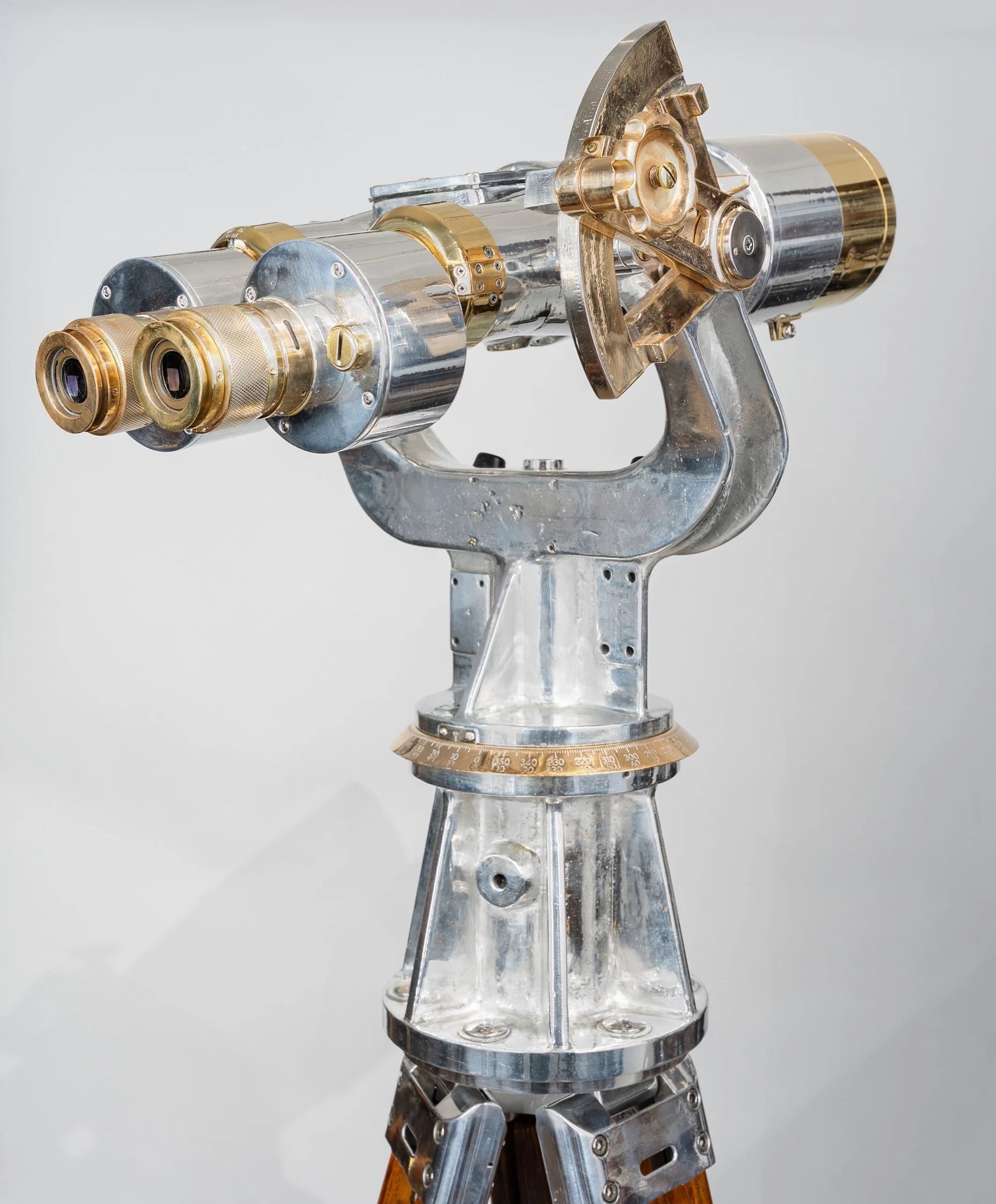
A pair of Japanese Imperial Navy 15×80 big-eye binoculars by Toko, the Tokyo Optical Company, circa 1940, retained on their original gimbal mount and deck-pattern pedestal, raised on a period hardwood tripod. The data plate carries Toko's diamond trademark, the 4-degree field designation, and serial number 1062.
Few of these instruments survive complete. Most big eyes reaching the market were separated from their shipboard fittings decades ago, so a set retaining its original gimbal, pedestal, and bearing ring is the exception. The instrument rides in a heavy polished fork, elevation set by a brass handwheel on a toothed quadrant, and turns on a brass bearing ring engraved through the full 360 degrees, a working compass rose in miniature. The bolted flange at the base is the original deck fitting that once fixed the mount to a warship's bridge wing.
The barrels run straight and level from objective to eyepiece, the configuration the Japanese navy specified for long watches on the open bridge. The 80mm objectives gather a remarkable quantity of light, and at 15 times magnification the image is bright, sharp, and immersive, as rewarding on a shoreline as on the moon. Each eyepiece focuses independently.
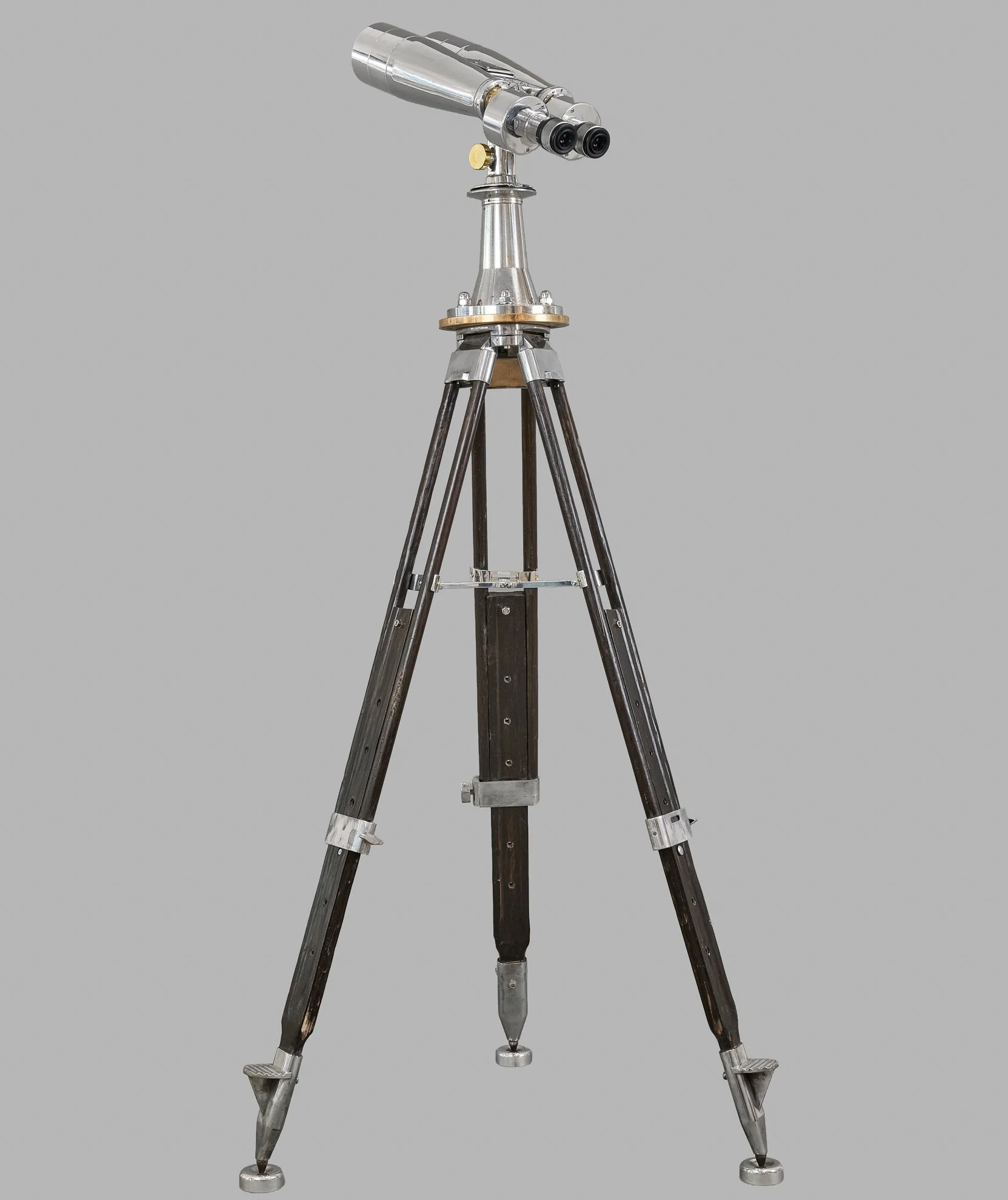
A 15×80 big eye naval binocular telescope by Fuji Photo Optical Co., Ltd., produced in Japan in the 1970s for naval service. With 80-millimeter objectives and fifteen times magnification, the Fuji Meibo 15×80 was the standard large-aperture observation instrument of the Japanese naval service — compact relative to the 25×150, yet delivering a quality and quantity of light gathering far beyond any conventional binocular.
The sand-cast aluminum body has been hand-polished to a mirror finish, the surface brought to a uniform brilliance that preserves all original casting details and the Fuji Meibo nameplate throughout. It is presented on an oak-and-brass field tripod of c.1940s manufacture — the dark-stained oak legs with their steel-spiked feet and polished aluminum fittings providing a striking contrast to the mirror finish of the instrument above.
The Fuji Meibo 15×80 represents the final evolution of Japan's Big Eye program — the remarkable story of how Imperial Japan developed the most powerful naval binoculars of the Second World War. For the full history, see our essay Japanese Big Eyes: The Imperial Navy's Giant Optics.
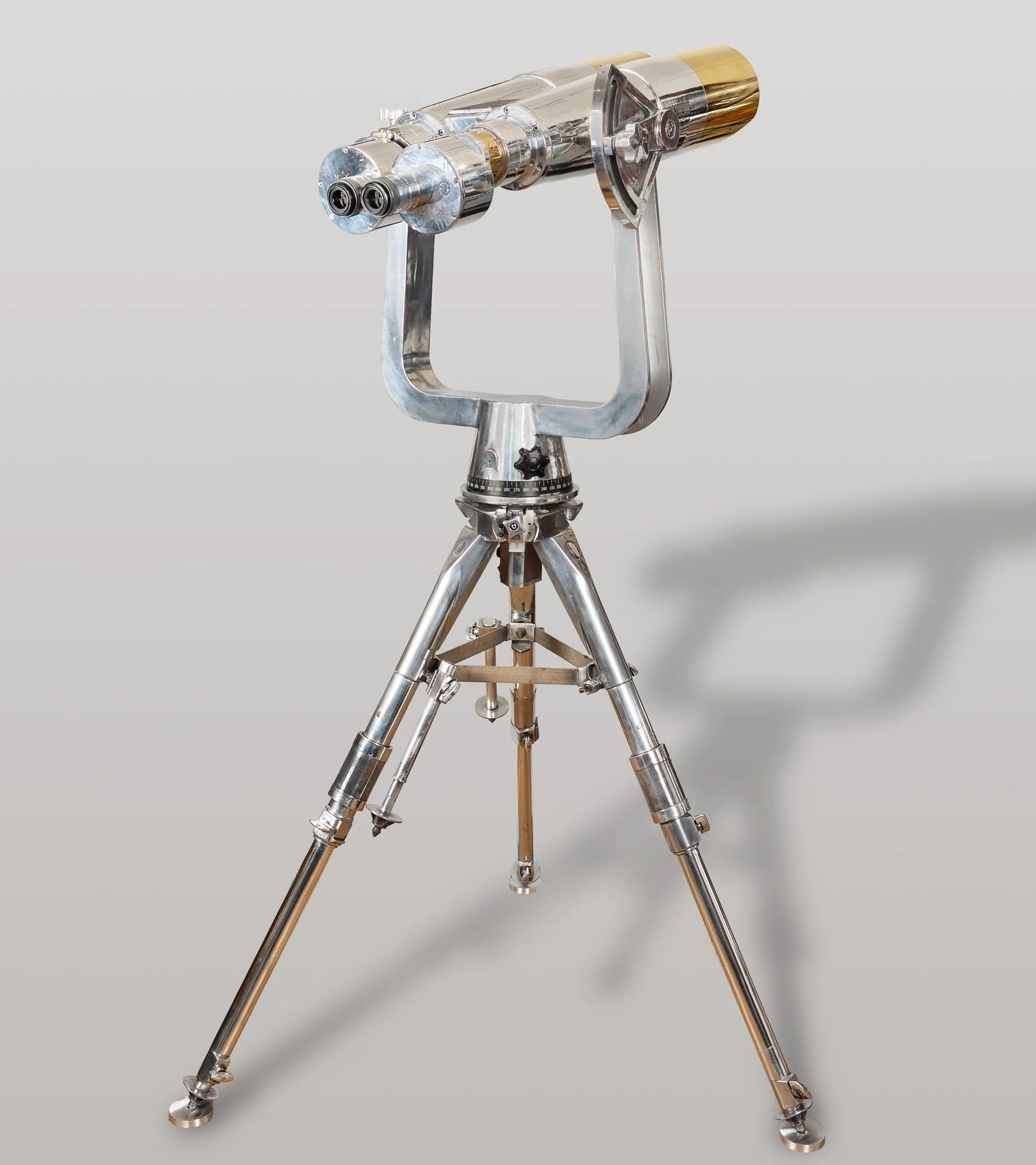
A monumental pair of Fuji Meibo 25×150 big-eye binoculars on their original deck mounting and naval-pattern tripod, by Fuji Photo Optical Co., Japan, 1950s. The data plate carries Fuji's script Meibo trademark and the 2.7-degree field designation.
The 25×150 is the largest of the Japanese big eyes, the pattern developed for the Imperial Navy to find ships at night before radar could, and continued by Fuji for whaling fleets and coastal observation. The 150mm objectives, each nearly six inches across, gather roughly four times the light of the familiar 15×80, and at 25 times magnification the image is extraordinary, with a brightness and depth no instrument of ordinary size approaches. These remain among the finest night-sky glasses ever made. This example carries the straight eyepiece configuration, the more sculptural of the two patterns, the twin barrels running unbroken to the great brass-capped objectives.
The set survives complete: the massive fork carries the glasses on a curved elevation quadrant secured by a polished handwheel, the cone beneath turns on a bearing ring graduated through the full 360 degrees, and the all-metal naval tripod with telescoping legs, folding spreader, and disc feet completes the ensemble.
Instrument, mount, and tripod have been hand polished in our workshop to a mirror finish, the brightwork set off against the brass objective shrouds. The optics are clear and bright, and focus, elevation, and traverse all operate smoothly.
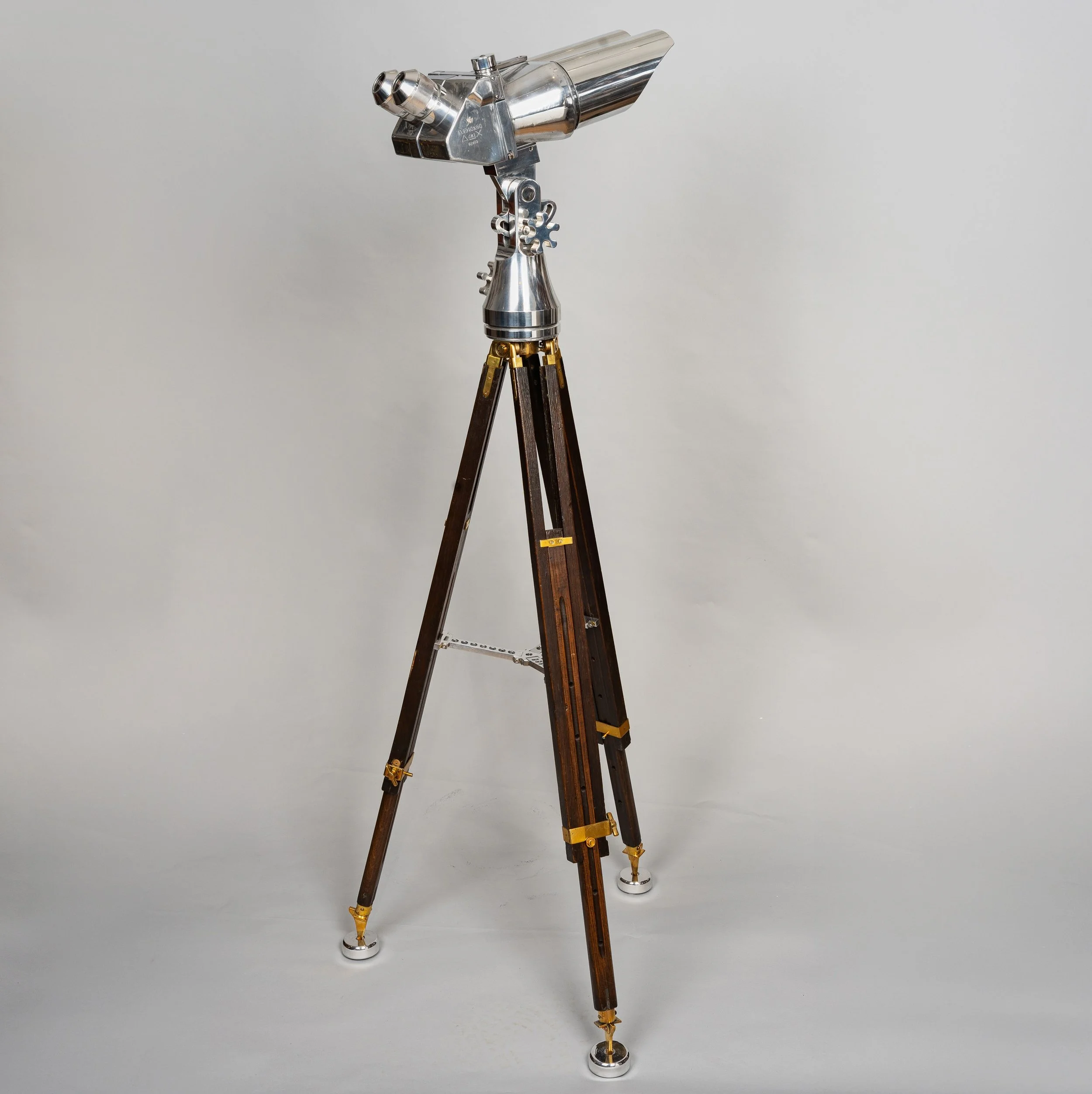
An exceptional example of the German anti-aircraft Flak binocular. The 10×80 Doppelfernrohr was developed following competitive trials in the early 1930s, in which Emil Busch, Möller Wedel and Ernst Leitz submitted designs for military evaluation; Busch's prototype was selected for its wider field of view and lower weight. Wartime production was then spread across several manufacturers under contract, with Schneider of Kreuznach, wartime code dkl, second only to Busch in output.
Designated D.F. 10×80 and known in service as the Flakglas, the instrument was engineered with a distinctive 45-degree inclined head for prolonged observation of aerial and terrestrial targets. It became the defining observation glass of the Flak arm, used for directing anti-aircraft fire and searchlights and deployed on every front from the Western Desert to Russia. It stands among the most recognizable optical instruments of the Second World War, prized for its history, its engineering and its sheer visual impact.
The present example bears the code dkl for Schneider Optische Werke, Kreuznach. Serial number 72473 is consistent with late-war manufacture of circa 1944. The sand-cast aluminum body has been hand-polished to a mirror finish, the engraved markings D.F. 10×80 / △ dkl X / 72473 crisp and fully legible.
The binoculars are mounted on a period hardwood-and-brass tripod with extending legs, brass ferrules and chrome-capped feet, giving full 360-degree rotation and elevation adjustment via the original star-wheel locking mechanism.
Maker: Schneider Optische Werke, Kreuznach (wartime code dkl)
Date: circa 1944
Condition: Excellent; minor age patina; optics clear
Literature: Stephen Rohan, Eyes of the Wehrmacht; Hans T. Seeger, Militärische Ferngläser und Fernrohre in Heer, Luftwaffe und Marine, pp. 232–237
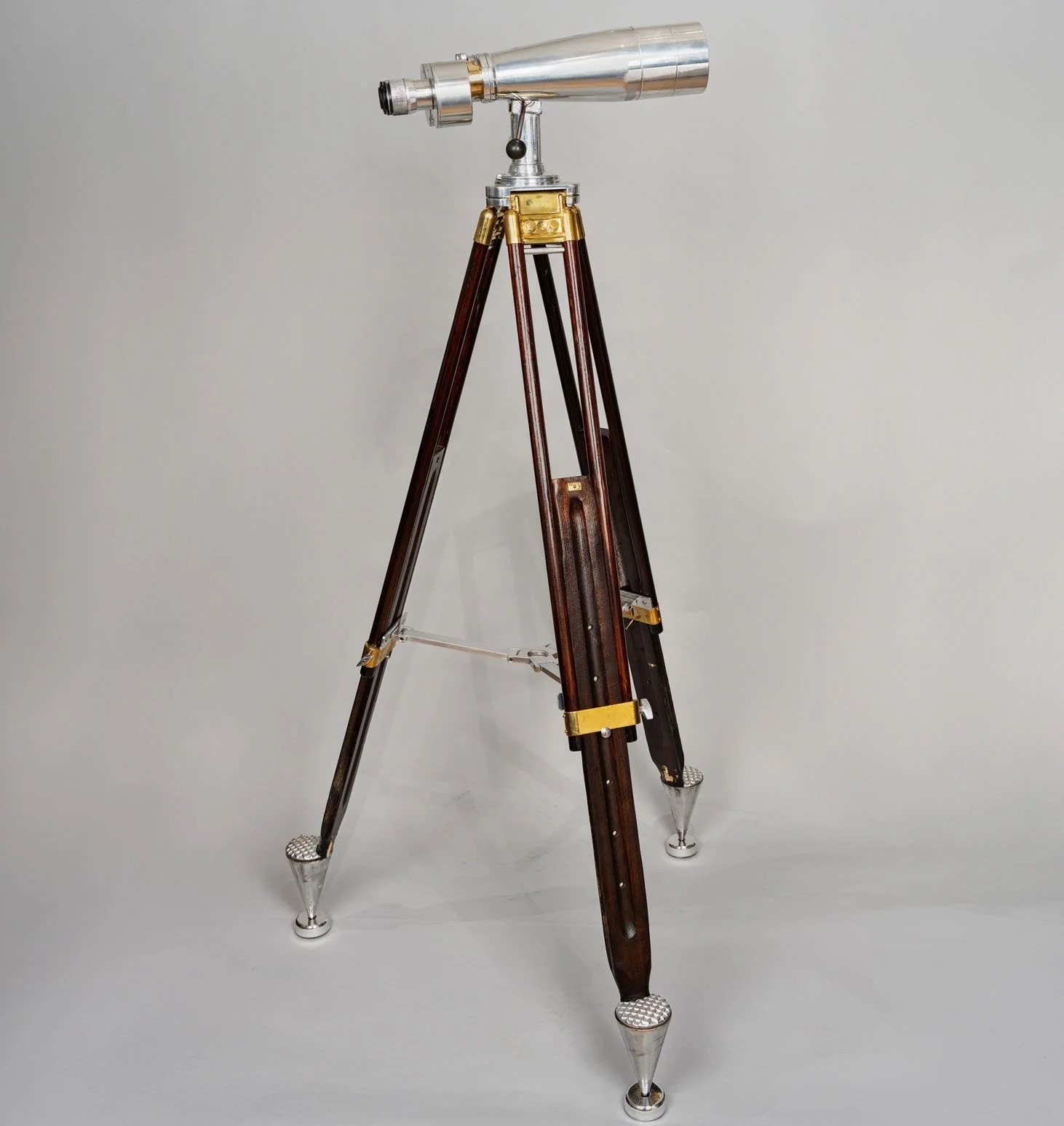
Among the most admired instruments in the canon of twentieth-century marine optics, the Fuji Meibo 15×80 is the definitive Japanese big-eye binocular: purpose-built for shipboard observation, rigorous in construction and unmistakable in presence.
This example, serial number 5436, was manufactured by Fuji Photo Optical Co., Ltd. during the 1970s, when the Meibo remained the instrument of choice aboard Japanese naval and research vessels.
The full story of the Fuji Meibo and Japan's Big Eye program, the most ambitious naval optics project of the twentieth century, is told in our essay Japanese Big Eyes: The Imperial Navy's Giant Optics.
The sand-cast aluminum body has been hand-polished to a brilliant mirror finish. The straight-through optical path, barrels running in an unbroken line from objective to eyepiece, marks it as a horizon glass, designed for open-bridge observation where the eye meets the sea at a natural angle. The 80mm objectives produce an image of exceptional brightness and clarity, and at 15× magnification a 4-degree field of view keeps the instrument as practical as it is powerful. The original anti-reflection coatings survive intact, visible as the characteristic deep blue-teal bloom across both objective faces.
Mounted on a period hardwood-and-brass tripod with extending legs, chrome-capped conical feet and brass ferrules, the ensemble offers full 360-degree rotation and vertical adjustment via the original locking lever. Mirror-polished alloy, warm brass and dark-lacquered hardwood combine to give the complete piece an interior presence few instruments can match.
Maker: Fuji Photo Optical Co., Ltd., Japan
Model: Meibo 15×80
Serial number: 5436, circa 1970s
Magnification: 15×
Objective diameter: 80mm
Field of view: 4°
Body: Sand-cast aluminum, hand-polished
Condition: Excellent; optics clear
SEO description:
Fuji Meibo 15×80 big eye naval binoculars, Japan, c.1970s, serial 5436, on period hardwood and brass tripod. Mirror-polished aluminum body, original coatings, optics clear.

A pair of German military binoculars of 10 × 80 magnification, attributed to Joseph Schneider and dating to the 1940s.
Constructed for use during World War II, the binoculars exemplify the high standards of German optical production, which was internationally recognized for precision, durability, and optical clarity. Schneider was among the key manufacturers contributing to the wartime supply of advanced viewing instruments, including binoculars designed for extended field use.
The present binoculars are configured with inclined eyepieces set at approximately 45 degrees, a feature developed to enhance observer comfort during prolonged surveillance. This design proved particularly effective in both anti-aircraft observation and general reconnaissance, where flexibility of viewing angle was essential.
Notably, the instrument no longer retains its original maker’s markings, which were deliberately removed in the immediate postwar period, most likely by Dutch authorities. Such practices were common, as recovered equipment was often reconditioned and redistributed to offset wartime losses. This alteration, while obscuring direct attribution, contributes an additional historical layer reflecting the transitional period following the war.
The binoculars retain a strong sculptural presence, combining industrial form with functional precision, and stand as a compelling example of mid-20th century military engineering.
Literature
German Military Optical Instruments 1939–1945
Optics and Observation in Modern Warfare
Comparative examples in the Deutsches Museum
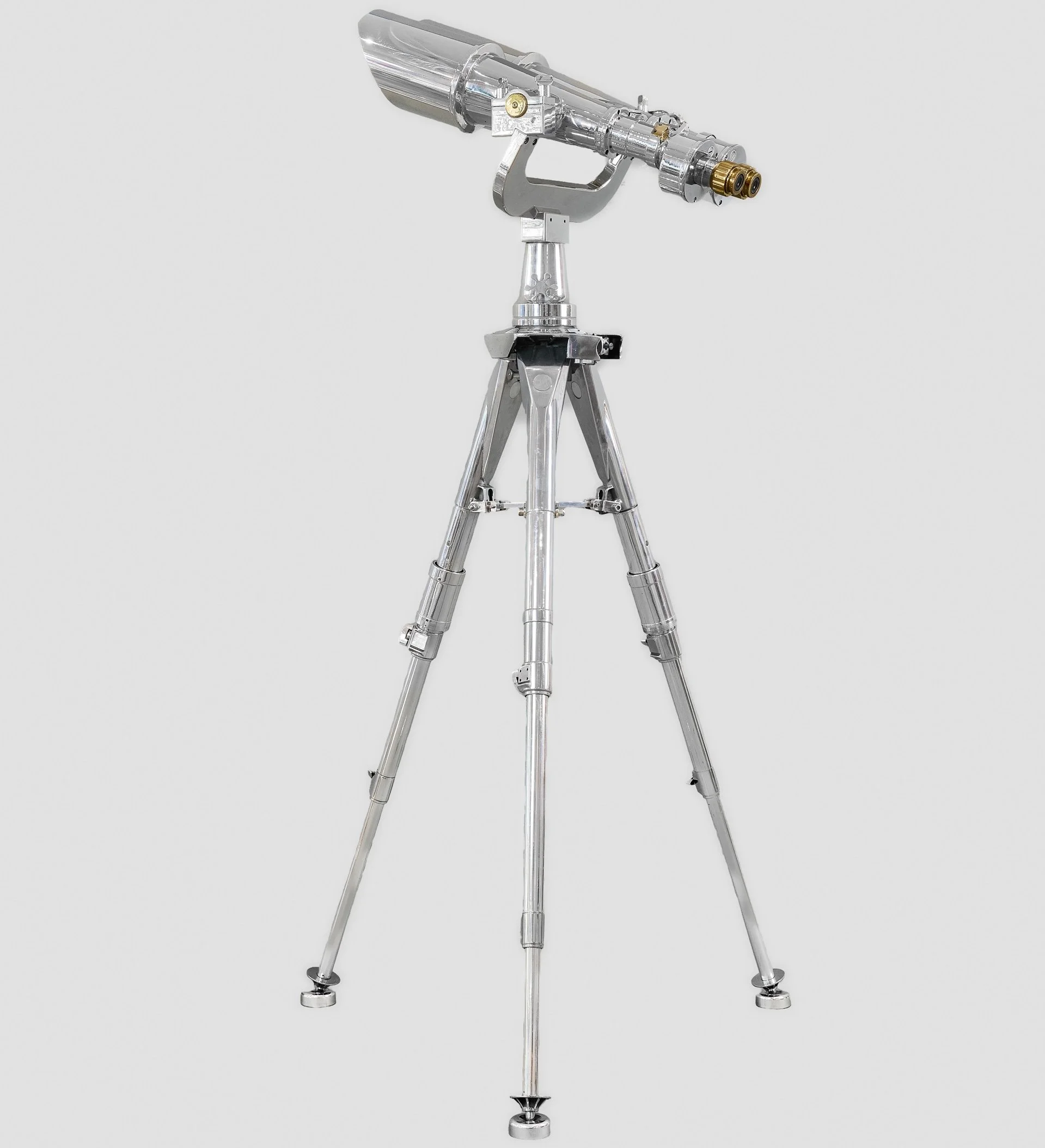
A 20×120 big eye naval binocular telescope by Nippon Kogaku — the manufacturer known today as Nikon — produced for the Imperial Japanese Navy in the 1940s. With 120-millimeter objectives and twenty times magnification, this is an instrument of exceptional resolving power, built to the exacting standards of a navy whose optical industry was among the finest in the world. The original Nikon nameplate is retained, stamped Nippon Kogaku, Made in Japan.
The Nikon 20×120 represents the largest and most powerful of Japan's wartime Big Eye instruments — the story of how Nippon Kogaku became the Imperial Navy's premier optical manufacturer is told in our essay, Japanese Big Eyes: The Imperial Navy's Giant Optics.
The sand-cast aluminum body has been hand-polished to a mirror finish, every surface worked to a uniform brilliance that preserves the original casting details throughout. It is presented on a Carl Zeiss field tripod of c.1940s manufacture — the two foremost optical names of the mid-twentieth century, German and Japanese, united on a single stand.
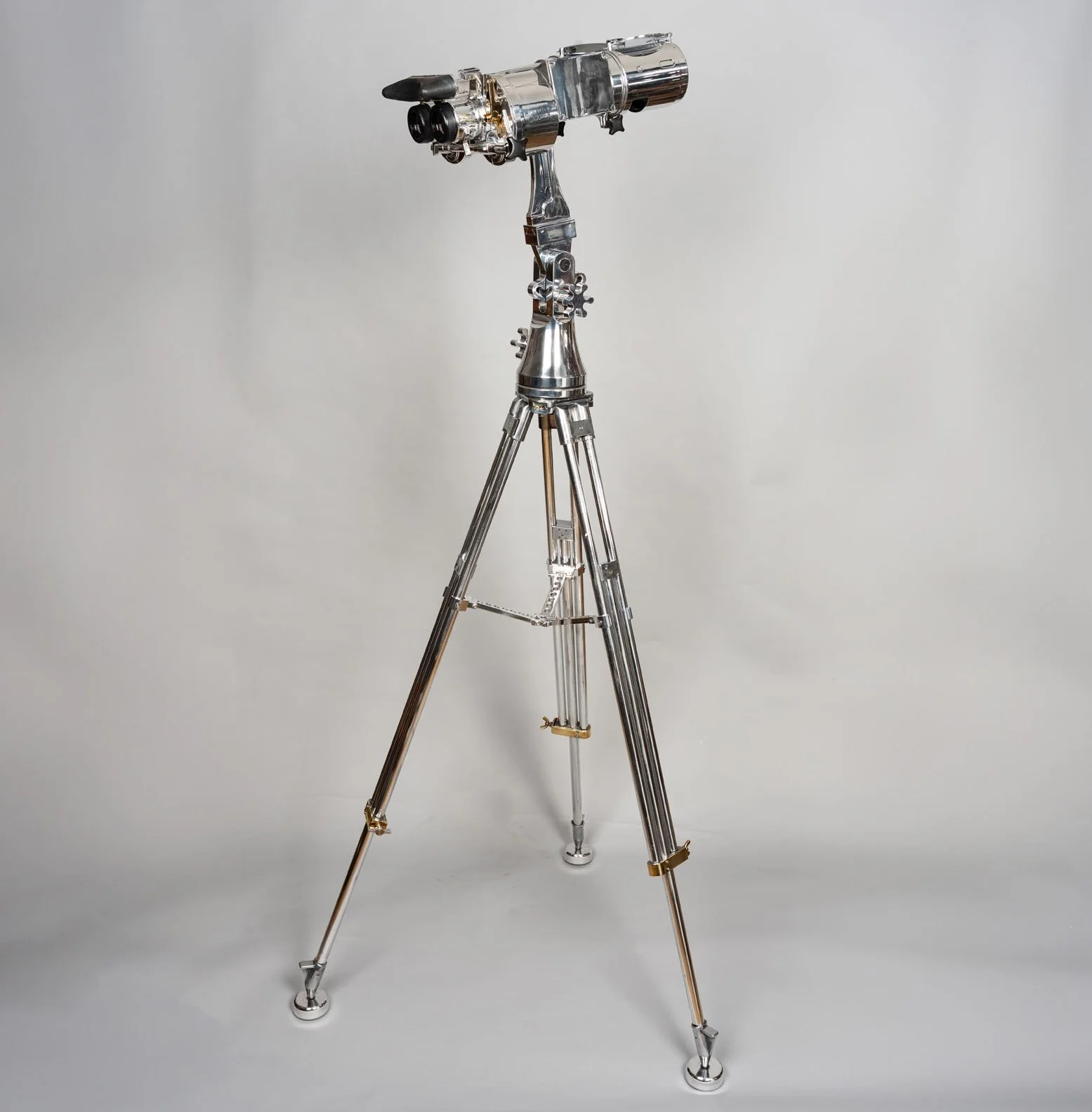
In early 1945, the United States Eighth Air Force bombed the Carl Zeiss optical works in Jena. Before the ruins fell behind the Iron Curtain, American forces evacuated the firm's senior scientists and engineers westward. By 1946, they had rebuilt in Oberkochen, Baden-Württemberg — Carl Zeiss reborn on the other side of the divide.
When West Germany joined NATO in 1955 and the Bundesmarine was created the following year, it turned to Zeiss for precision optics for fast-attack ships patrolling the Baltic Sea against the Soviet fleet. This binocular is a direct product of that transformation.
The full story of Carl Zeiss's remarkable postwar resurrection and the DF 8×60's role in Bundesmarine service is told in our essay Carl Zeiss Military Binoculars: A Cold War Relic.
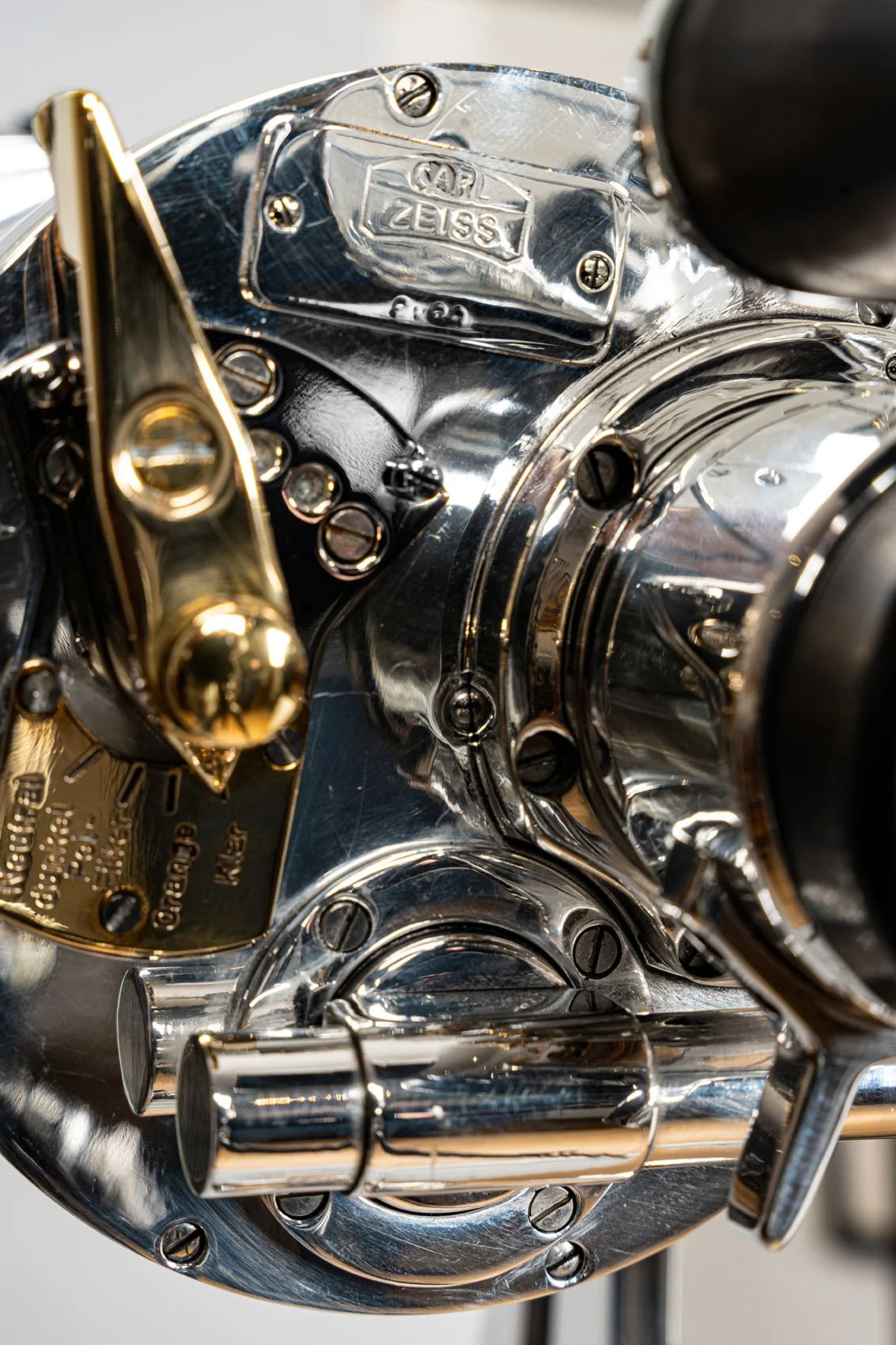
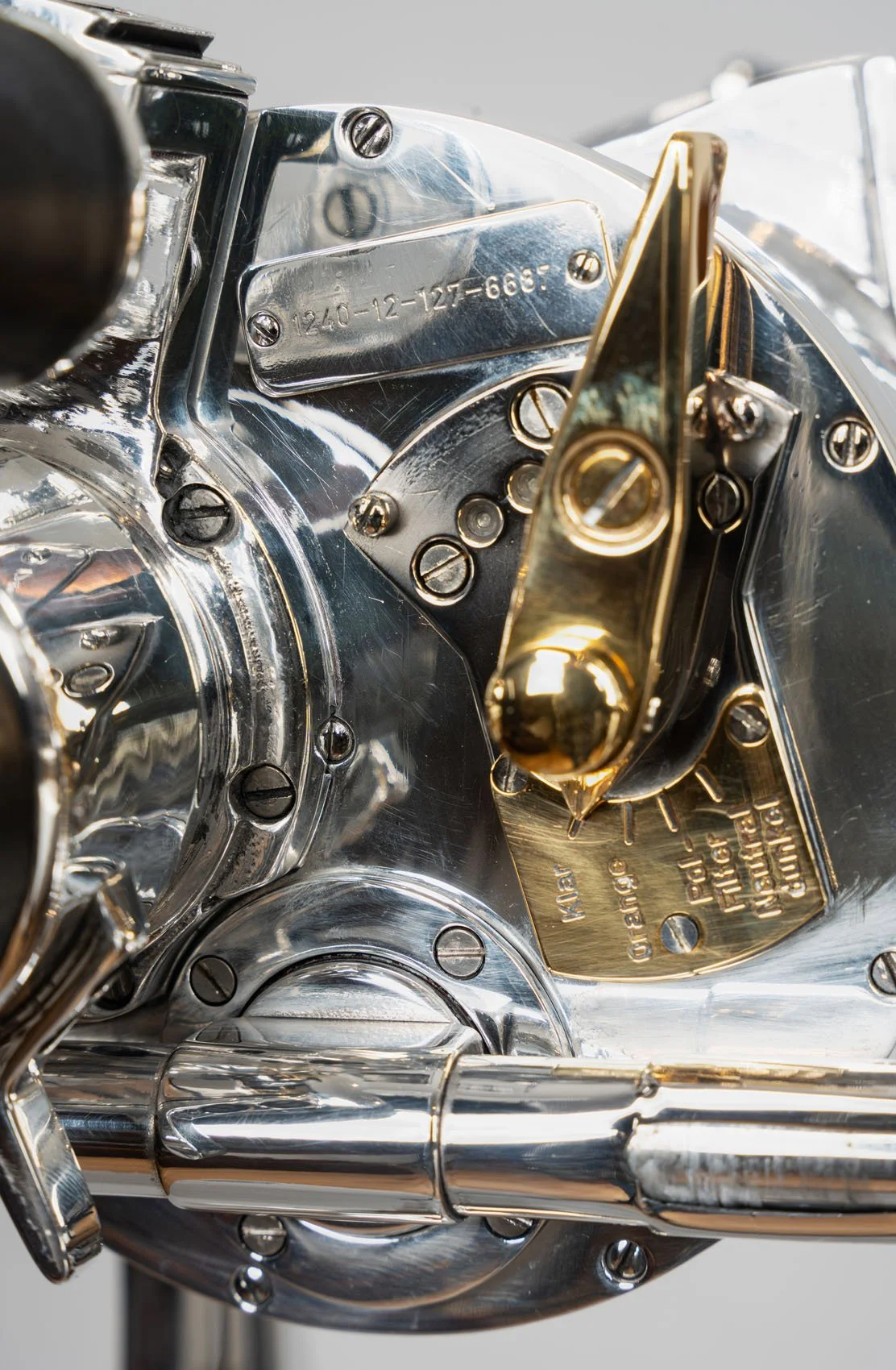
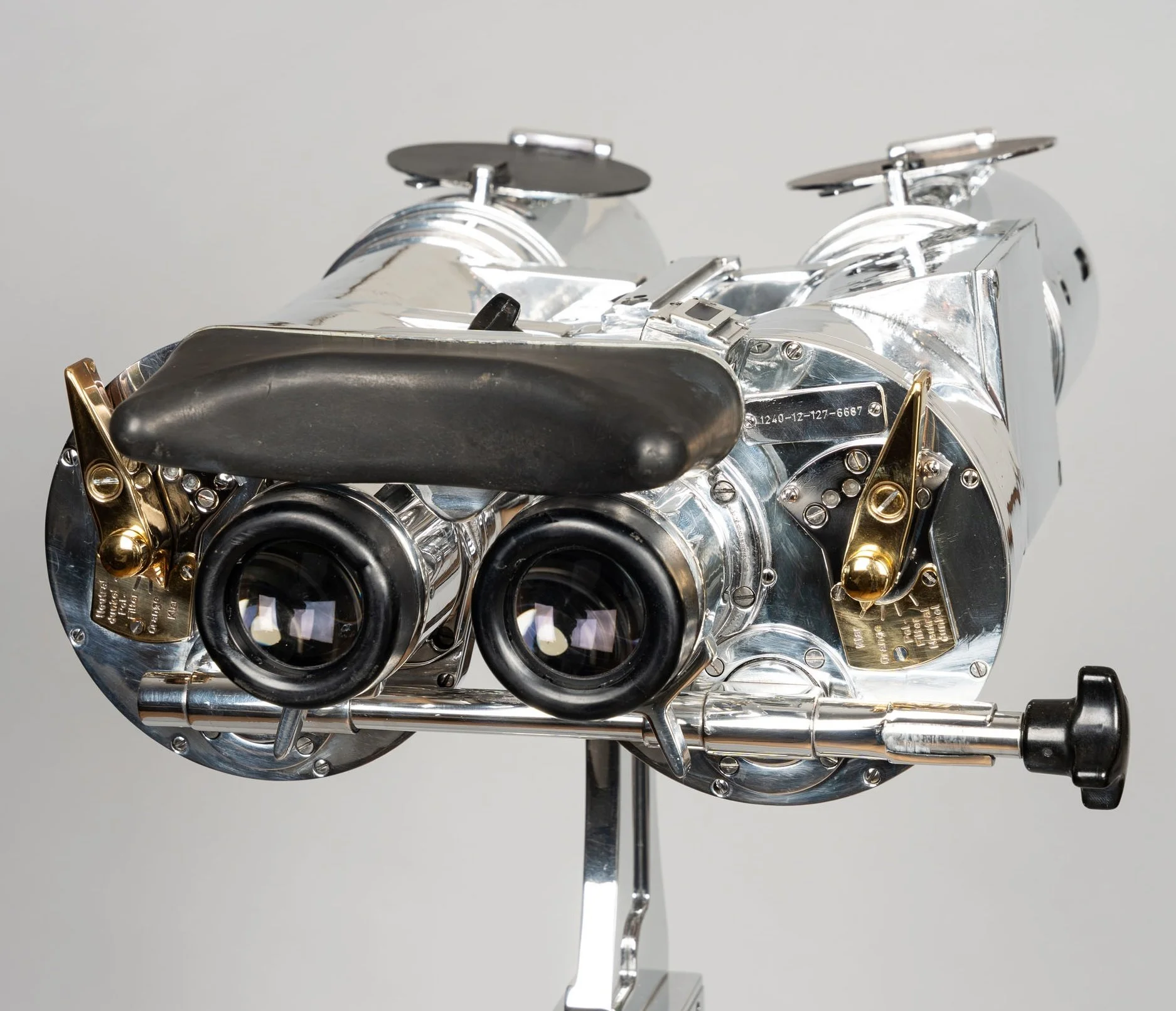
The DF 8×60 is a big eye binocular of the highest military specification — the optical head of the Rohrzielgerät RZA 5b torpedo aiming system, mounted aboard the Jaguar and Zobel-class fast attack torpedo boats operating in the Baltic. Its specifications reflect that mission precisely: 60mm objective lenses for exceptional light-gathering at dusk and first light; a field of view of 154 meters at 1,000 meters for rapid target acquisition; 22mm of eye relief for use with naval headgear; an illuminated reticle for reading bearing onto a contact and passing it to the fire-control system. The brass filter selector offers five positions — Klar, Orange, Filter, Neutral, Dunkel — covering every light condition from noon glare to the near-dark of a Baltic dawn.
The body carries the Carl Zeiss Oberkochen maker's plate and retains its original NATO stock number — 1240-12-127-6687 — engraved and fully legible. The prefix 1240 designates the supply class of optical sighting and observation instruments; the country code 12 identifies the Federal Republic of Germany as the procuring nation. It is the documentary record of the instrument's formal military acceptance and Bundesmarine service, intact after more than sixty years.
Surviving examples of large-format West German military optics from this period in collector condition are genuinely scarce. Instruments of this class were used hard; when vessels were decommissioned, optics were typically stripped, refurbished, reissued, or disposed of through surplus channels without paperwork. Most comparable pieces reach the market with their NATO stock numbers worn or polished away, their provenance reduced to the maker's mark alone. This example retains both, and both are corroborated by Hans Seeger's Fernglaser und Fernrohre — the standard scholarly reference on German binoculars — in which the pattern is cataloged at p. 367, fig. 249b, with the original 1961 Zeiss factory data sheet.
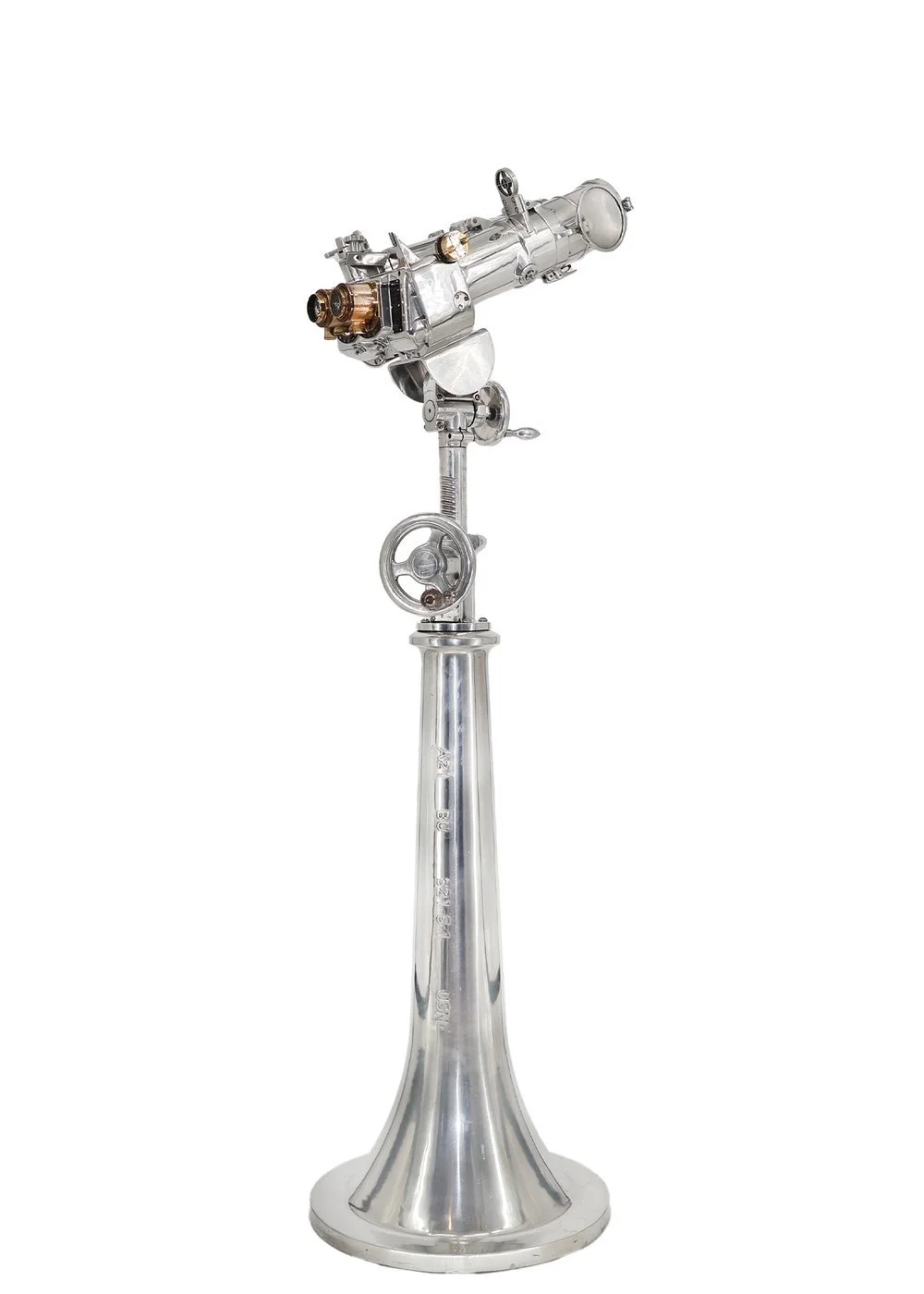
The instrument is presented on a period 1940s military field tripod. The complete display stands approximately five feet tall.
Maker: Carl Zeiss, Oberkochen, West Germany Date: c. 1962 Magnification: 8× Objective diameter: 60mm Field of view: 154m at 1,000m (8.8°) Eye relief: 22mm Filter positions: Klar · Orange · Filter · Neutral · Dunkel NATO stock number: 1240-12-127-6687 Tripod: Period military field tripod, c. 1940s Display height: approximately 5 feet
Condition: Binocular head in exceptional display condition. Original optics retaining coatings and full collimation. All mechanical functions — filter selector, dioptre adjustment, interpupillary adjustment — are operating correctly. NATO stock number plate and Carl Zeiss maker's plate are both present and fully legible. Period military tripod; all adjustments operational.
Literature: Seeger, Hans. Fernglaser und Fernrohre. The DF 8×60 pattern is cataloged at p. 367, fig. 249b, with the original 1961 Carl Zeiss Oberkochen factory data sheet.
A 15×80 big eye naval binocular telescope by Fuji Photo Optical Co., Ltd., produced in Japan in the 1970s for naval service. With 80-millimeter objectives and fifteen times magnification, the Fuji Meibo 15×80 was the standard large-aperture observation instrument of the Japanese naval service — compact relative to the 25×150, yet delivering a quality and quantity of light gathering far beyond any conventional binocular.
The sand-cast aluminum body has been hand-polished to a mirror finish, preserving all original casting details and the Fuji Meibo nameplate throughout. Presented on a dark wood field tripod with polished brass collar bands, the warm tones of the brass provide a striking contrast to the mirror finish of the instrument above. The optics are in exceptional condition.
The Fuji Meibo 15×80 represents the final evolution of Japan's Big Eye program — the remarkable story of how Imperial Japan developed the most powerful naval binoculars of the Second World War. For the full history, see our essay Japanese Big Eyes: The Imperial Navy's Giant Optics.
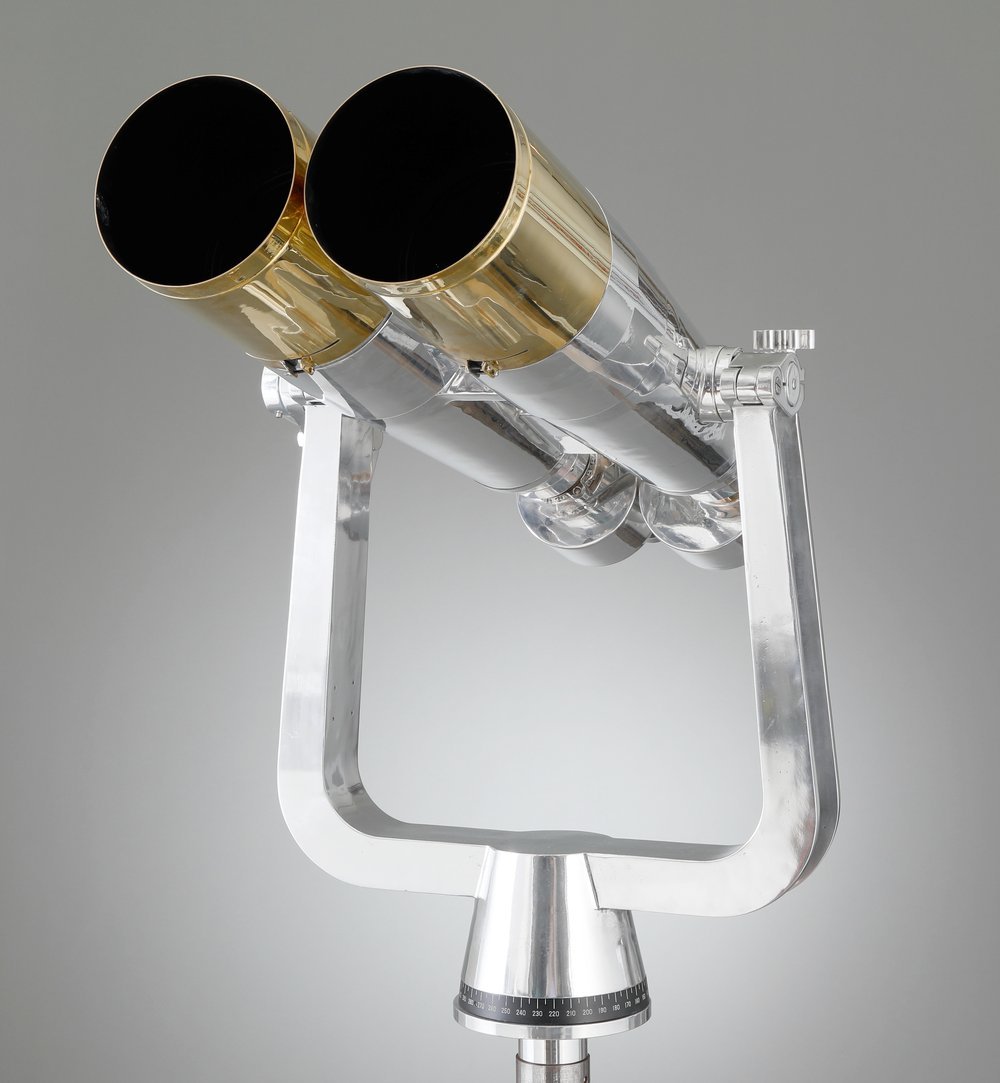
A monumental pair of Japanese naval binoculars by Fuji Meibo, with 25 × 150 magnification, constructed in polished steel and retaining their original deck-mounted gimbal and tripod support.
Of characteristic straight-body form, the present instrument embodies the refined engineering of Japanese naval optics developed during the period surrounding the World War II, where long-range visual clarity was critical for fleet coordination and engagement.
The binoculars retain entirely original optical elements, notable for their exceptional clarity and depth, a testament to the advanced optical manufacturing standards achieved in Japan during the period. The robust gimbal mounting—designed to stabilize the instrument against the constant motion of a warship—remains intact, offering both functional and sculptural presence.
Such instruments were typically allocated singly to major warships, particularly destroyers, where they served as primary long-range viewing devices. Their scarcity today reflects both their specialized use and the attrition of wartime matériel.
Beyond their technical function, the present example possesses a striking aesthetic quality: the interplay of machined steel, precision mechanics, and monumental scale elevates the object firmly into the realm of industrial sculpture.
Literature
Japanese Naval Optical Instruments and Fire Control Systems, naval archives publications
Military Optics of the Second World War, comparative studies of Allied and Axis instrumentation
Museum collections including the Smithsonian Institution (optical and military technology holdings)
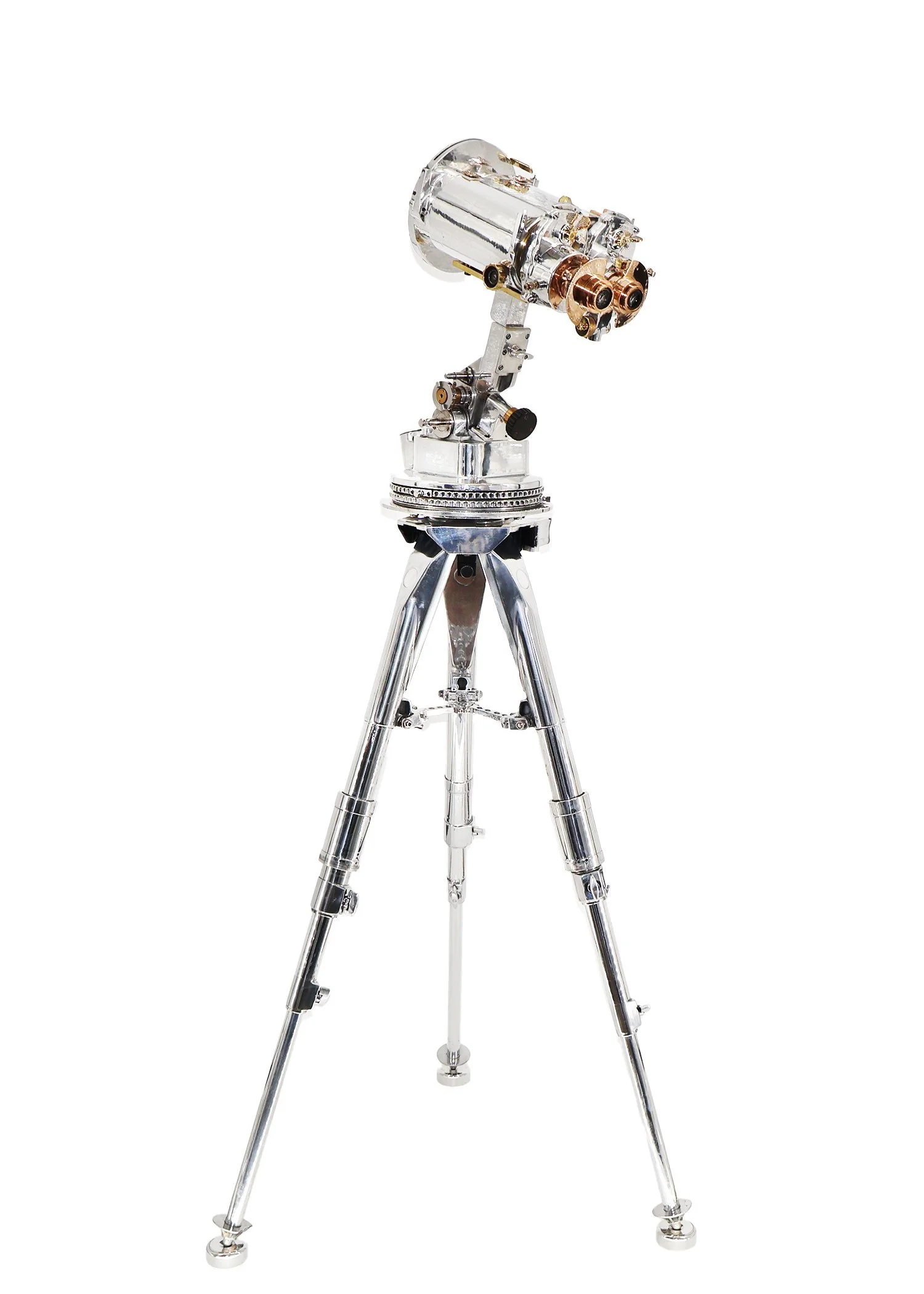
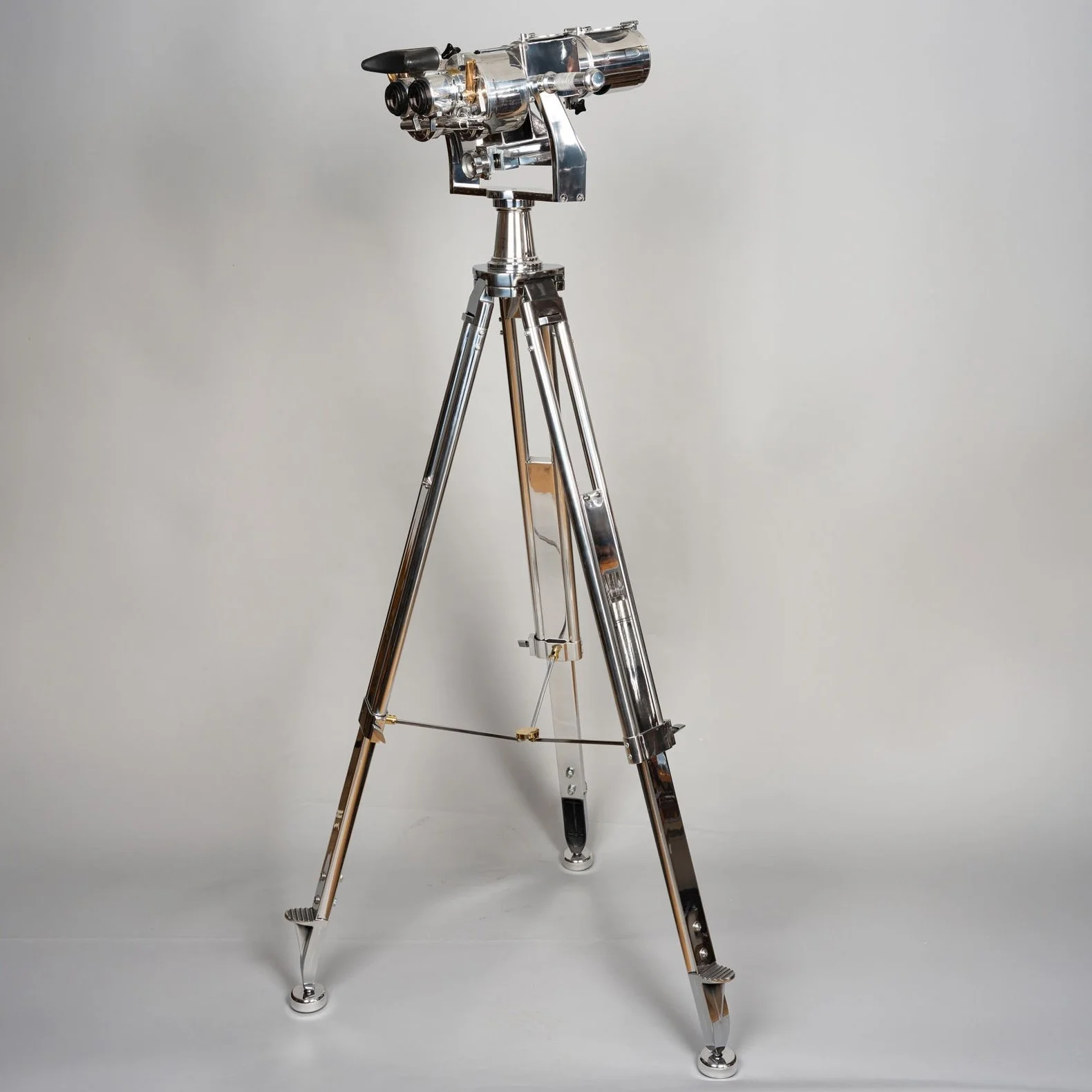
Produced by Carl Zeiss at their Oberkochen works in West Germany from circa 1962, the DF 8×60 was purpose-designed as an observation and fire control telescope for naval use — employed in connection with fire control systems and torpedo aiming devices, and built to a standard of precision that represented, in Seeger's assessment, among the most ambitious military and naval optics ever independently developed.
The full story of the DF 8×60's role aboard the Bundesmarine's Jaguar-class torpedo boats — and what makes this instrument among the most significant pieces of Cold War naval militaria — is told in our essay Carl Zeiss Military Binoculars: A Cold War Relic.
This example is of the type used aboard the Bundesmarine's Jaguar-class fast attack torpedo boats during the 1960s — nimble, heavily armed vessels that formed the backbone of West Germany's coastal defense fleet throughout the Cold War. The DF 8×60 served as both an observation glass and a fire-control instrument aboard these ships, connected directly to the RZA 5b torpedo-aiming device, making it an instrument of active operational significance rather than merely a standard-issue optic. The 8×60 configuration delivers 8× magnification through 60mm objectives, producing a 154-meter field of view at 1,000 meters and the exceptional light-gathering performance demanded by high-speed naval operations in the North Sea and the Baltic.
The 45° inclined binocular head allows comfortable observation of the horizon and elevated targets during extended watches. The coated optics are of the highest order, producing the brilliant, high-contrast image for which Zeiss instruments are universally regarded. The integrated five-position filter system — Klar (clear), Orange, Pol. Filter (polarising), Neutral, and Dunkel (dark) — are operated via a pair of elegant gold-toned selector levers, one to each barrel, allowing rapid adaptation to changing light and sea conditions. This system is fully documented in Seeger (Abb. 249b) as standard equipment on the DF 8×60 naval variant. The Carl Zeiss nameplate, engraved with serial number 542415, is mounted to the eyepiece housing and is in excellent condition.
Hand-polished to a brilliant mirror finish, the instrument carries a commanding sculptural presence — a feat of precision engineering and an object of considerable beauty. Mounted on a period all-chrome extending tripod with a fully articulated head offering 360° rotation and elevation adjustment.
Maker: Carl Zeiss, Oberkochen, West Germany
Condition: Excellent; minor age patina; optics clear
Literature: Hans T. Seeger, Fernglaser und Fernrohre, pp. 365–367, Abb. 249a/b

A pair of Kriegsmarine naval binoculars by Carl Zeiss, of 10 × 80 magnification, stamped with wartime code (blc) and dated 1940.
Manufactured in Jena during the early years of World War II, the present binoculars reflect the advanced optical engineering developed under the direction of Carl Zeiss, whose innovations defined military optics of the period.
The large objective lenses—measuring 80 mm—afford exceptional light transmission, a critical advantage in naval observation, particularly under dawn, dusk, and adverse weather conditions. The 10-power magnification provided stable, wide-field viewing suitable for rangefinding, reconnaissance, and target identification across open water.
During the war, German manufacturers adopted coded markings such as (blc) to obscure production origins; this code is firmly associated with Zeiss production, further reinforcing the instrument’s authenticity and historical context.
Zeiss instruments were deployed extensively across the German armed forces, including the Kriegsmarine, where optical superiority was essential for navigation, surveillance, and engagement. Their reputation for precision extended to a broad range of wartime applications, from submarine periscopes to advanced targeting systems.
Today, surviving examples of Kriegsmarine binoculars—particularly those retaining clear markings and early wartime dates—are increasingly scarce. The present example stands as both a functional scientific instrument and a powerful artifact of industrial and military history.
Literature
German Military Optical Instruments 1939–1945
Zeiss and the Development of Modern Optics, institutional publications
Collections of the Deutsches Museum and Smithsonian Institution (comparative optical instruments)
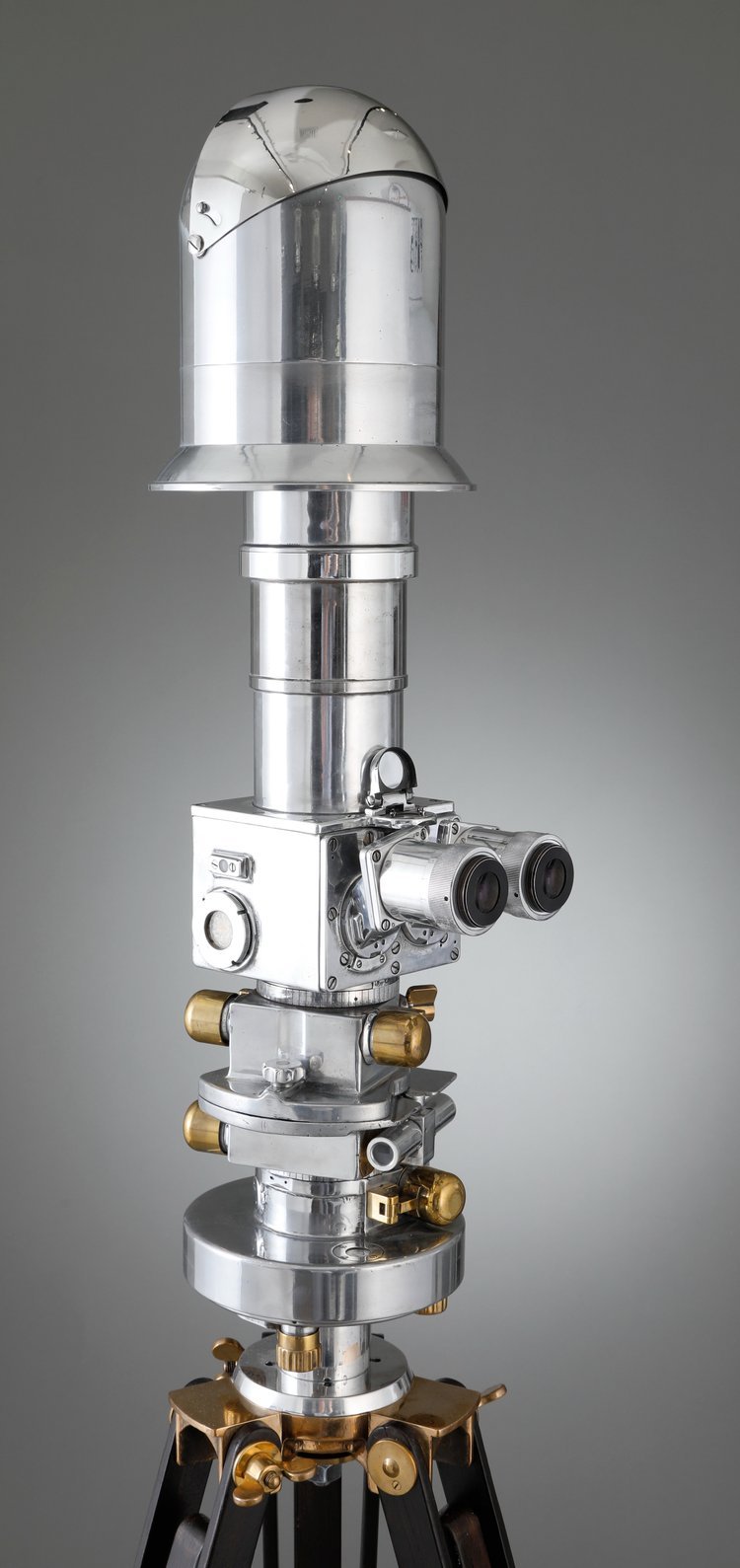
A periscope binocular by Carl Zeiss, of 10 × 50 magnification, produced during the Cold War period and associated with observation along the Berlin Wall.
The instrument is constructed to allow indirect viewing via a raised optical path, enabling the observer to remain below a visual barrier while maintaining a clear line of sight. This configuration proved especially useful in surveillance scenarios where exposure was to be minimized.
The binocular incorporates a manually adjustable viewing system, allowing the line of sight to be directed both vertically and horizontally. This flexibility enabled precise observation across a controlled field without requiring repositioning of the operator.
A rangefinding reticle, visible through the right ocular, further enhances the instrument’s functionality, permitting estimation of distances to observed subjects or objects—an essential feature in both military and border surveillance contexts.
The optical quality reflects the enduring reputation of Carl Zeiss, whose instruments have long been regarded as among the finest in the world. The present example stands as a compelling artifact of Cold War technology, uniting precision optics, mechanical ingenuity, and historical significance.
Literature
Optical Instruments of the Cold War Era
Surveillance and Observation Technologies 1945–1990
Comparative holdings in the Deutsches Museum
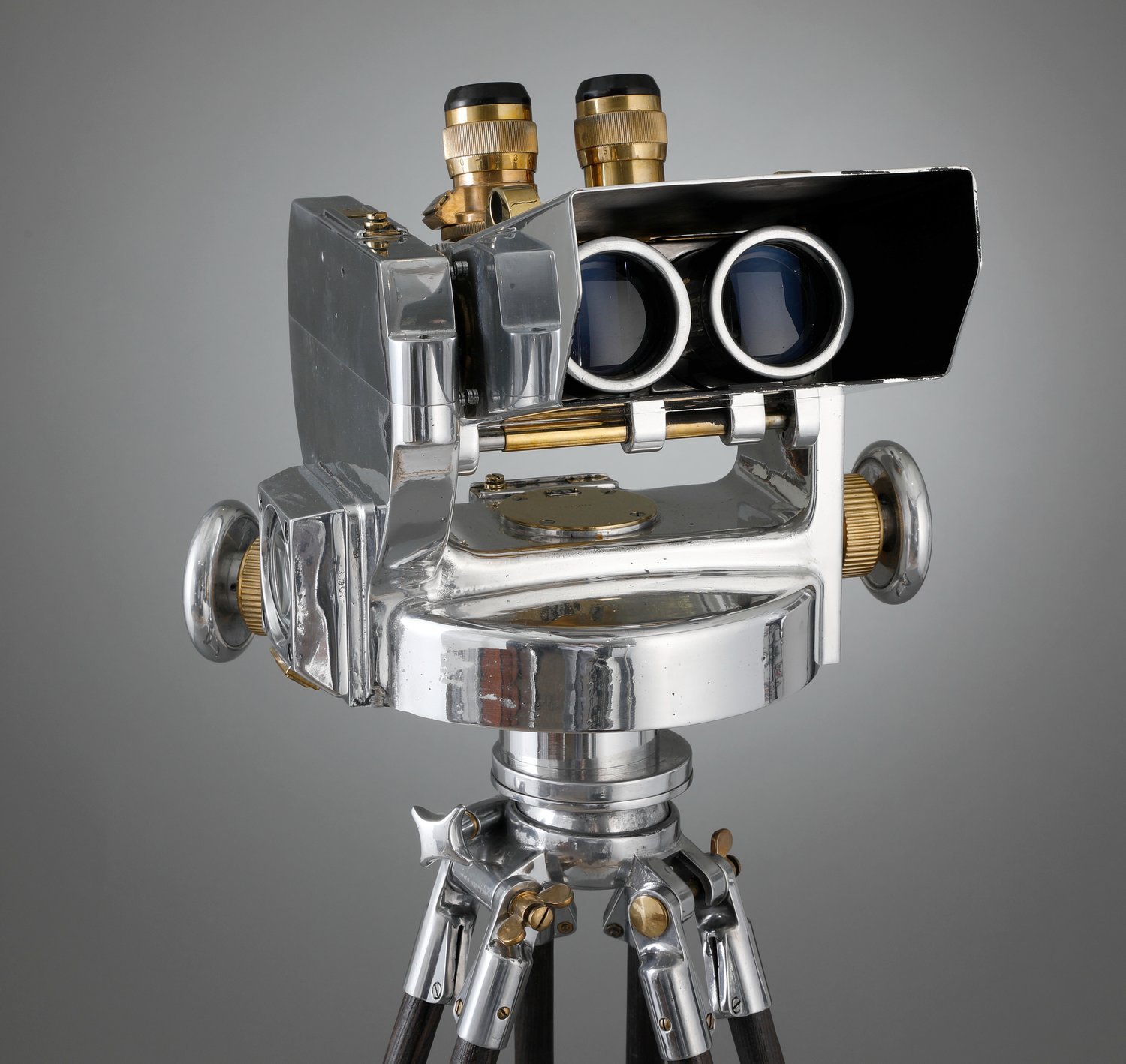
A pair of Swedish military binoculars by NIFE (Nordiska Instrumentfabriken Eskilstuna), of 8 × 50 magnification, dating to the period of World War II.
Constructed with characteristic precision, the binoculars reflect Sweden’s longstanding reputation for high-quality engineering and optical production. The 8-power magnification, paired with 50 mm objective lenses, offers a balanced combination of clarity, light transmission, and portability, making the model suitable for both field observation and maritime use.
Unlike the heavily militarized production of larger nations, Swedish optical instruments of this period often demonstrate a refined, almost minimalist approach to construction, emphasizing durability, clarity, and efficiency without excess.
The present example has been carefully hand-polished, revealing the underlying craftsmanship of the metal body and lending the instrument a striking visual presence that elevates it beyond its utilitarian origins. The optics remain clear, preserving the functional integrity of the piece.
Today, surviving NIFE binoculars from this period are increasingly scarce, particularly in such visually compelling condition, and represent an appealing intersection of military history, scientific instrumentation, and Scandinavian design.
Literature
Scandinavian Scientific Instruments of the 20th Century
Military Optics of the Second World War
Comparative holdings in the Swedish Army Museum
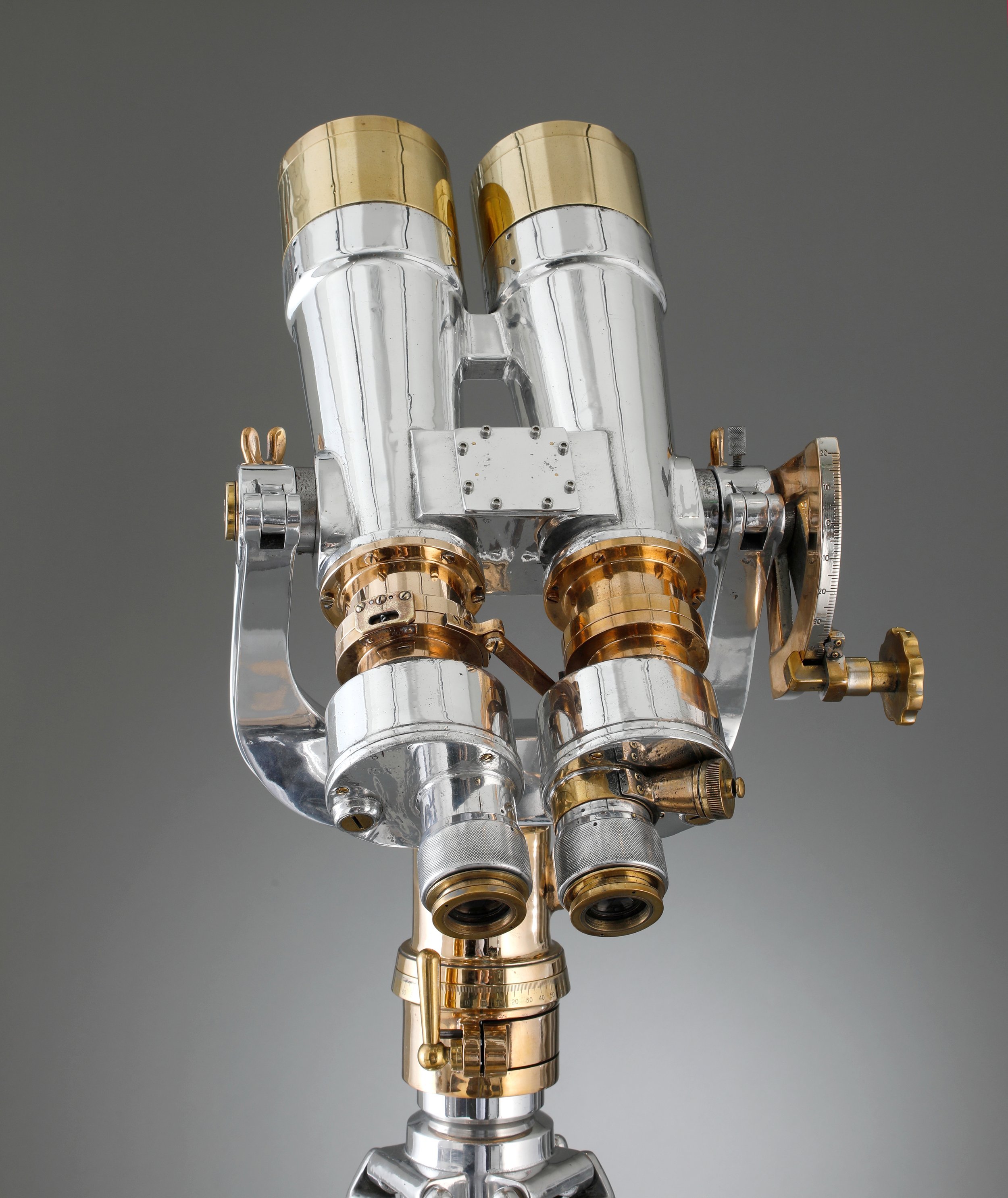
A pair of Japanese naval binoculars by Nikko, of 15 × 80 magnification, dated 1943.
Of large-scale construction, measuring approximately 18 inches in length and weighing close to 25 pounds, the binoculars were designed for long-range naval surveillance, where stability and optical clarity were paramount. The instrument employs a Porro II prism system, paired with air-spaced achromatic objective lenses, allowing for excellent light transmission and image correction.
The binoculars are fitted with Erfle eyepieces, offering a notably wide field of view—approximately 60 degrees—an advanced feature for the period that significantly enhanced situational awareness during maritime observation.
Unlike inclined binocular designs, the present example retains a straight-through ocular configuration, emphasizing direct sight alignment and maximizing optical efficiency. This format was particularly suited to deck-mounted use, where stability and forward viewing were essential.
Japanese naval optics of this scale were produced in limited numbers and were typically allocated to major vessels. Their survival today is uncommon, particularly in examples that retain their structural integrity and optical performance.
Beyond their functional role, these binoculars possess a commanding physical presence, combining industrial precision with sculptural form, placing them firmly within the realm of museum-quality scientific instruments.
Literature
Japanese Naval Optical Instruments and Fire Control Systems
Military Optics of the Second World War
Comparative holdings in the Smithsonian Institution
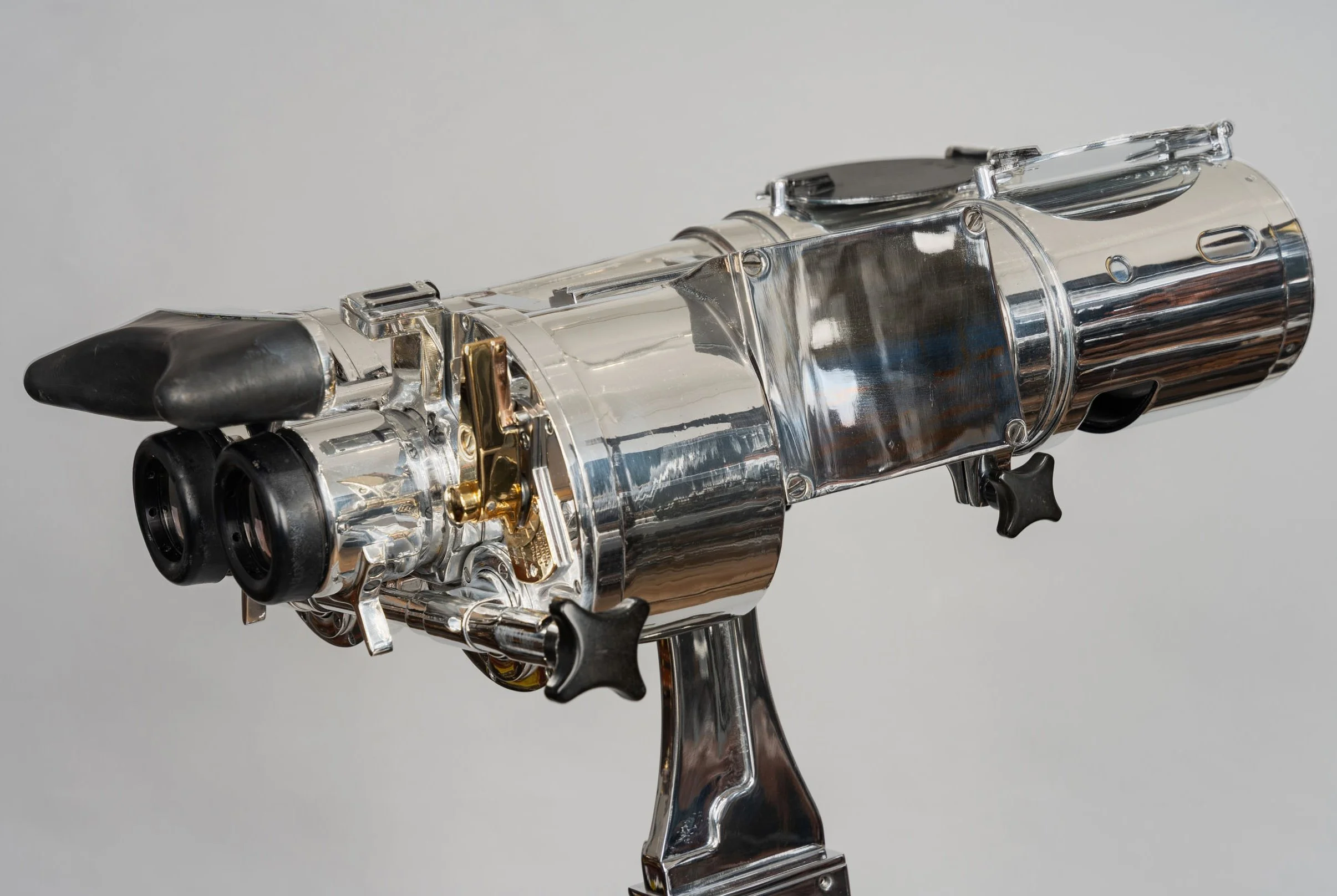




The Fuji Meibo 25×150 is among the largest and most powerful binoculars ever produced for naval service. It is an instrument of an entirely different order from conventional binoculars: 150-millimeter objective lenses in each barrel, 25x magnification, and a resolving power at extreme range that made it the premier long-distance observation instrument of the Japanese naval service. Manufactured by Fuji Photo Optical Co., Ltd. in Japan in the 1970s, the 25×150 was designed exclusively for fixed deck mounting, its scale and weight demanding a permanent platform, and its optical performance rewarding one.
The Fuji Meibo 25×150 represents the apex of Japan's Big Eye program — the largest naval observation instrument the Imperial fleet put to sea. For the full history of these extraordinary instruments, see our essay Japanese Big Eyes: The Imperial Navy's Giant Optics.
The sand-cast aluminum body has been hand-polished to a mirror finish, the surface worked to a brilliance that preserves all original casting details and markings. Polished brass sunshades to the objectives. The original gimbal mount, complete and operational, is retained. The instrument is presented on a Carl Zeiss field tripod of c.1940s manufacture, the pairing uniting two of the foremost names in twentieth-century optical engineering.
The optics are in excellent condition throughout.
Price on application