
Good Night: Churchill on Wall Street — Autograph Letters and Artifacts from the Crash of 1929
Winston Churchill watched Black Tuesday unfold from the visitors' gallery of the New York Stock Exchange. Two autograph letters written in its aftermath — one to Lord Beaverbrook declining financial help, one to the broker who lost him a fortune — together with the closing ticker tape of October 29, 1929, form one of the most vivid documentary records of the crash that exists in private hands. The self-winding stock ticker in the Daniels Antiques collection, manufactured by T.A. Edison Inc. for Western Union, is the type of instrument that stood on Exchange floors across America that day — printing prices hours behind the market as the financial world collapsed around it.
At 3:00 in the afternoon on October 29, 1929, the closing bell rang on the floor of the New York Stock Exchange. The self-winding stock ticker — the machine that had faithfully recorded every transaction on the Exchange floor for decades — was running more than four hours behind. It would not catch up until long after midnight. By then, 16,388,700 shares had changed hands, a record that would stand for nearly four decades. The closing tape read simply: "Total Sales Today 16,388,700 … Good Night … Oct 29 1929."
Among the men who had watched it all unfold was Winston Churchill.
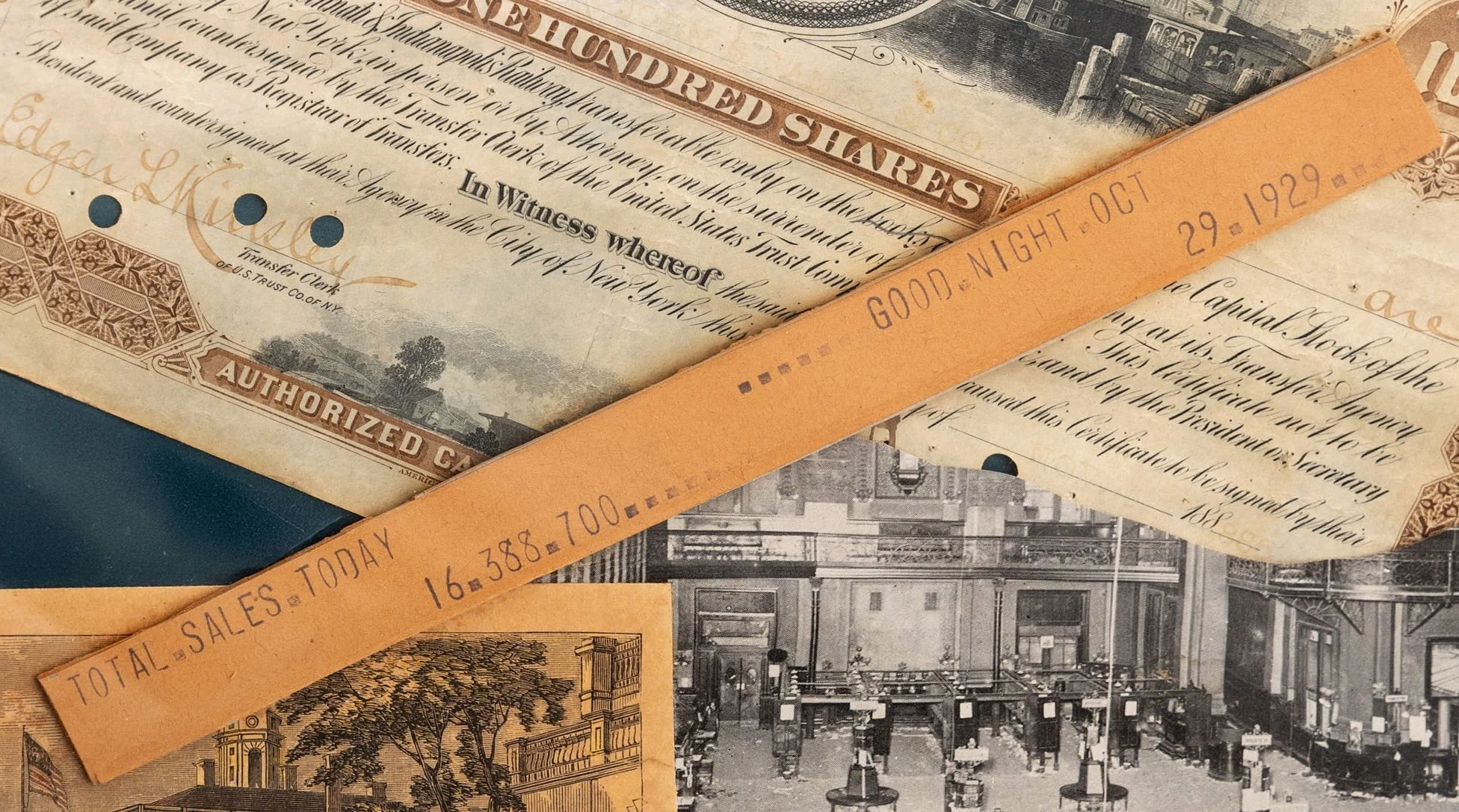
The closing ticker tape, New York Stock Exchange, October 29, 1929: "Total Sales Today 16,388,700 … Good Night."
Churchill on Wall Street
Churchill arrived in New York in October 1929 on a lecture tour of North America — a financial necessity. The Conservative government had been defeated earlier that year, and Churchill was out of office and in need of income. He had traveled through Canada and across the United States, meeting Herbert Hoover, Bernard Baruch, Charlie Chaplin, and Marion Davies, before arriving in New York just as the markets began their catastrophic unraveling.
He was present in the visitors' gallery of the New York Stock Exchange on Black Thursday, October 24, 1929, watching from above as the greatest financial disaster in American history gathered pace. That evening, from his room at the Savoy-Plaza Hotel, he looked down into the street at a crowd gathered around a man who had fallen from a window fifteen stories above. He would later write of the scene in the Daily Telegraph: "Under my very window a gentleman cast himself down fifteen stories and was dashed to pieces, causing a wild commotion and the arrival of the fire brigade."
Four Hours Behind the Market
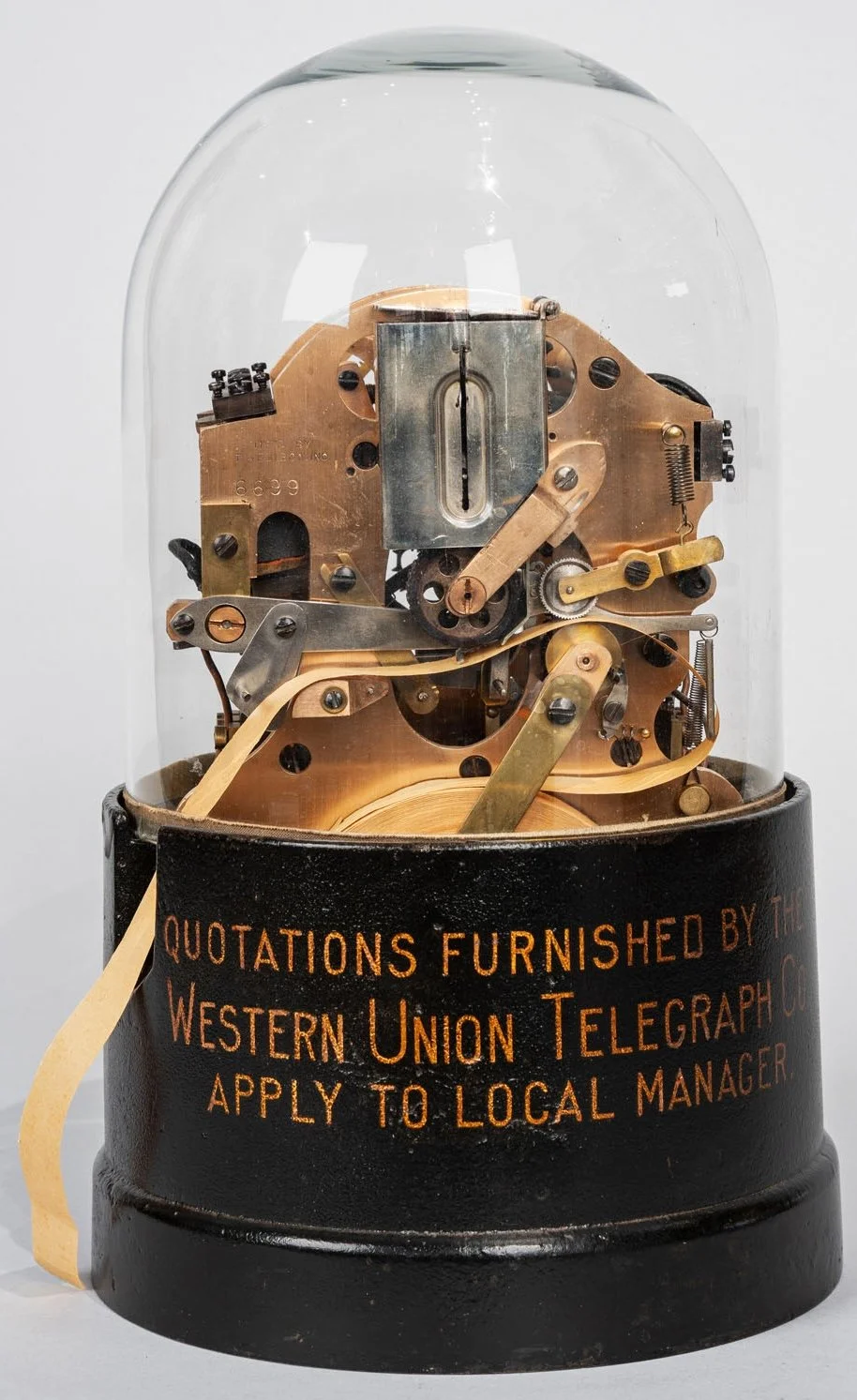
Stock ticker manufactured by T.A. Edison Inc. for the Western Union — Daniels Antiques collection.
The self-winding stock ticker — manufactured by T.A. Edison Inc. for Western Union in the early twentieth century — had represented a remarkable mechanical advance over the Universal Stock Tickers it succeeded. They were the nervous system of Wall Street: receiving prices from the floor via a telegraph line and simultaneously printing company abbreviations and share prices on a continuous spool of paper tape for every subscriber on the circuit.
On October 29, 1929, they were overwhelmed. The volume of transactions on Black Tuesday was so far beyond anything the system had been designed to handle that the tape fell progressively further behind the market. Brokers across the country were acting on prices that were already hours old. No one knew, in real time, what anything was worth. The machine that had modernized financial markets — that had, since Edward Calahan's first instrument clicked into life in December 1867, promised instantaneous information to every subscriber — had met its limit. The ticker tape that closed the day, running hours late, remains one of the most extraordinary surviving documents of the crash.
Two Letters from the Aftermath
Three weeks after Black Tuesday, Winston Churchill wrote to his friend and confidant Lord Beaverbrook — the press baron Max Aitken — from 62 Onslow Gardens, Kensington. The letter, dated November 18, 1929, is a personal and revealing document written in the immediate aftermath of the Crash.
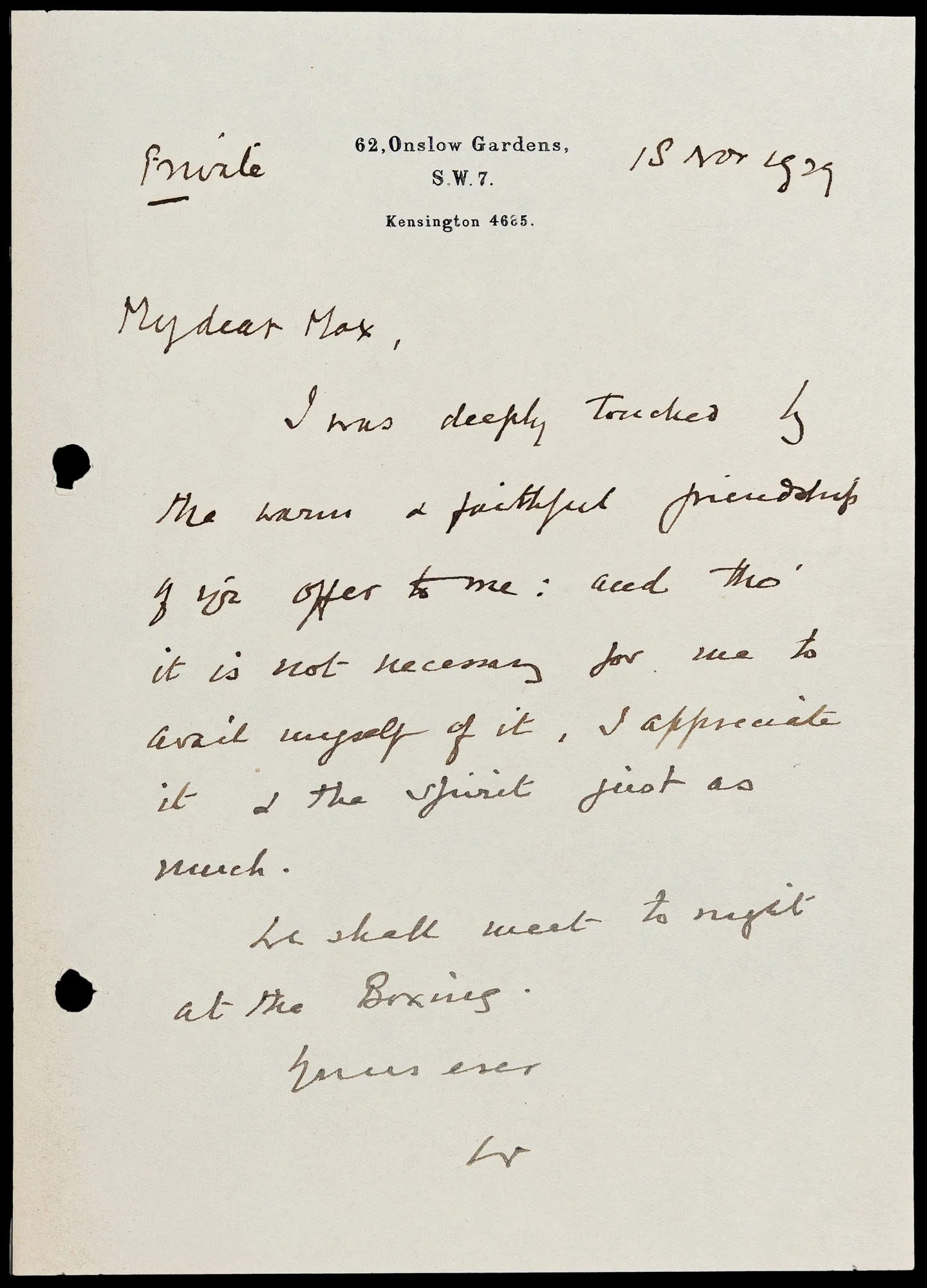
Churchill autograph letter signed to Lord Beaverbrook, 62 Onslow Gardens, 18 November 1929. Signed with the intimate initial "W." Daniels Antiques.
"I was deeply touched by the warm & faithful friendship you offer to me, and though it is not necessary for me to avail myself of it, I appreciate it & the spirit just as much. We shall meet tonight at the Boxing."
The offer Churchill was declining was Beaverbrook's proposal to help him financially in the wake of his Crash losses. The letter is characteristic of Churchill at his most privately vulnerable — acknowledging the gesture without surrendering his pride. Written on the headed notepaper of 62 Onslow Gardens, S.W.7, in Churchill's flowing autograph hand, it is signed with the intimate initial "W," reserved for his closest friends. Churchill's biographer Kenneth Young, in his study of the Churchill–Beaverbrook relationship, notes that Churchill had additional reasons for declining: "His acceptance would certainly have put him in an invidious position. He was afterward alleged (by the German intelligence service) to be in Beaverbrook's pay, but he never was" (Churchill and Beaverbrook, 1966, p. 111).
Provenance: purchased from John Wilson, London, July 2, 1980 (£180); Forbes Collection; Daniels Antiques. John Wilson was among the leading autograph dealers in London; his acquisition of a substantial body of Beaverbrook correspondence accounts for the appearance of several Churchill–Beaverbrook letters in the Forbes collection.
Fourteen months after Black Tuesday, Churchill wrote again — this time to the man who had managed his account through the disaster. The letter, dated December 3, 1930, and written from Chartwell, is warm and generous in tone.
William Clarkson Van Antwerp (1867–1935) was a partner and head of the San Francisco office of E.F. Hutton & Co., a Governor of the New York Stock Exchange, and author of The Stock Exchange from Within (1913). He had been recommended to Churchill by Bernard Baruch. Churchill met him at William Randolph Hearst's San Simeon estate in September 1929, opened an account with Hutton within days, and handed Van Antwerp discretionary authority over his portfolio. Van Antwerp's telegrams pursued Churchill eastward by rail; one, sent October 1, warned: "Market heavy. Liquidating is becoming more urgent." Churchill pressed on regardless.
The letter of December 3, 1930 — warm, gracious, entirely without rancor — is addressed to the man who managed that account through the disaster:
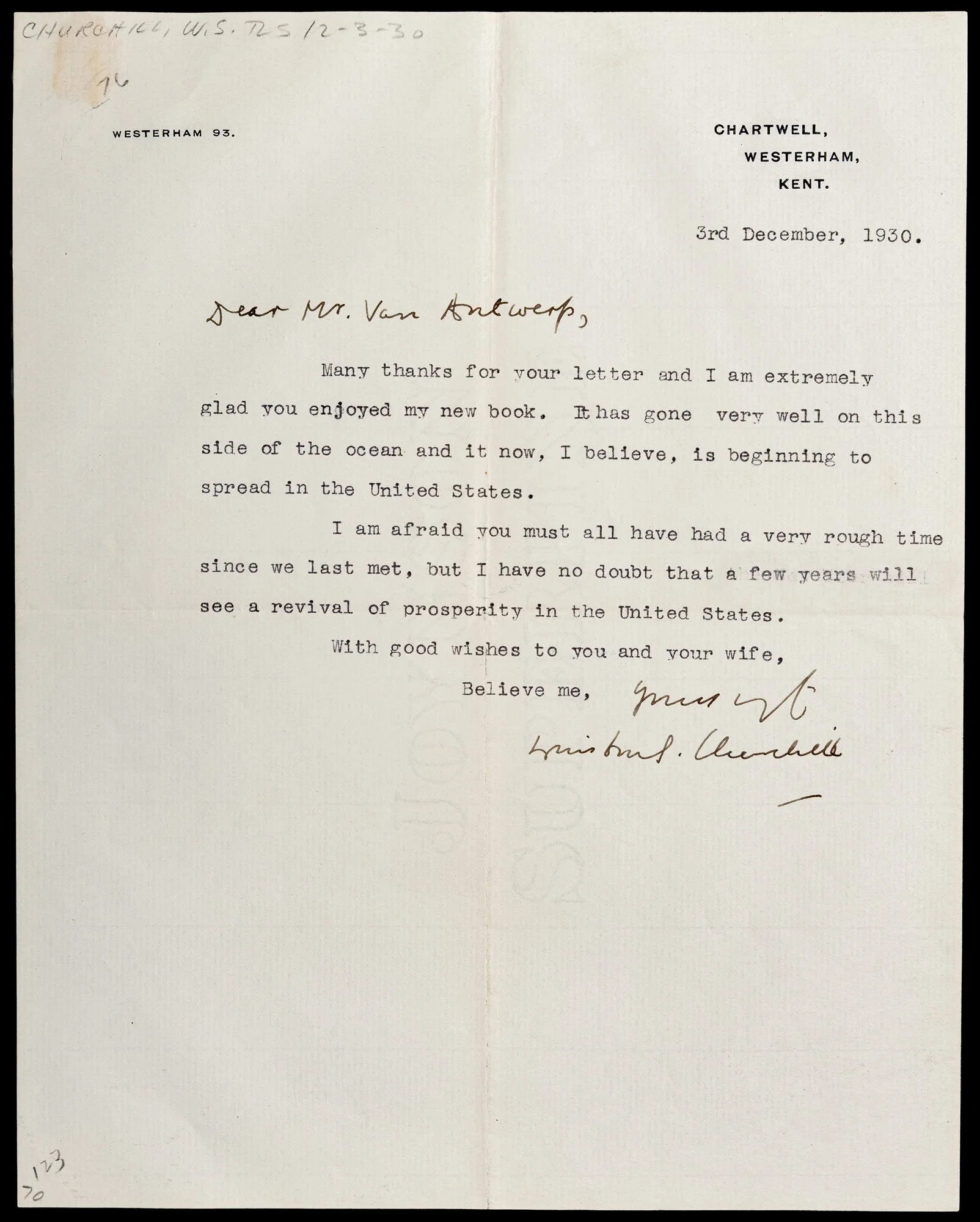
Churchill typed letter signed to William Van Antwerp, Chartwell, 3 December 1930. Signed in full: Winston S. Churchill. Daniels Antiques.
"I am afraid you must all have had a very rough time since we last met, but I have no doubt that a few years will see a revival of prosperity in the United States."
The letter is characteristic of Churchill at his most measured and forward-looking. Writing fourteen months after the crash, having lost a substantial sum of his own money in the same markets, he offers no recrimination and no self-pity — only a quiet confidence in American resilience. It is the voice that would sustain a nation through a far greater crisis a decade later. The letter is typed on Chartwell, headed notepaper, and is signed in full in Churchill's hand below the valediction "Believe me."
Provenance: Kenneth W. Rendell, Inc., Newton, Massachusetts; Daniels Antiques.
Why These Letters Matter
The two letters span the full arc of Churchill's experience of the Wall Street Crash — from the raw weeks immediately following Black Tuesday, when he was declining offers of personal financial help, to the cautious optimism of a year later. Together they document one of the most consequential episodes in Churchill's private life, at a moment when his finances were severely damaged, and his political career appeared to be over. Within a decade, he would be Prime Minister.

For the collector of Winston Churchill autograph material, the Beaverbrook letter is a rare instance of Churchill writing in his own hand about a personal financial crisis, at the moment of maximum vulnerability. The Van Antwerp letter offers the counterpoint — warm, without recrimination, directed at the man who managed the account through the disaster. Together, they reveal something about Churchill's character that no biography quite captures so neatly.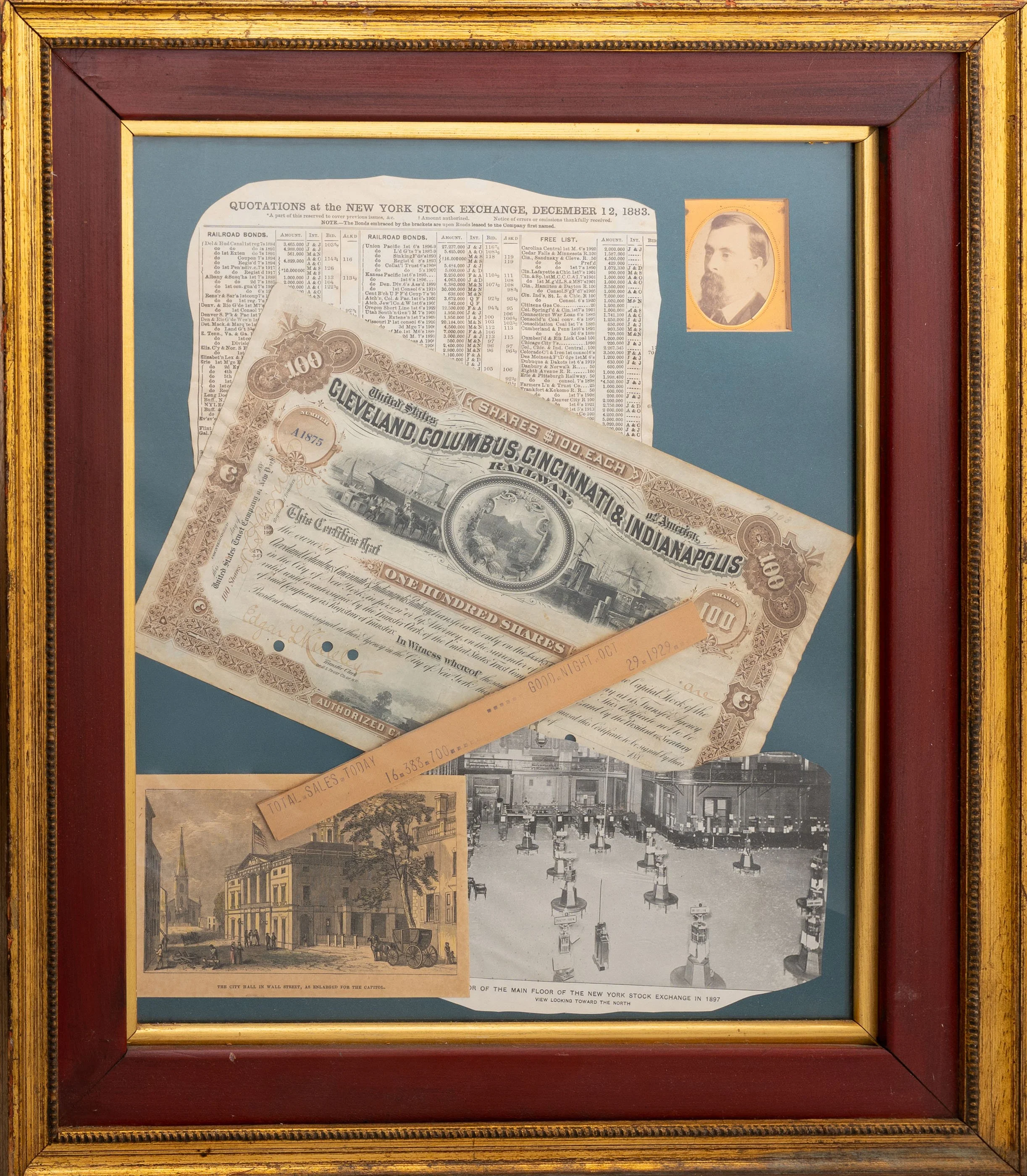
Period assemblage: Black Tuesday closing ticker tape, NYSE floor photograph, 1883 Exchange quotations sheet, and Cleveland, Columbus, Cincinnati & Indianapolis Railway stock certificate. Daniels Antiques collection.
The self-winding stock ticker in the Daniels Antiques collection is a direct material witness to the same events. It is the type of instrument that stood on the floor of the New York Stock Exchange on October 29, 1929, clicking out prices hours after the market had collapsed around it. The closing tape in the collection — "Total Sales Today 16,388,700 … Good Night … Oct 29 1929" — came from the collection of a New York Stock Exchange floor member of fifty years' service. Closing tape in hand, Churchill's letters on the desk: the crash of 1929 has rarely felt so present.
Both Churchill letters are available for private acquisition through Daniels Antiques. The Beaverbrook letter (November 18, 1929) is a single-sheet autograph letter signed in Churchill's hand; the Van Antwerp letter (December 3, 1930) is a single-sheet typed letter signed in full. Both are in excellent condition, unframed. Provenance details are available on request. Please contact Simon Daniels directly in Aspen, Colorado.
If you own a piece in this category and are considering selling, we would be glad to hear from you. Get in touch with Daniels Antiques.
Literature & Sources
Churchill's own writings
Winston S. Churchill, "What I Heard and Saw in America," twelve-part newspaper series, 1930. Reproduced in The Collected Essays of Sir Winston Churchill, vol. IV, Churchill at Large. Library of Imperial History, London, 1975.
Winston S. Churchill, dispatch published in The Daily Telegraph, December 9, 1929.
Biographical sources
Bradley P. Tolppanen, Churchill in North America, 1929. Hillsdale College Press.
Martin Gilbert, Winston S. Churchill, Official Biography, vol. V. Heinemann, London, 1976.
Kenneth Young, Churchill and Beaverbrook. Eyre & Spottiswoode, London, 1966.
Financial history
John Kenneth Galbraith, The Great Crash 1929. Houghton Mifflin, Boston, 1954.
Period sources
New York Stock Exchange closing ticker tape, October 29, 1929. From the collection of a New York Stock Exchange floor member of fifty years' service. Daniels Antiques.
William C. Van Antwerp, The Stock Exchange from Within. Moody Magazine and Book Company, New York, 1913.