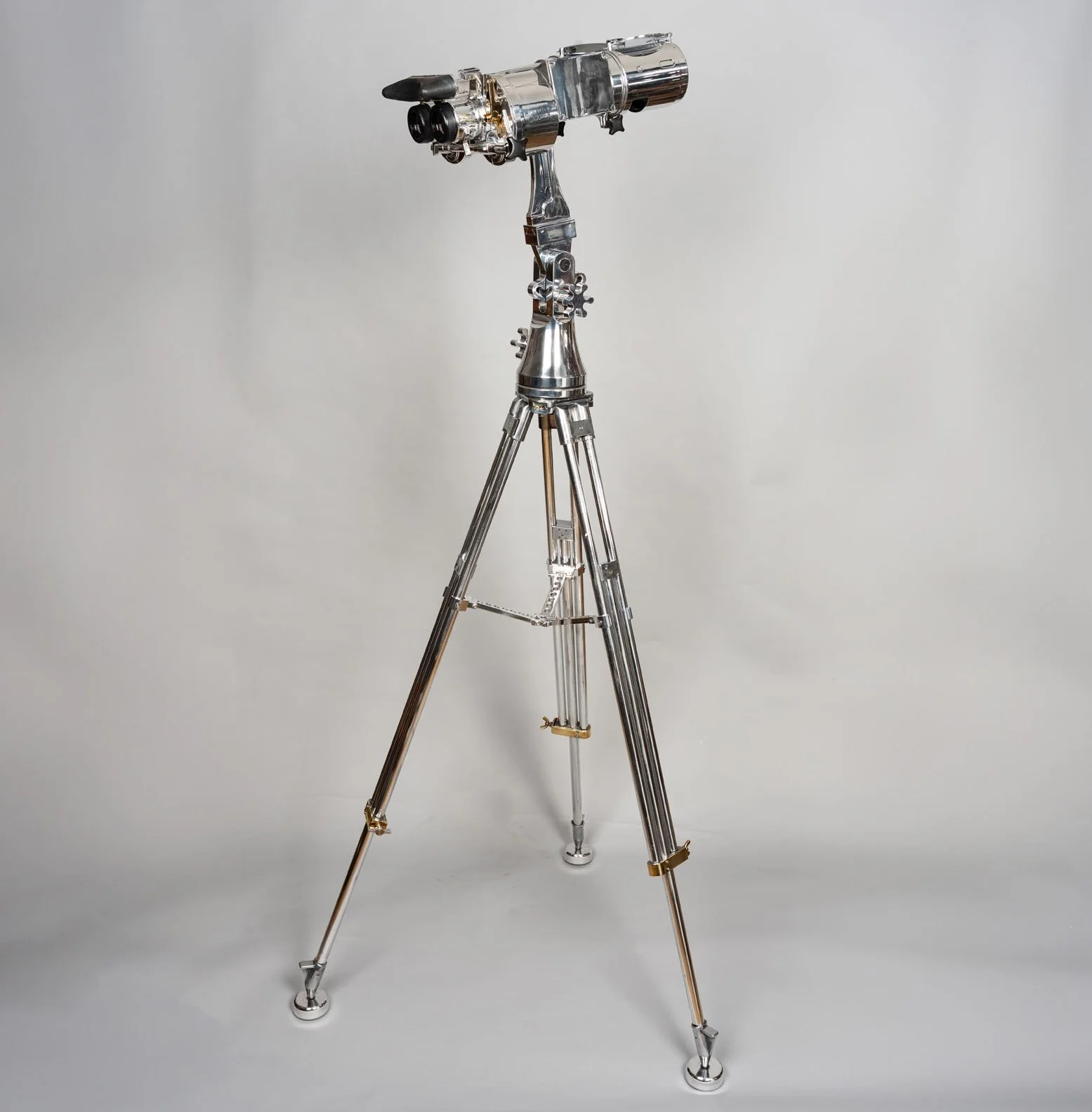
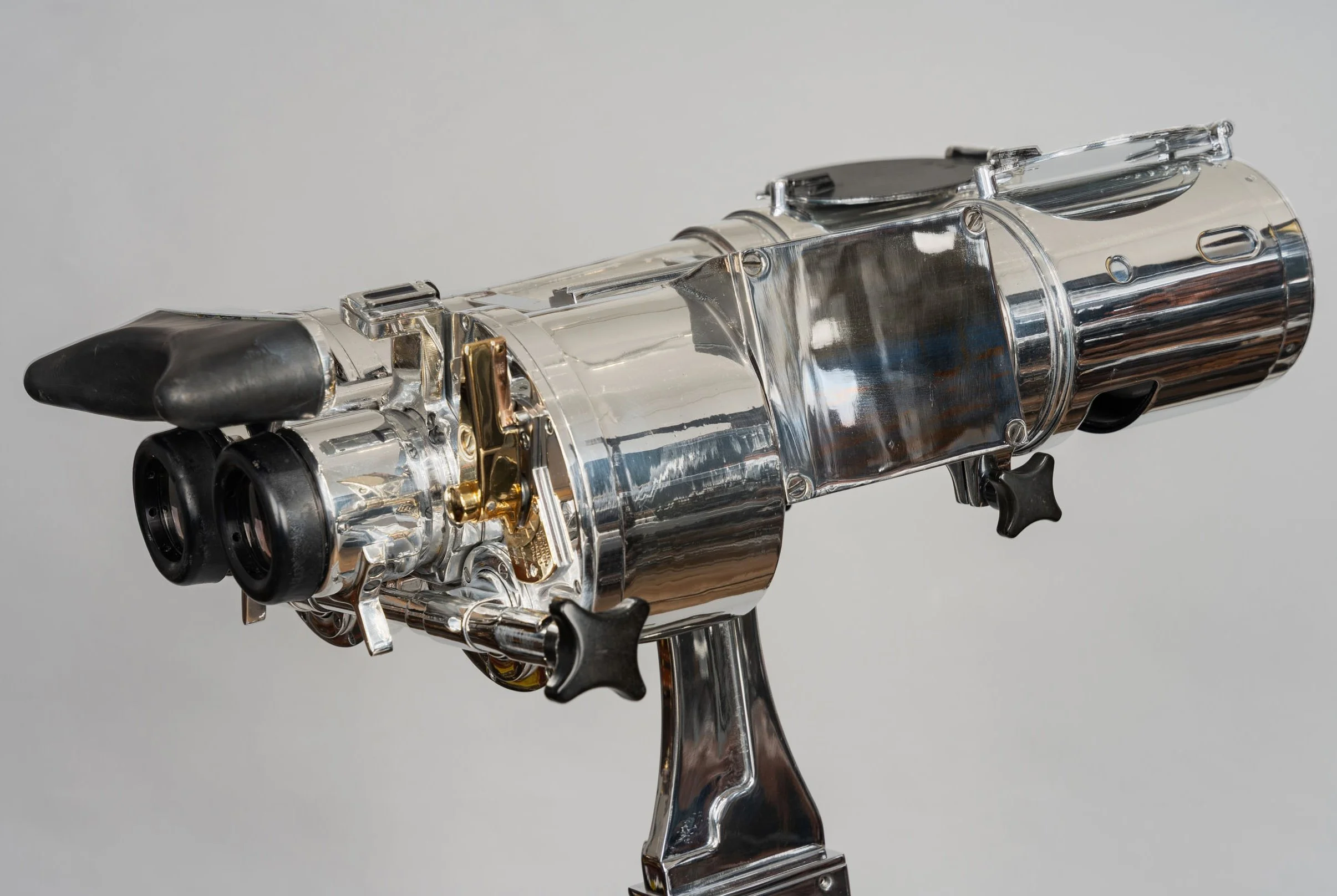
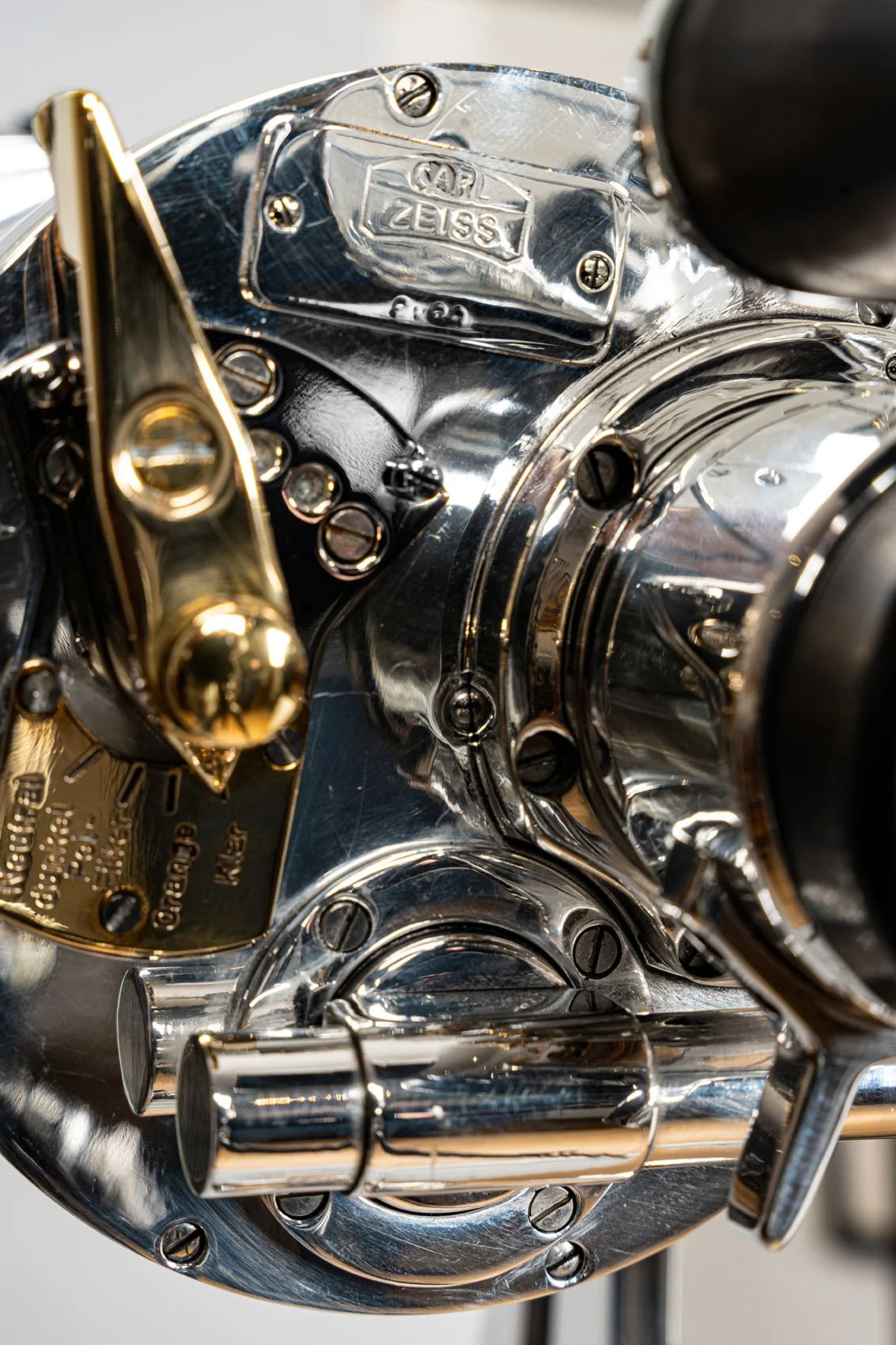
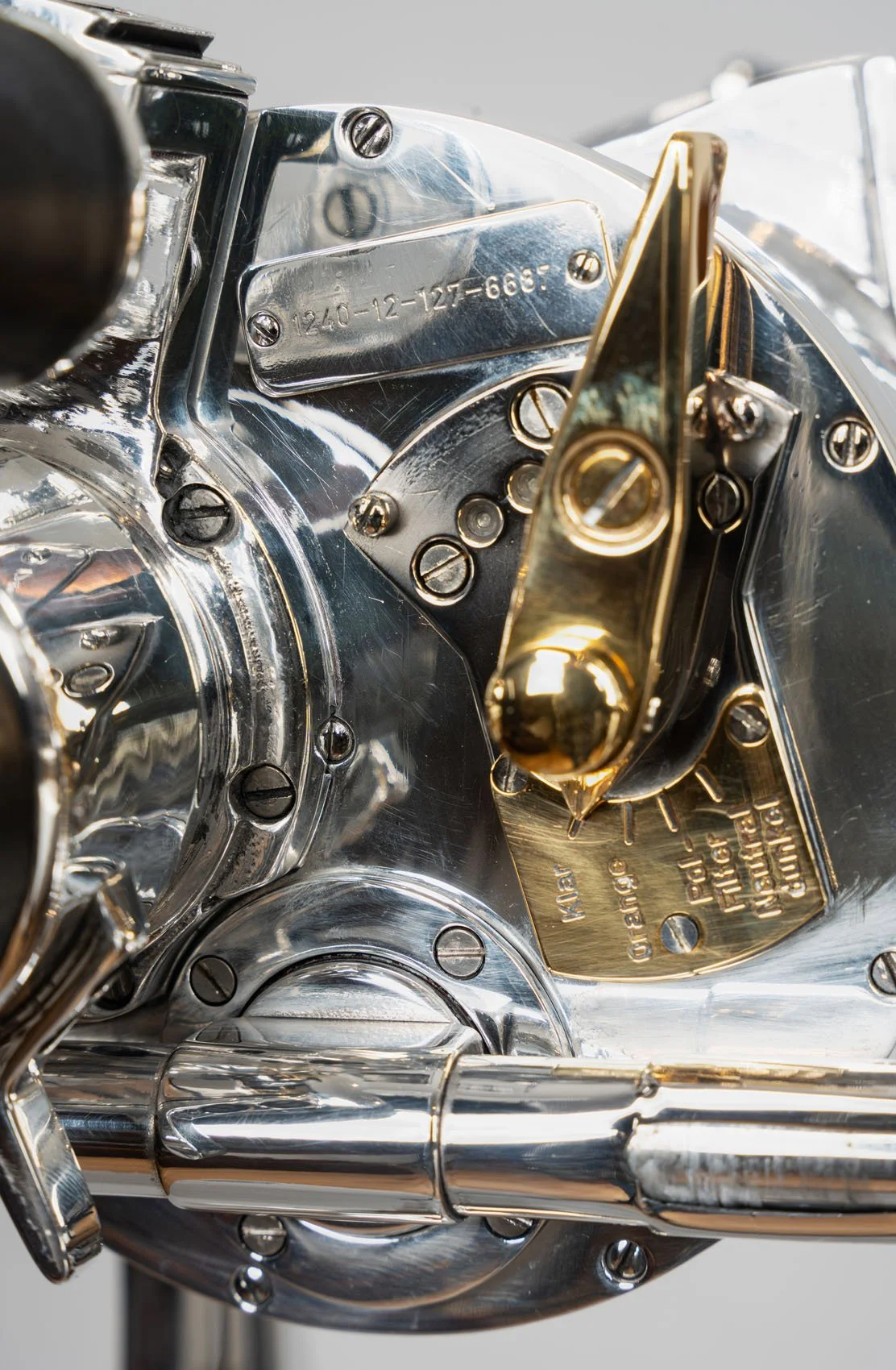
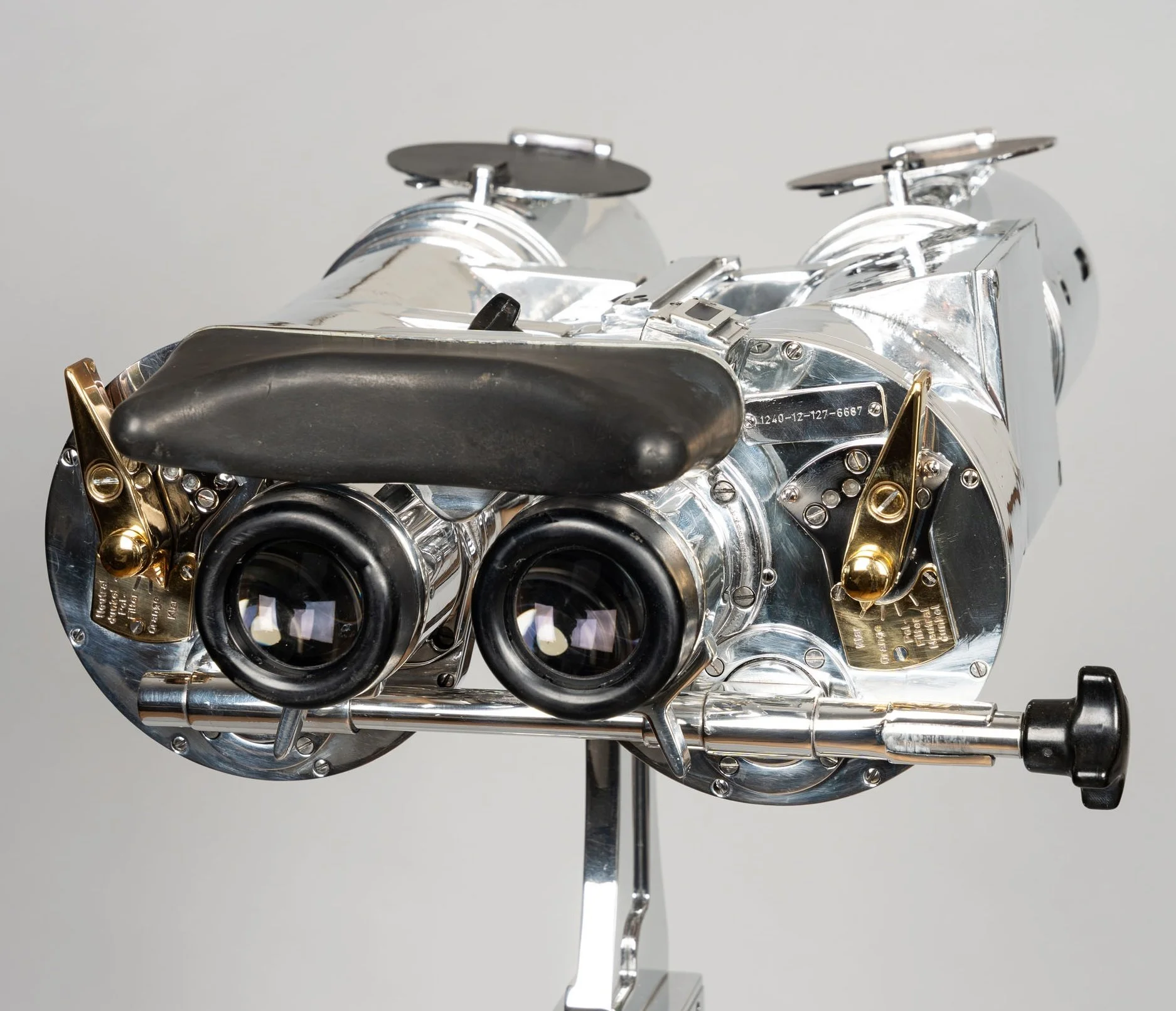
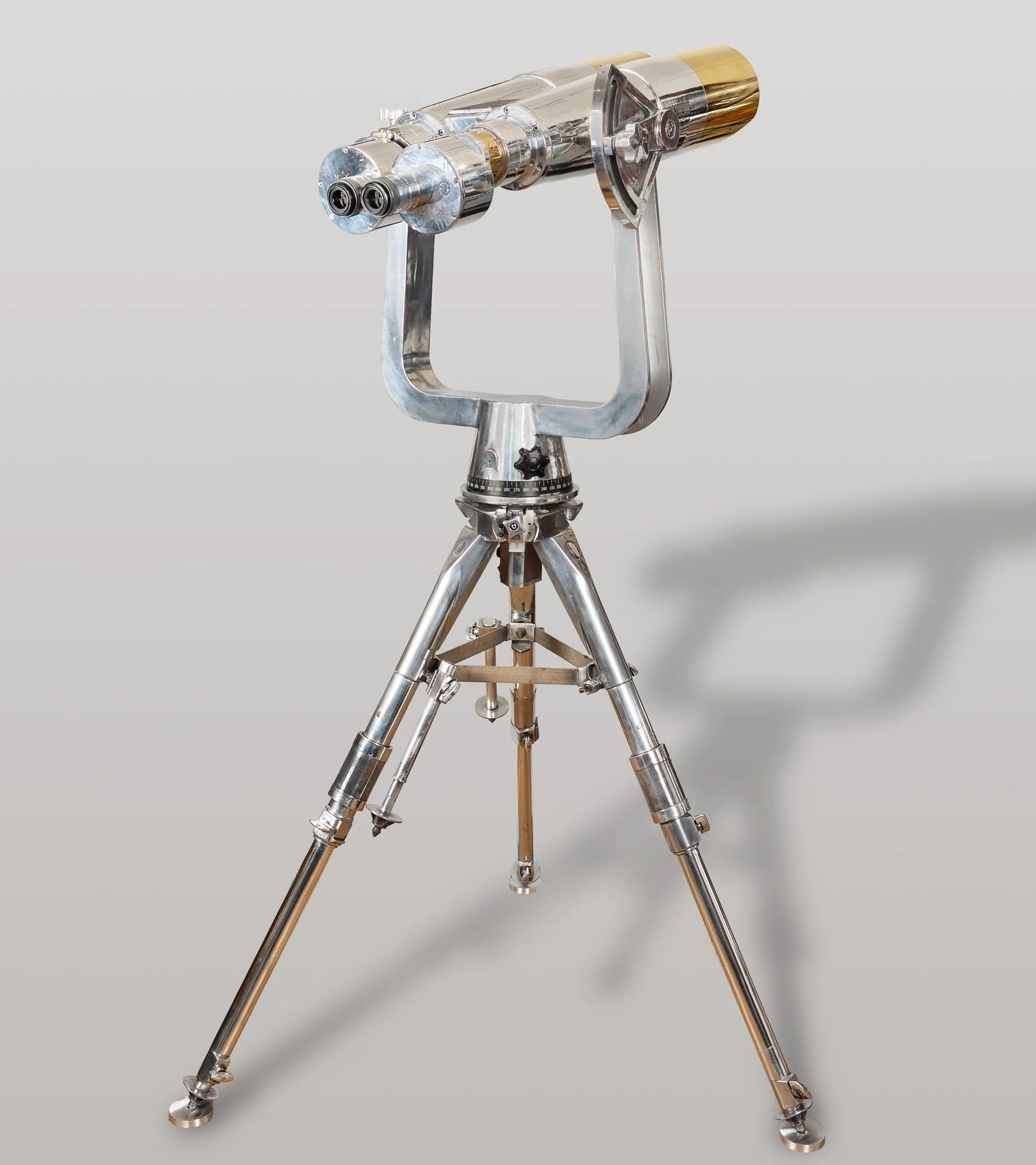
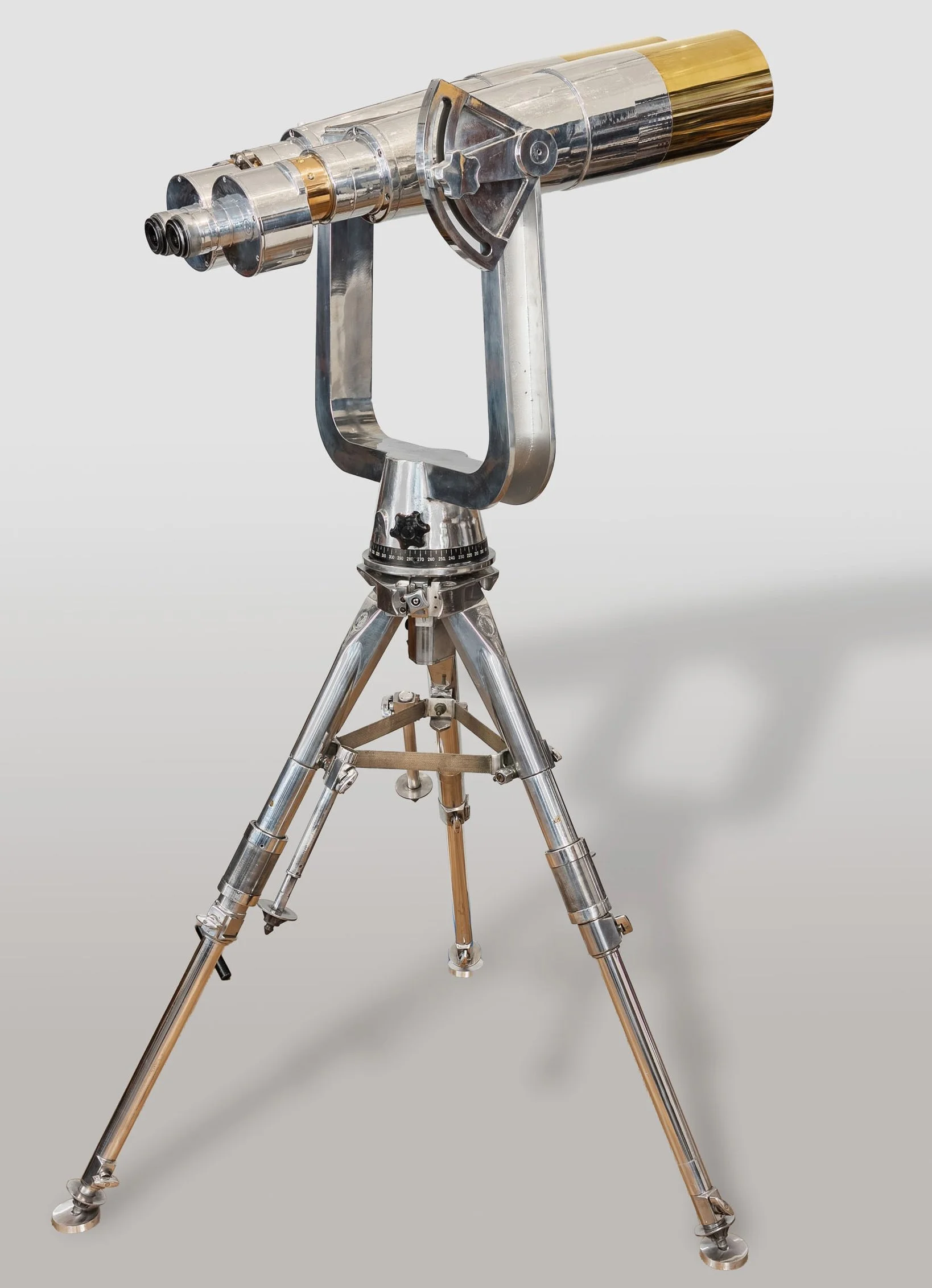
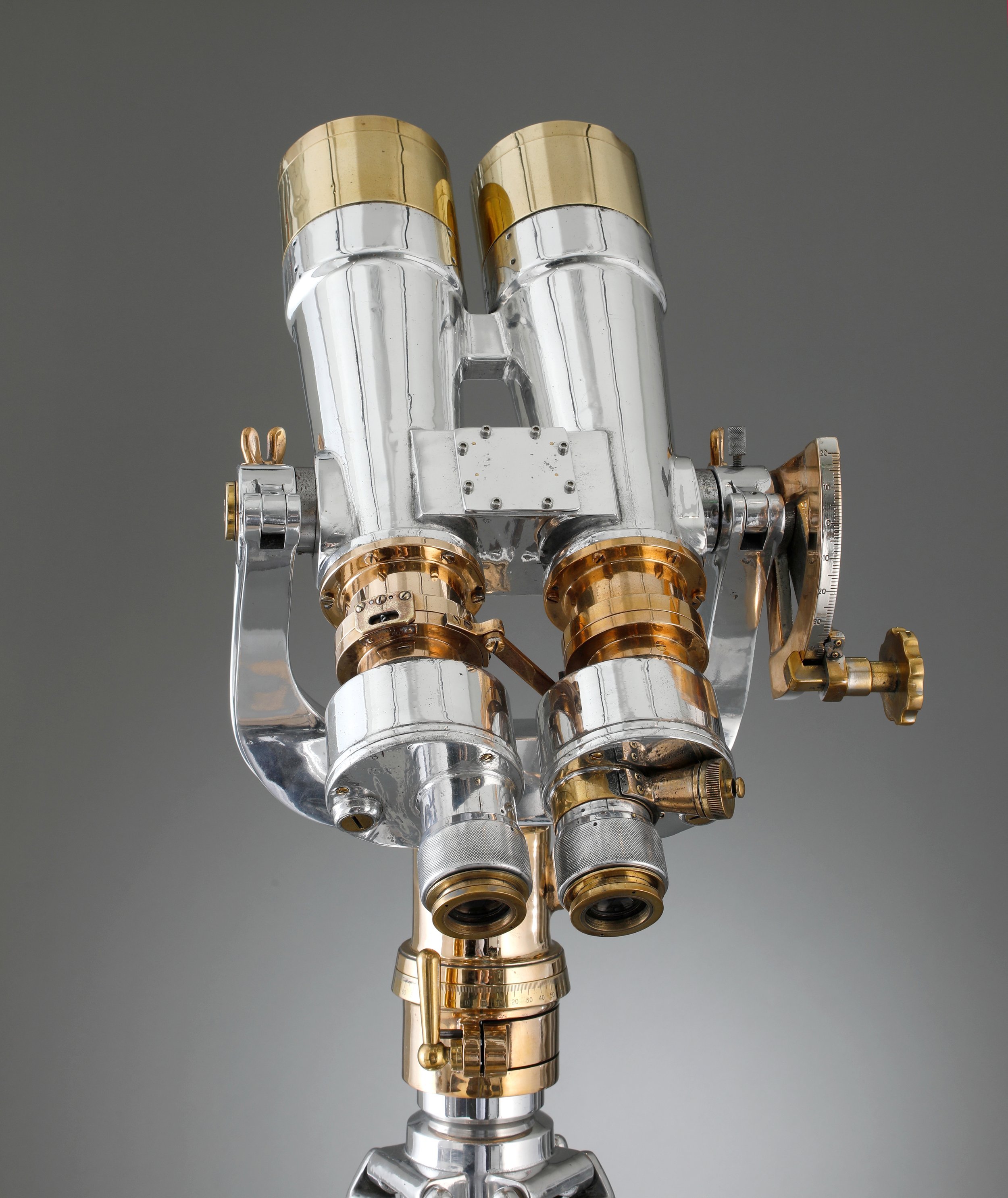
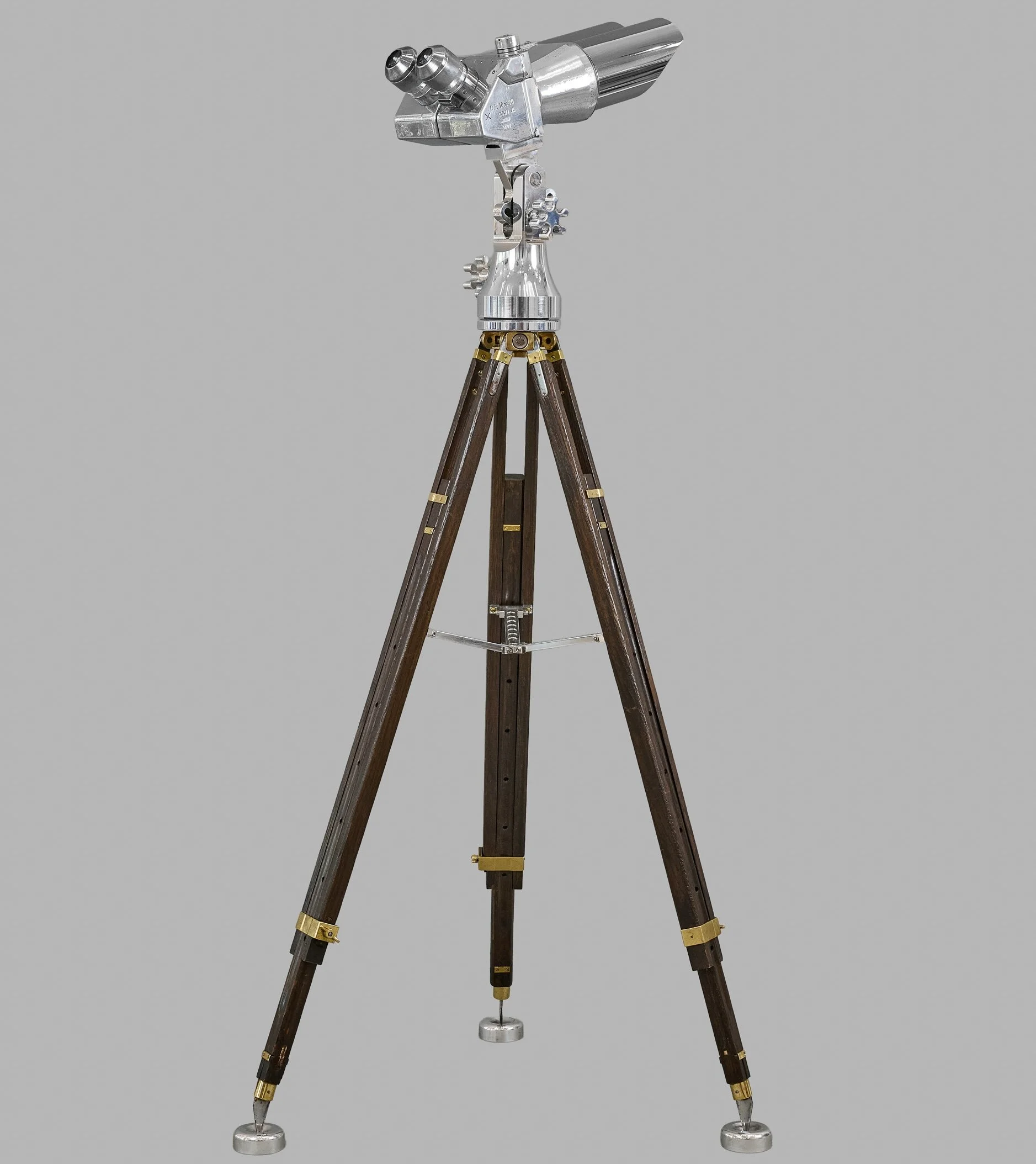
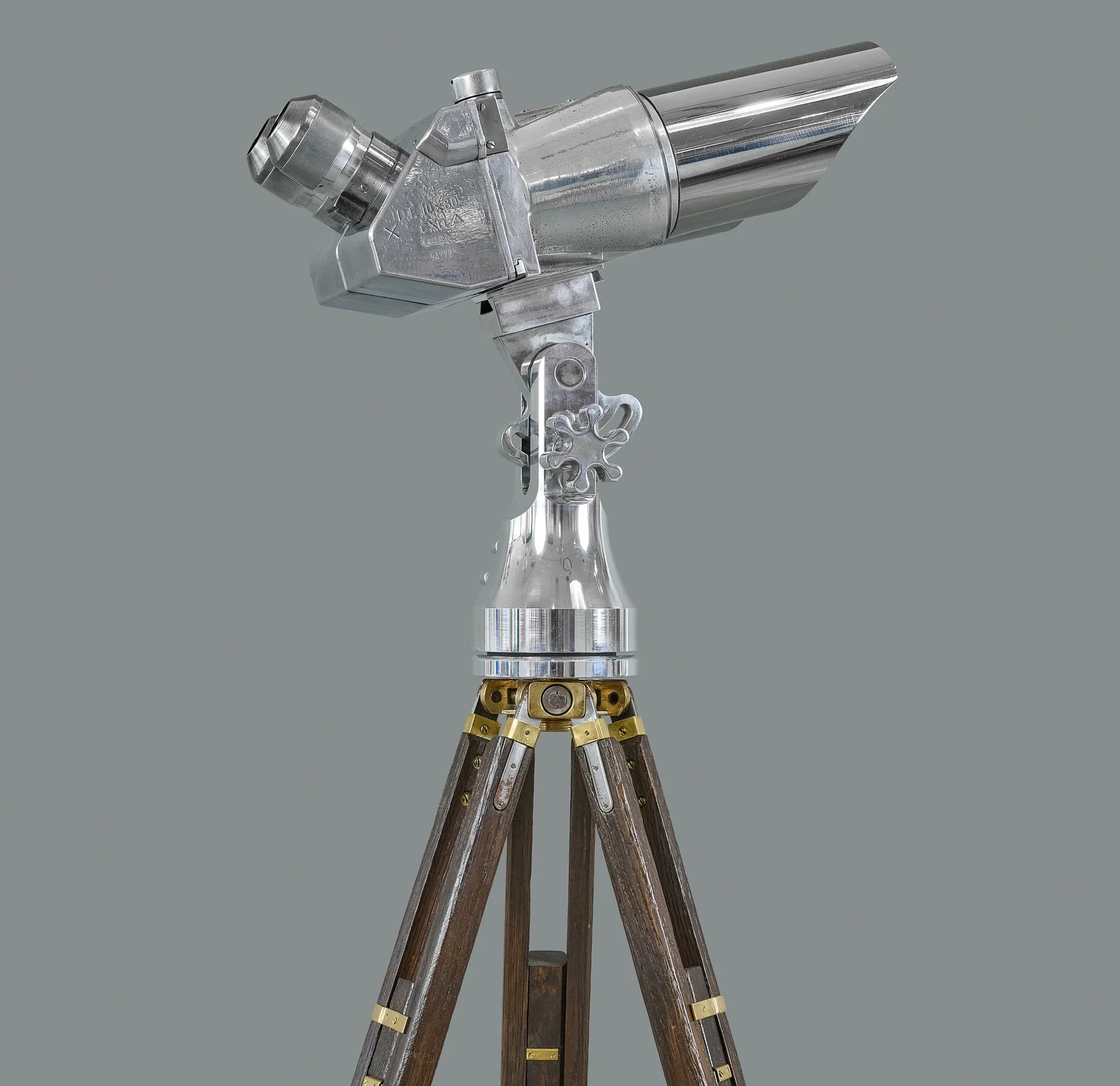
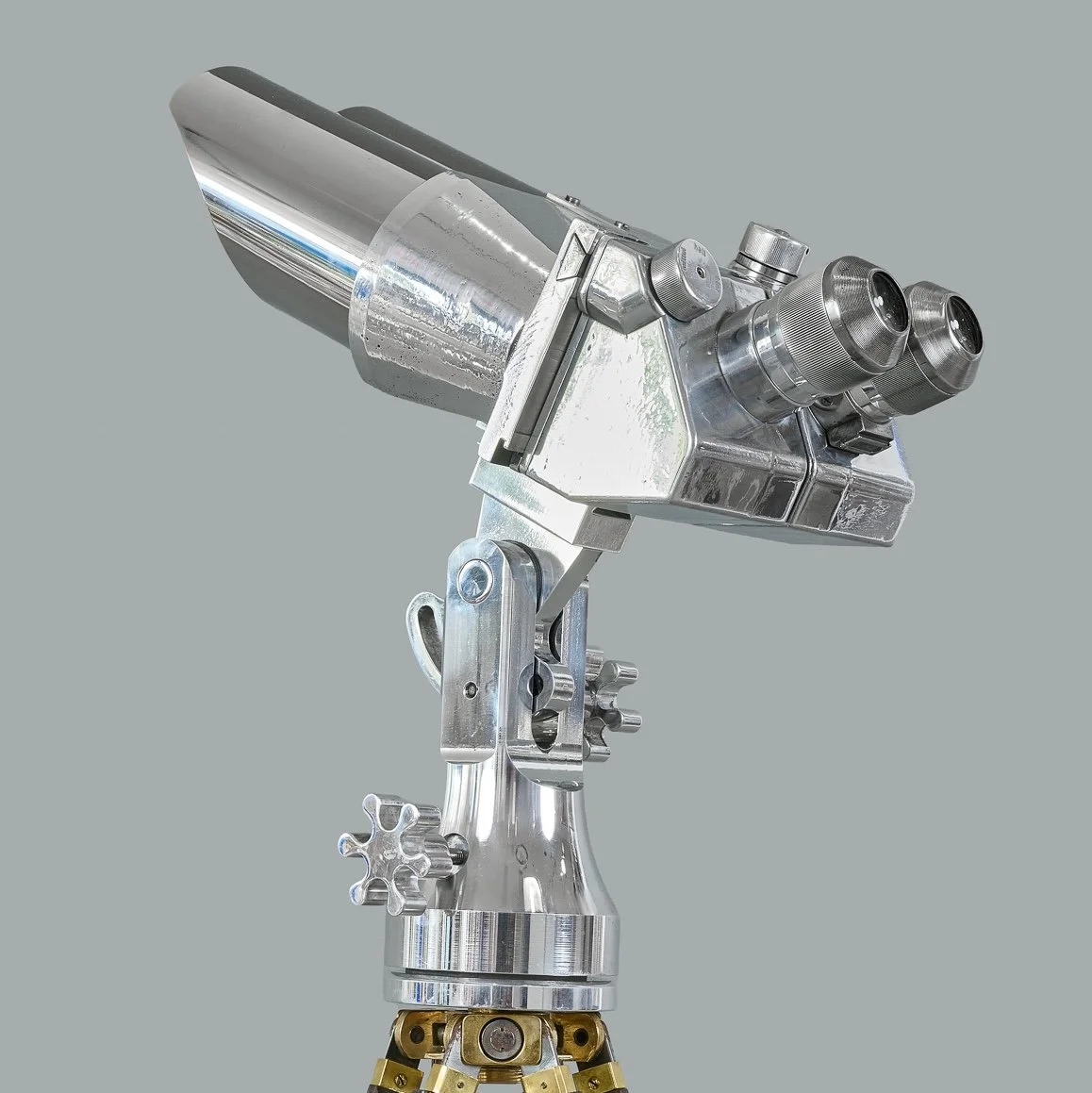
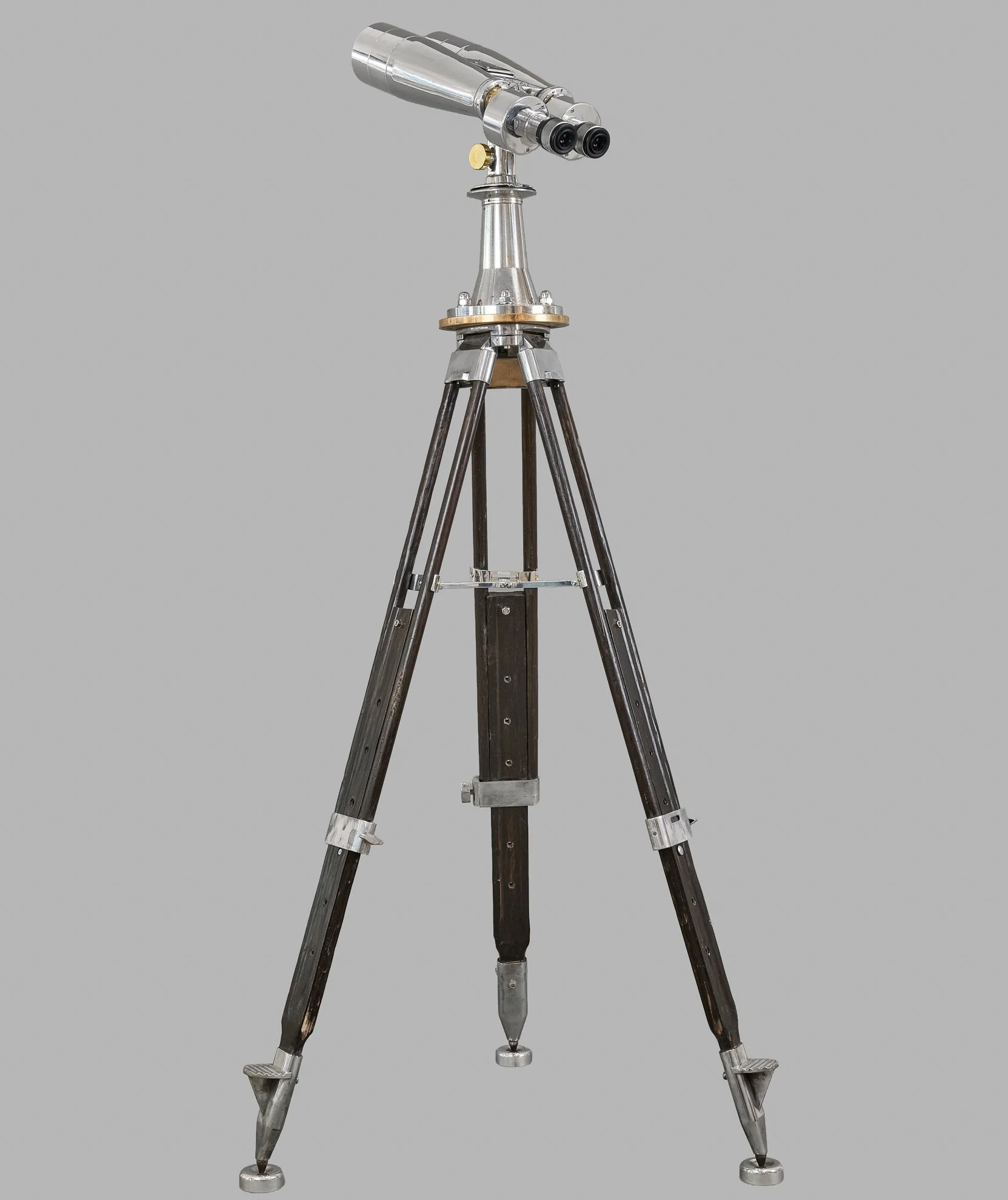
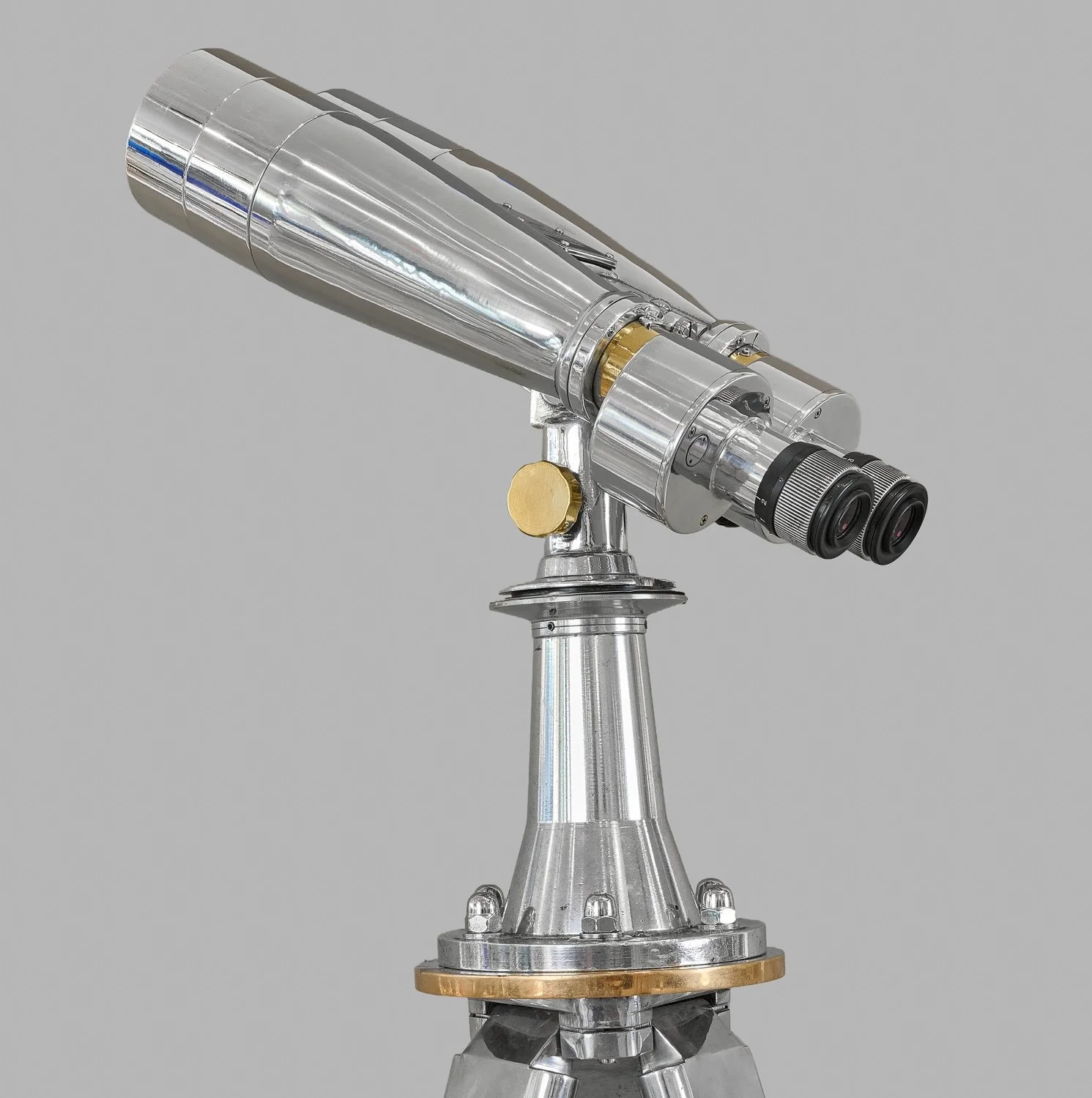
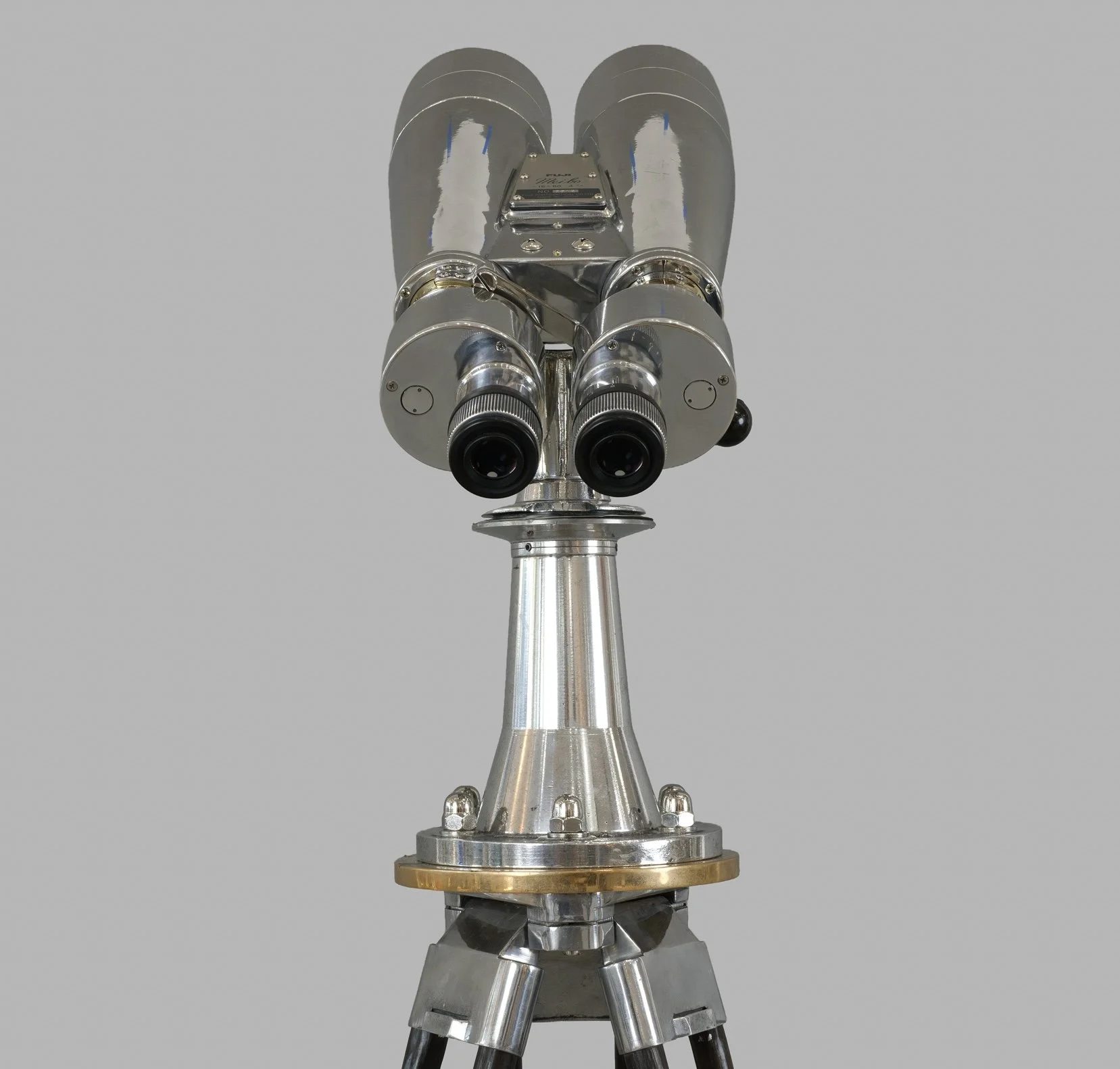
A pair of Japanese Imperial Navy 15×80 big-eye binoculars by Toko, the Tokyo Optical Company, circa 1940, retained on their original gimbal mount and deck-pattern pedestal, raised on a period hardwood tripod. The data plate carries Toko's diamond trademark, the 4-degree field designation, and serial number 1062.
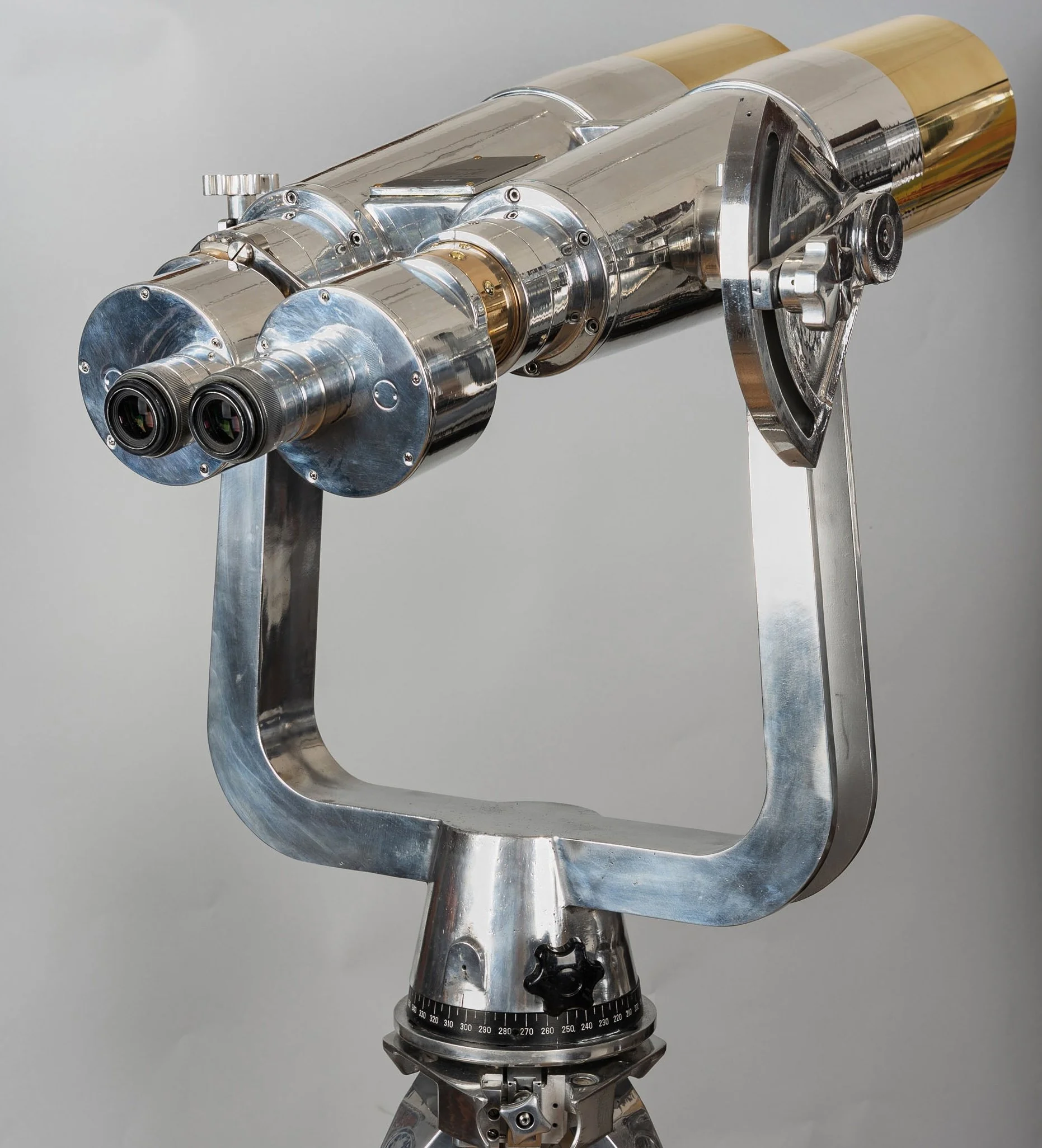
Few of these instruments survive complete. Most big eyes reaching the market were separated from their shipboard fittings decades ago, so a set retaining its original gimbal, pedestal, and bearing ring is the exception. The instrument rides in a heavy polished fork, elevation set by a brass handwheel on a toothed quadrant, and turns on a brass bearing ring engraved through the full 360 degrees, a working compass rose in miniature. The bolted flange at the base is the original deck fitting that once fixed the mount to a warship's bridge wing.
The barrels run straight and level from objective to eyepiece, the configuration the Japanese navy specified for long watches on the open bridge. The 80mm objectives gather a remarkable quantity of light, and at 15 times magnification the image is bright, sharp, and immersive, as rewarding on a shoreline as on the moon. Each eyepiece focuses independently.
A pair of Japanese Imperial Navy 15×80 big-eye binoculars by Toko, the Tokyo Optical Company, circa 1940, retained on their original gimbal mount and deck-pattern pedestal, raised on a period hardwood tripod. The data plate carries Toko's diamond trademark, the 4-degree field designation, and serial number 1062.
Few of these instruments survive complete. Most big eyes reaching the market were separated from their shipboard fittings decades ago, so a set retaining its original gimbal, pedestal, and bearing ring is the exception. The instrument rides in a heavy polished fork, elevation set by a brass handwheel on a toothed quadrant, and turns on a brass bearing ring engraved through the full 360 degrees, a working compass rose in miniature. The bolted flange at the base is the original deck fitting that once fixed the mount to a warship's bridge wing.
The barrels run straight and level from objective to eyepiece, the configuration the Japanese navy specified for long watches on the open bridge. The 80mm objectives gather a remarkable quantity of light, and at 15 times magnification the image is bright, sharp, and immersive, as rewarding on a shoreline as on the moon. Each eyepiece focuses independently.

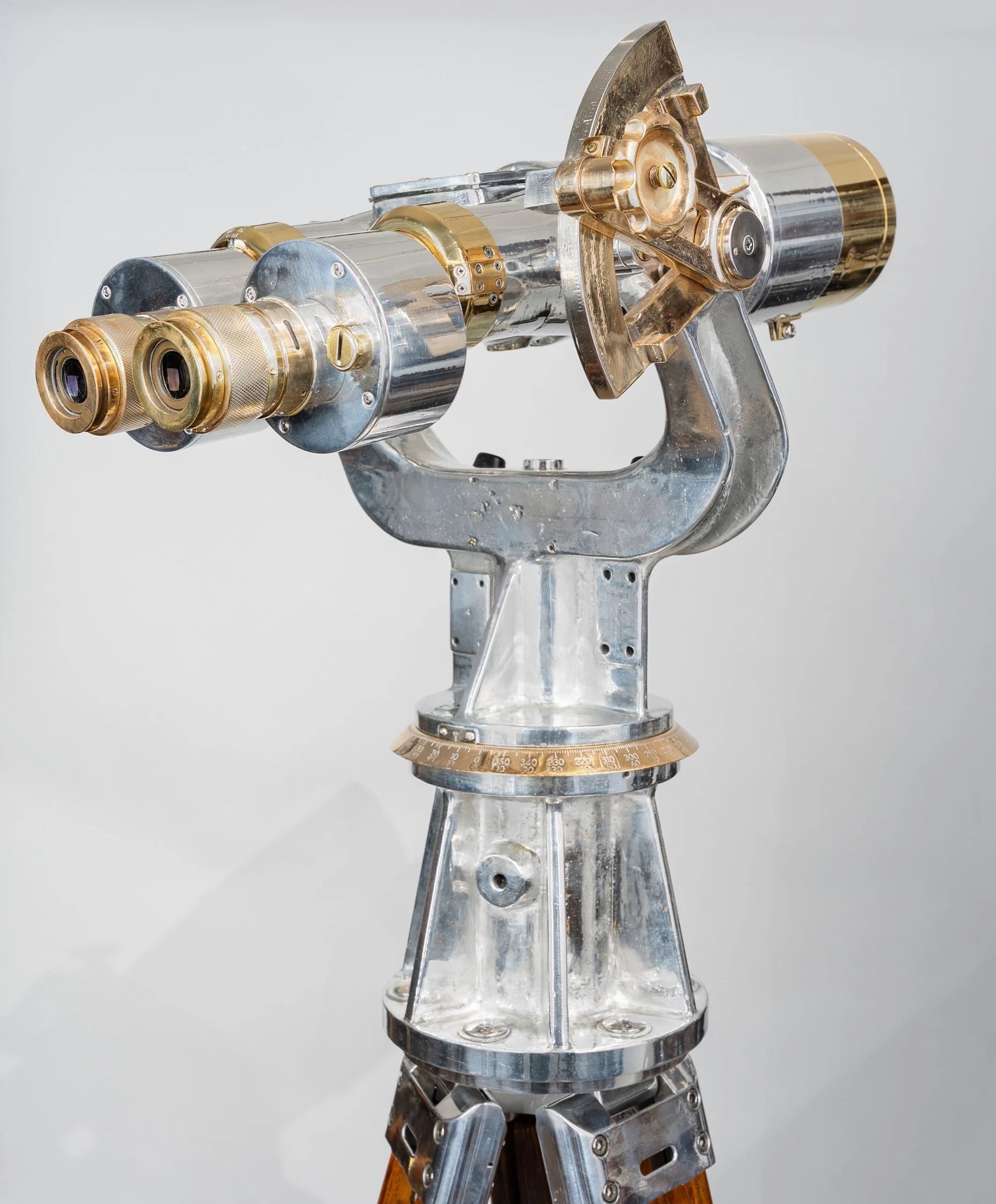 Image 1 of 3
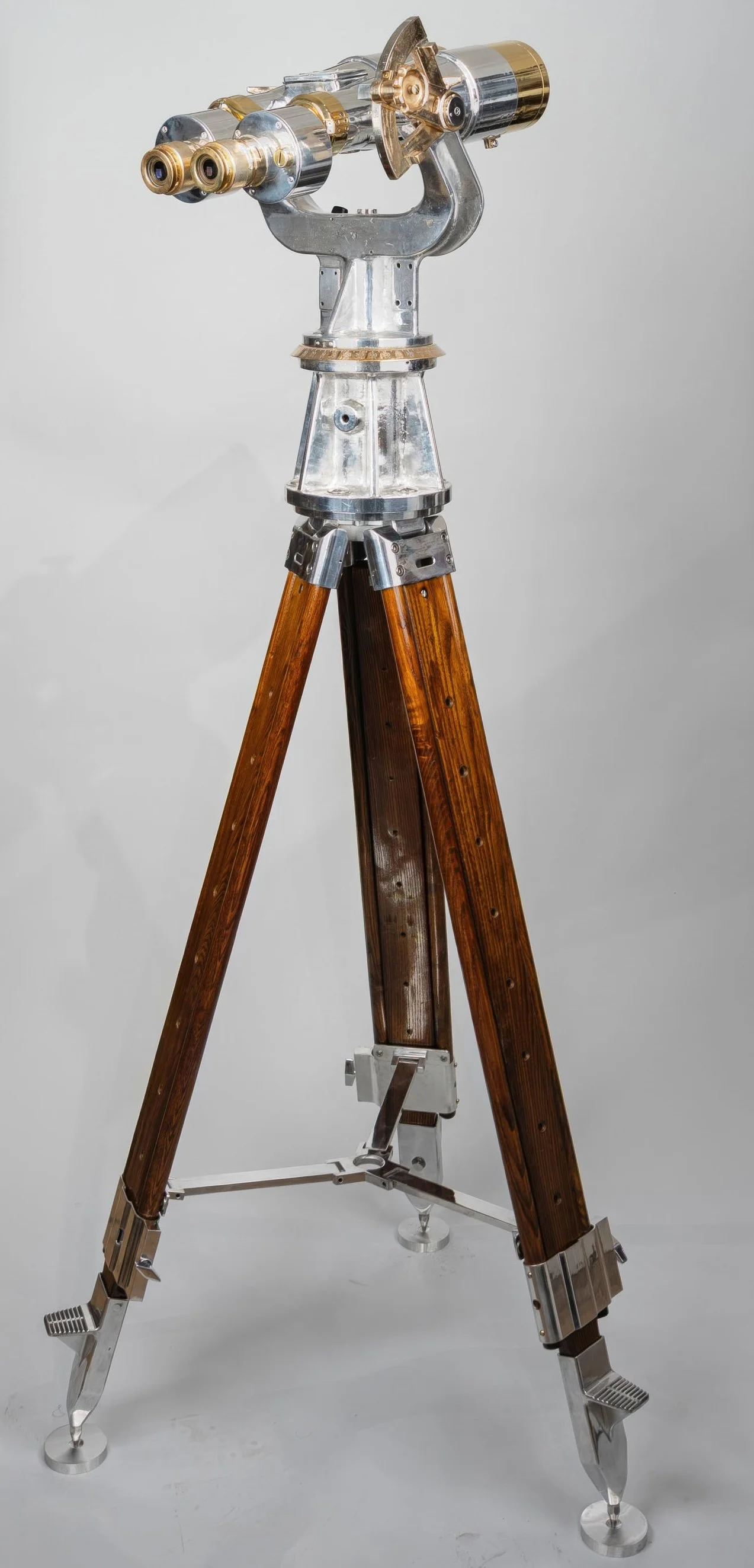 Image 2 of 3
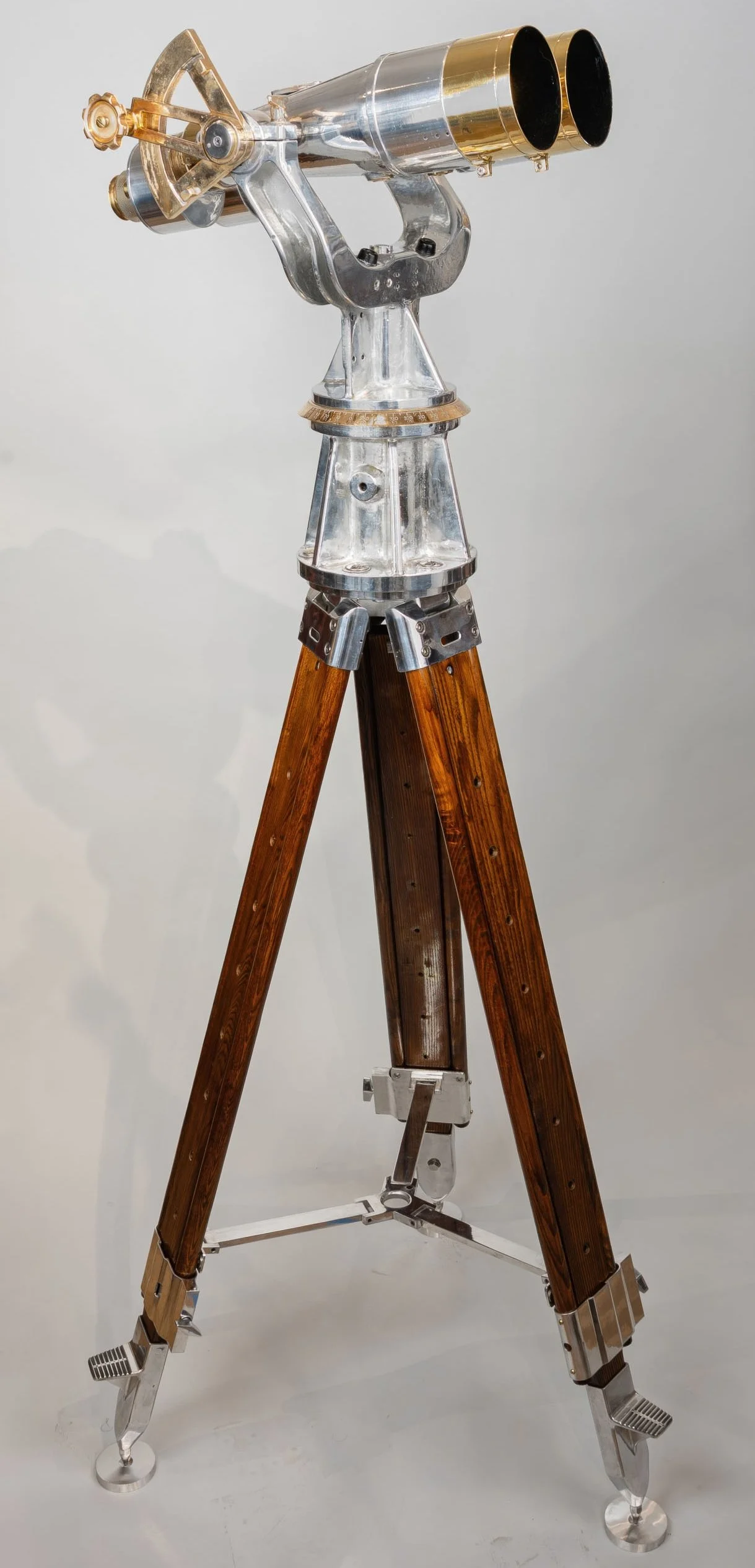 Image 3 of 3