A French Industrial Series automaton clock in the form of a submarine, by André Guilmet, Paris, circa 1890. The black patinated hull, riveted throughout, rides atop a cast-bronze sea on an oval plinth of green onyx with a gilt rim. The silvered conning tower houses the movement behind a gilt-bezelled enamel dial, and the deck carries a full complement of fittings in gilt and silvered bronze: boarding ladders, railings, an anchor with chains, a copper vent cowl, a binnacle compass, and a stern davit crane with a winding wheel. A funnel-form thermometer stands amidships, its scale printed in English, indicating an example made for the export market. It measures 23 inches long, 15 inches high, and 10 inches deep, 58.5 by 38 by 25.5 cm.
The clock is a two-motion automaton. When wound, the conning tower rotates, and the stern propeller turns beneath the counter, both driven by the same train that powers the clock, so the vessel is animated whenever it is running.
The submarine is the rarest subject in Guilmet's nautical group, which also included a quarterdeck, a lighthouse, and a battleship. When this model was designed, no such vessel existed in service yet, and its true ancestor is literary. Jules Verne's Twenty Thousand Leagues Under the Sea of 1870 gave the public the Nautilus, an elongated cigar-shaped hull of riveted plates with a raised pilot house and a platform where Captain Nemo takes the air, and the illustrations by Alphonse de Neuville and Édouard Riou for the first illustrated Hetzel edition fixed that image in the popular imagination. The clock reads as the Nautilus made domestic, the same spindle hull, raised tower, and railed deck, translated to the drawing room. Reality only caught up afterward: France launched the Gymnote, her first working electric submarine, in 1888, and the larger Gustave Zédé followed in 1893. This is a mythical ship assembled from the fittings of real ones, machinery presented as spectacle.
The example survives in exceptional condition, the gilding bright, the patina unrubbed, and the chains and deck fittings complete. The series is discussed in Derek Roberts, Mystery, Novelty and Fantasy Clocks, 1999, pp. 253-270.
A French Industrial Series automaton clock in the form of a submarine, by André Guilmet, Paris, circa 1890. The black patinated hull, riveted throughout, rides atop a cast-bronze sea on an oval plinth of green onyx with a gilt rim. The silvered conning tower houses the movement behind a gilt-bezelled enamel dial, and the deck carries a full complement of fittings in gilt and silvered bronze: boarding ladders, railings, an anchor with chains, a copper vent cowl, a binnacle compass, and a stern davit crane with a winding wheel. A funnel-form thermometer stands amidships, its scale printed in English, indicating an example made for the export market. It measures 23 inches long, 15 inches high, and 10 inches deep, 58.5 by 38 by 25.5 cm.
The clock is a two-motion automaton. When wound, the conning tower rotates, and the stern propeller turns beneath the counter, both driven by the same train that powers the clock, so the vessel is animated whenever it is running.
The submarine is the rarest subject in Guilmet's nautical group, which also included a quarterdeck, a lighthouse, and a battleship. When this model was designed, no such vessel existed in service yet, and its true ancestor is literary. Jules Verne's Twenty Thousand Leagues Under the Sea of 1870 gave the public the Nautilus, an elongated cigar-shaped hull of riveted plates with a raised pilot house and a platform where Captain Nemo takes the air, and the illustrations by Alphonse de Neuville and Édouard Riou for the first illustrated Hetzel edition fixed that image in the popular imagination. The clock reads as the Nautilus made domestic, the same spindle hull, raised tower, and railed deck, translated to the drawing room. Reality only caught up afterward: France launched the Gymnote, her first working electric submarine, in 1888, and the larger Gustave Zédé followed in 1893. This is a mythical ship assembled from the fittings of real ones, machinery presented as spectacle.
The example survives in exceptional condition, the gilding bright, the patina unrubbed, and the chains and deck fittings complete. The series is discussed in Derek Roberts, Mystery, Novelty and Fantasy Clocks, 1999, pp. 253-270.

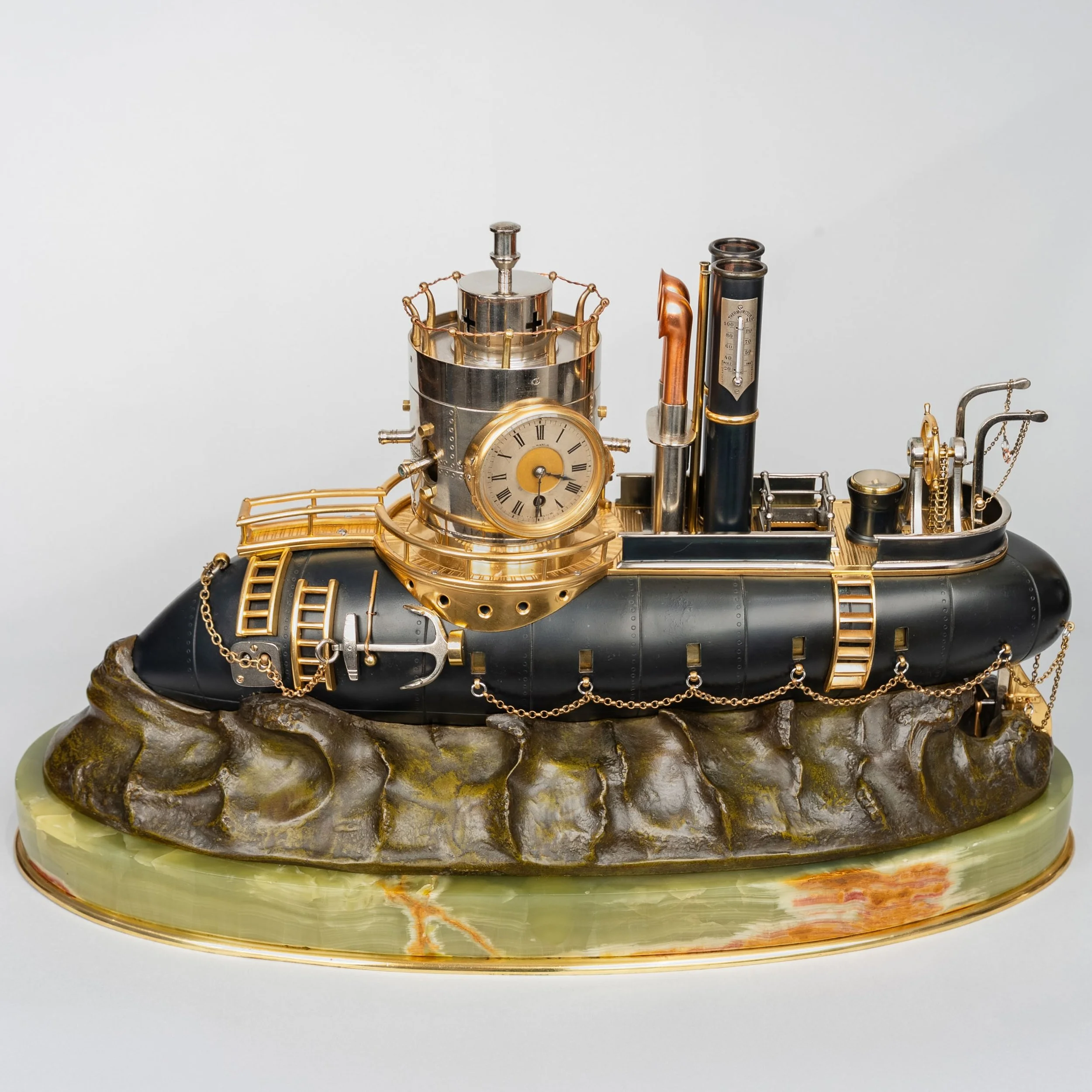 Image 1 of 4
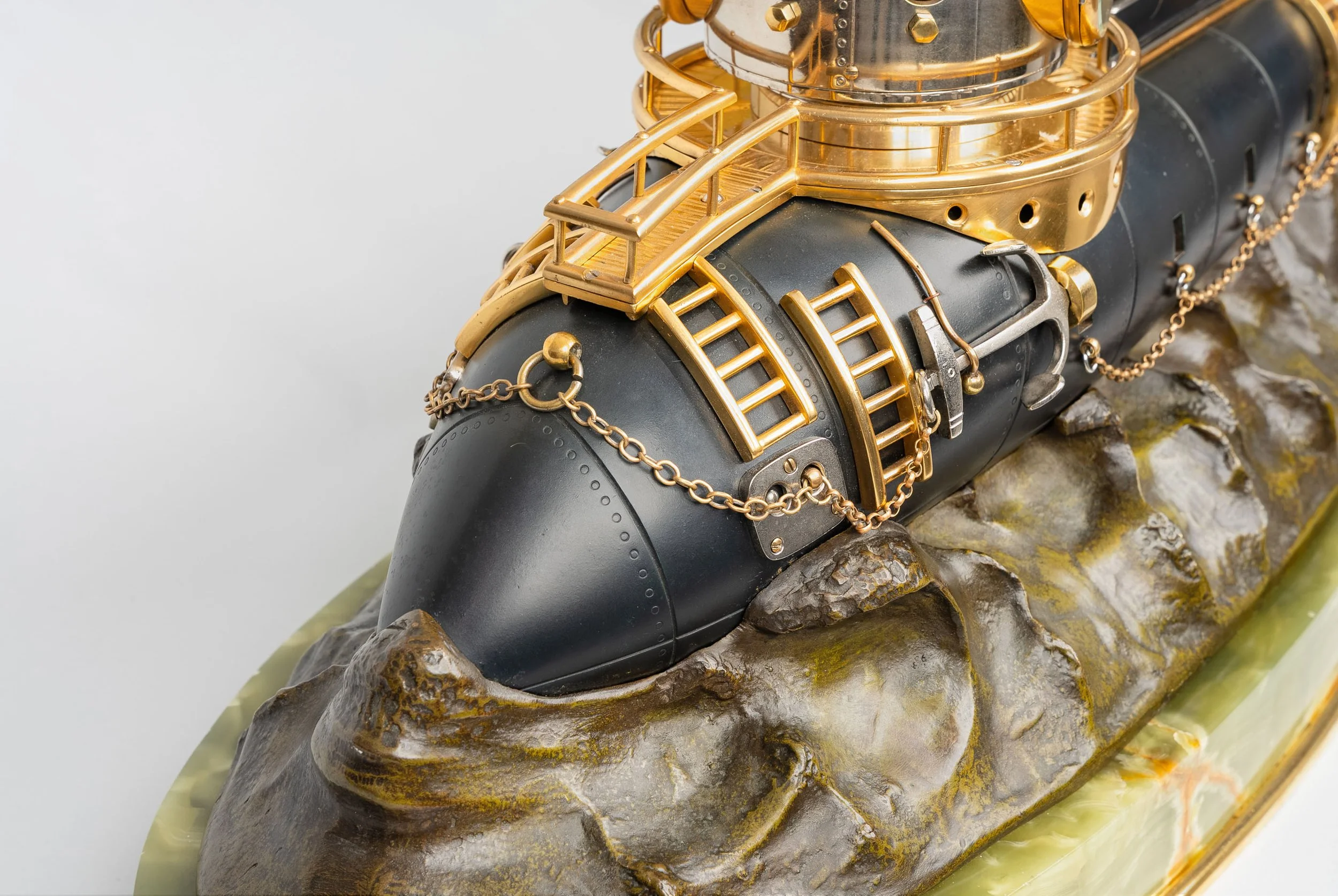 Image 2 of 4
 Image 3 of 4
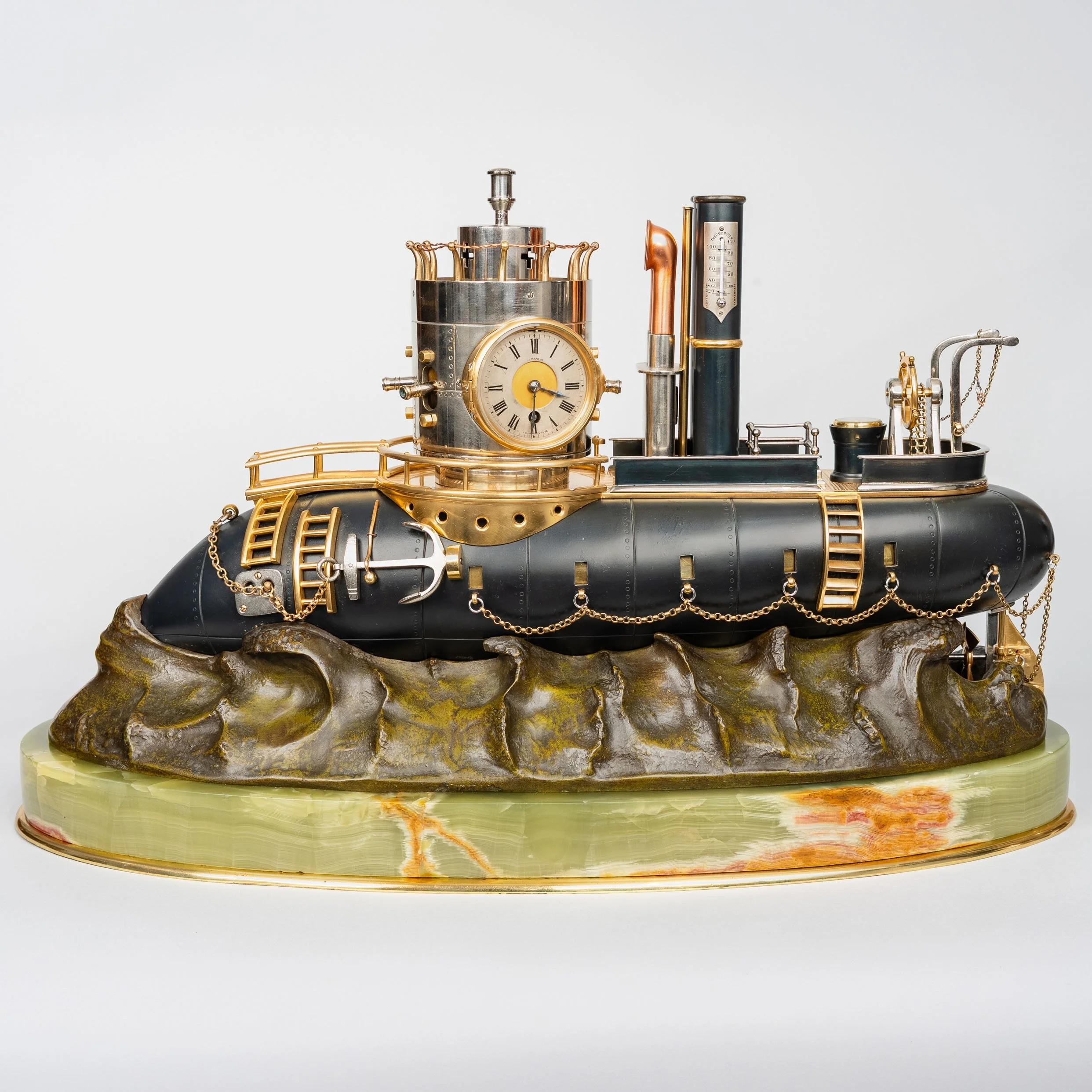 Image 4 of 4