Among the subjects that defined Swiss Black Forest carving at its most ambitious, the eagle in full flight occupied a singular position — a form that demanded from the carver not merely technical skill but a command of composition, structure, and dramatic timing that separated the great workshops from the merely competent. To carve an eagle at rest was a test of naturalistic observation. To carve an eagle at the moment of strike — wings fully extended, head driving downward, talons locked on prey, the entire mass of the bird suspended in a single instant of maximum energy — was a test of sculptural genius. The present group, attributed to the Ruef Brothers of Brienz, meets that test at the highest level.
The Ruef Brothers were among the most accomplished and celebrated carvers of the late nineteenth-century Brienz school — workshop masters whose technical command of deeply undercut plumage and whose instinct for dramatic composition placed their work in a category apart from the general production of the industry. Their eagle groups, when they appear on the market, are recognised immediately by specialists: the characteristic density of the feather carving, the structural boldness of the extended wing, the precision of the talon work, and the expressive intensity of the head.
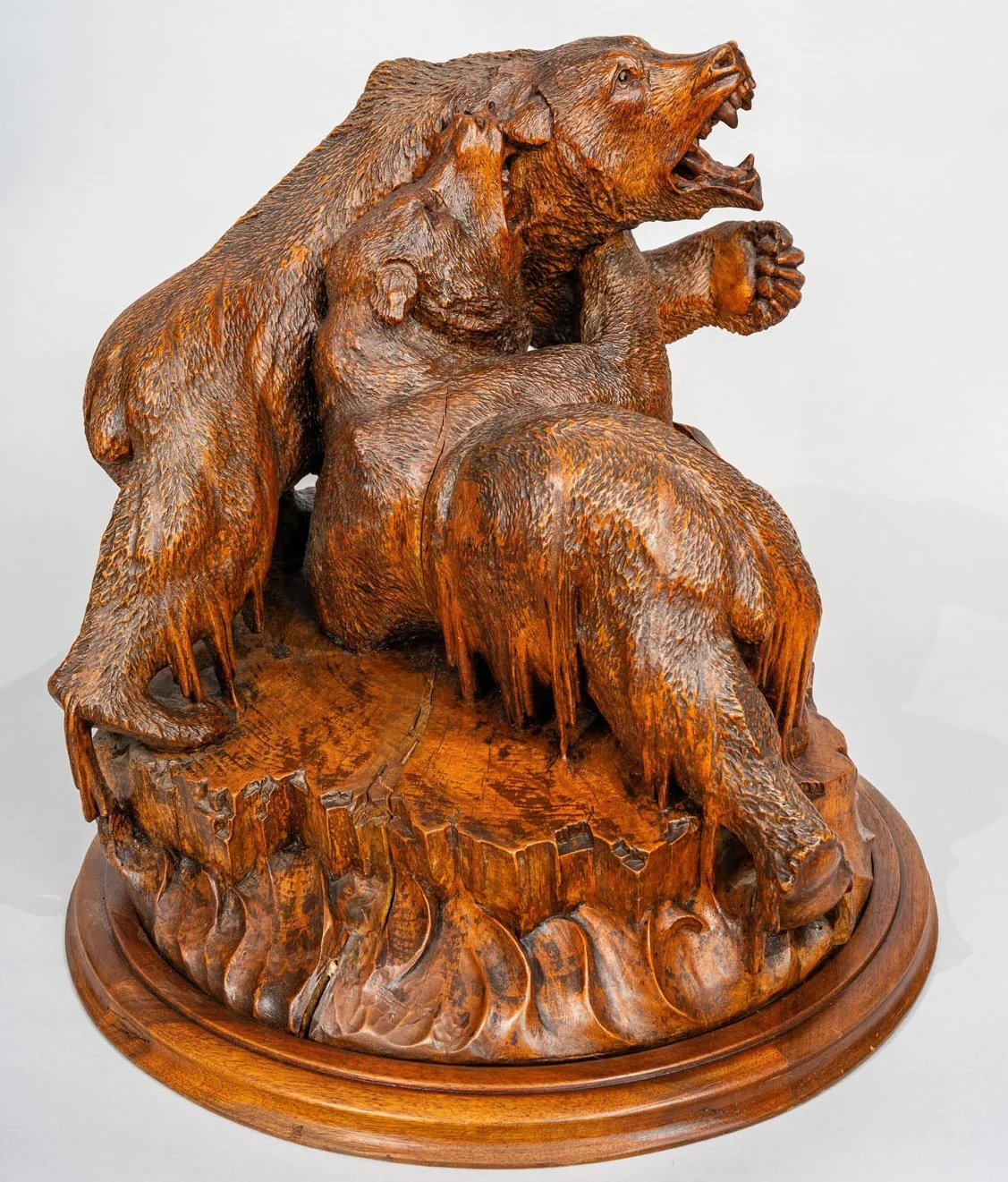
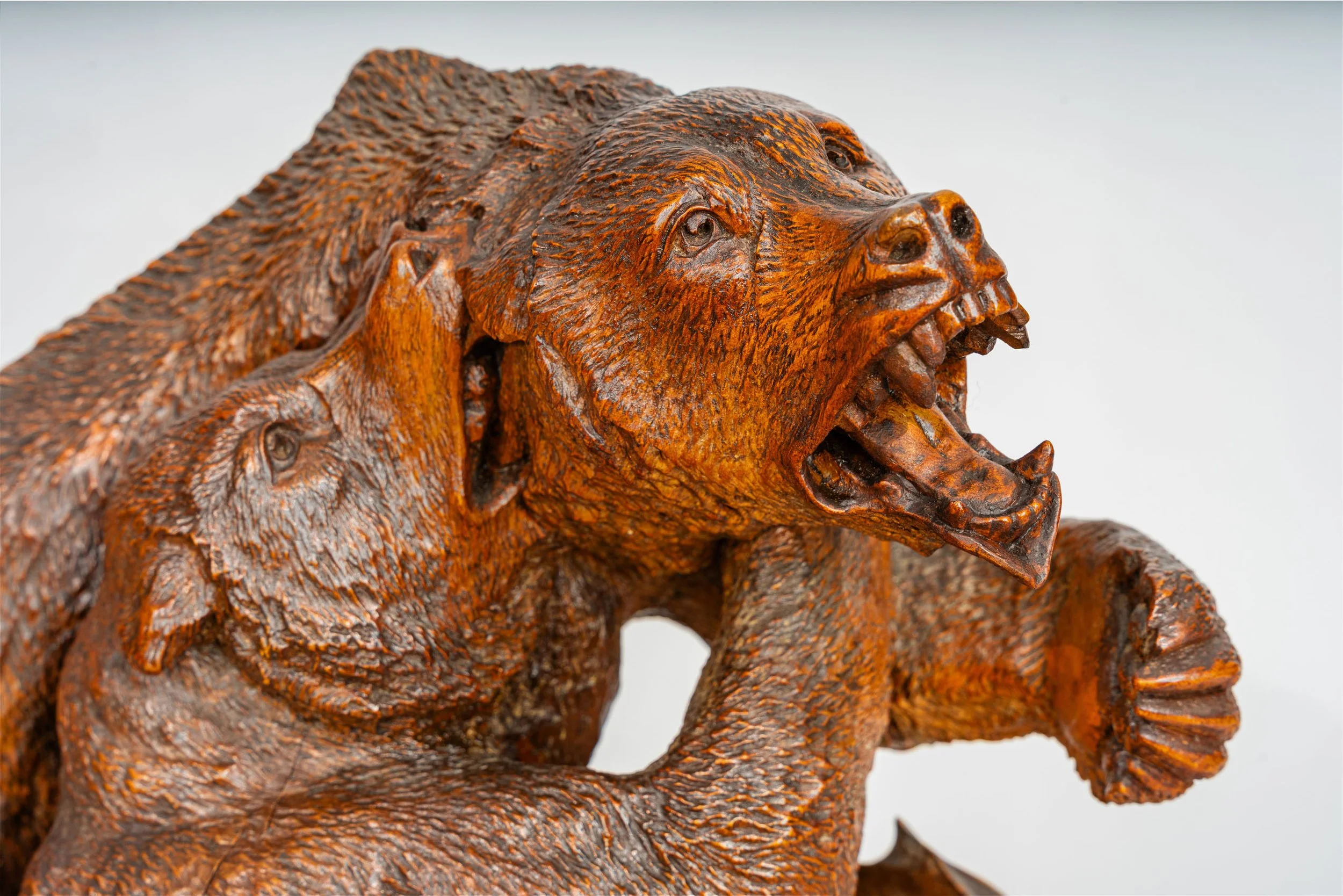
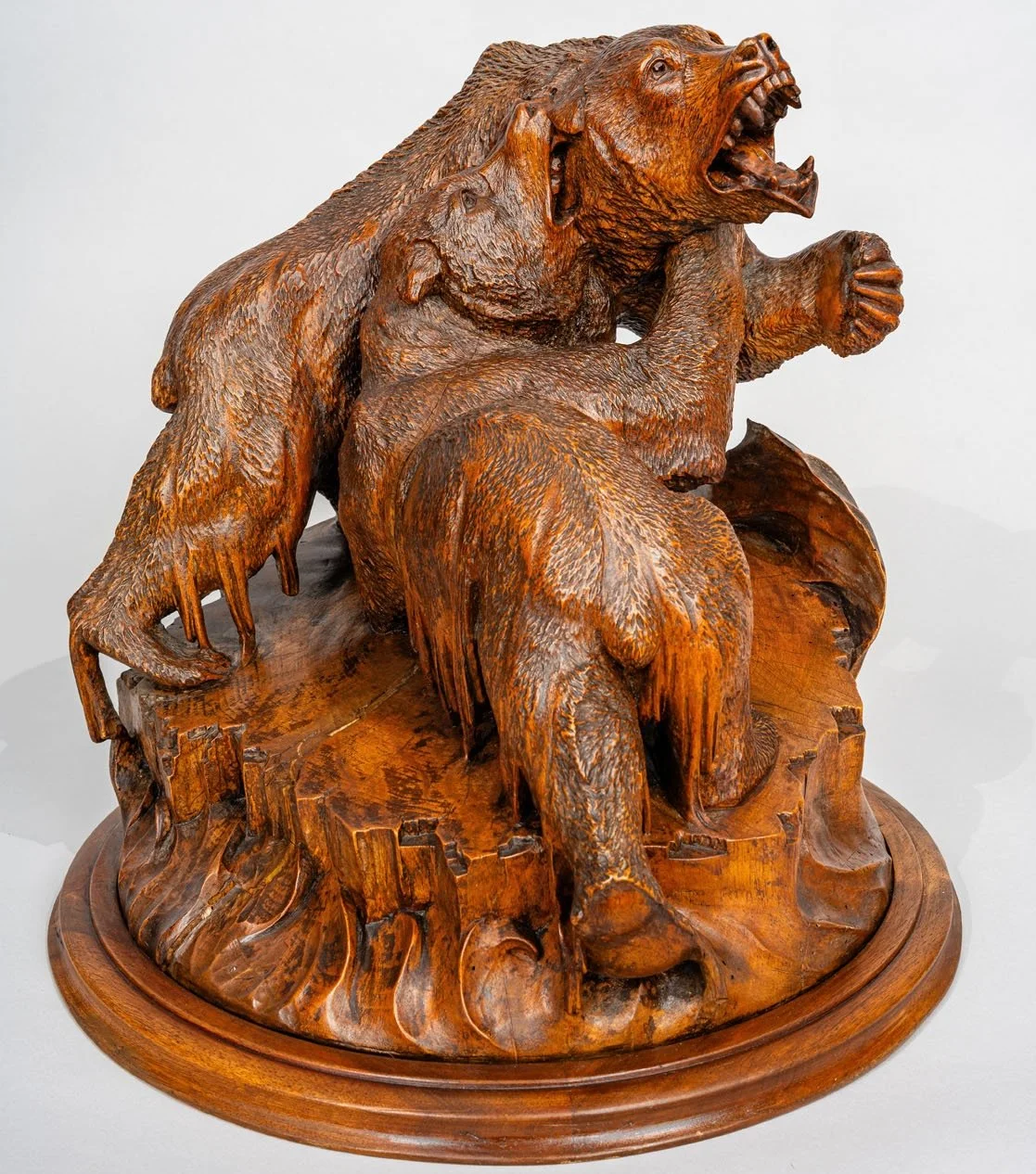
The present group depicts a golden eagle with wings fully outstretched, carved in linden wood and mounted on a rugged naturalistic base of rocks and broken timber. The wingspan is of exceptional breadth — the wings swept back and upward in the asymmetric posture of a bird in the act of landing upon or seizing prey, each flight feather deeply undercut and rhythmically layered in the manner that defines the finest Brienz plumage carving. The head is driven forward and downward, the beak open, the eyes alert — the expression of a predator at the moment of absolute focus. The talons are sharply and individually defined, gripping the rocky outcrop of the base with the conviction of a carver who has observed the living bird with care.
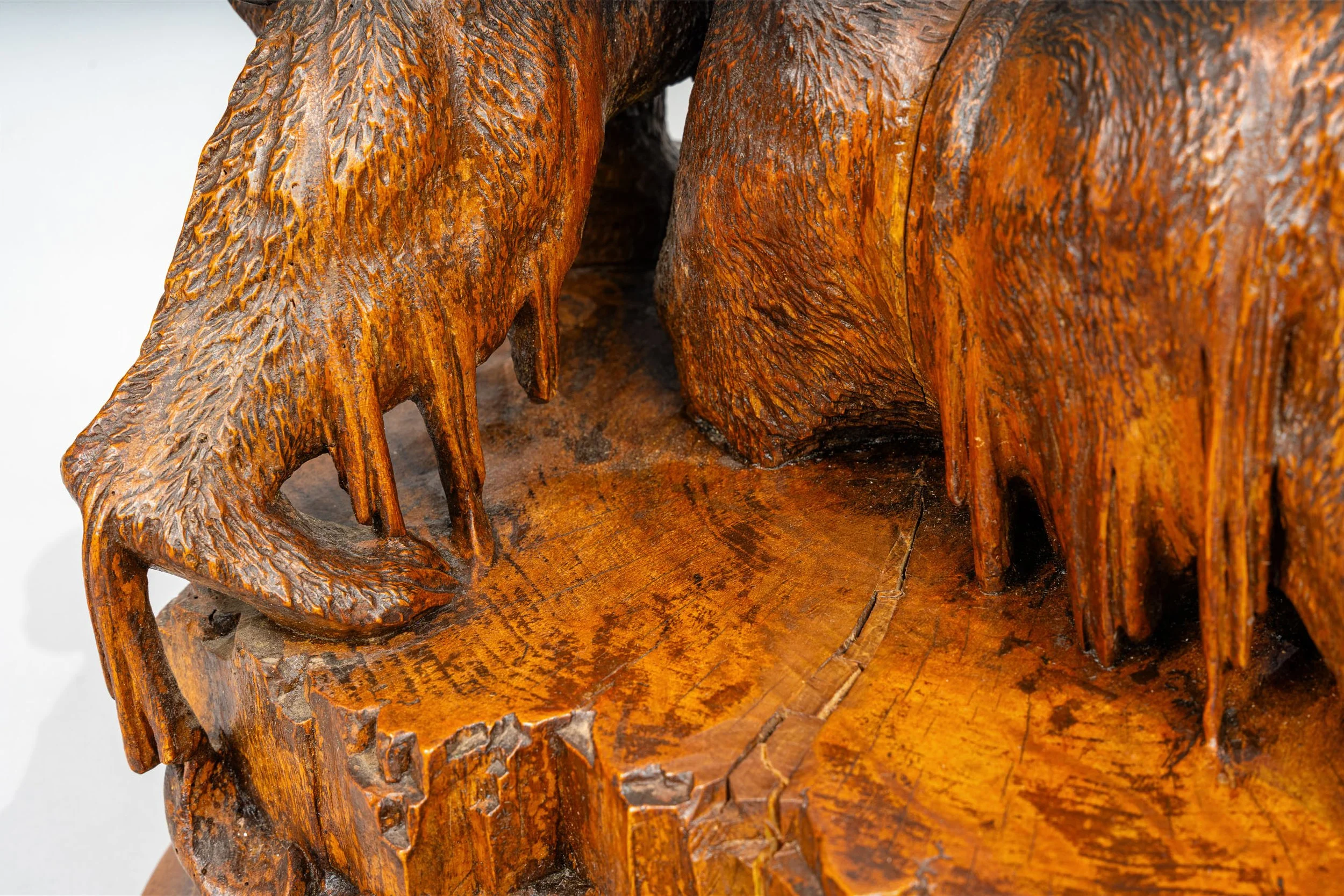
Below and around the central figure, subsidiary birds animate the base: one looks upward toward the dominant eagle, its posture conveying subordination and alertness; a further bird at the lower right adds density to the composition and grounds the narrative — the hierarchy of the alpine world rendered in wood with complete conviction. The base itself is handled with the bold, confident chisel work of the Brienz tradition, the stratified rockwork and broken timber providing a naturalistic and structurally resolved platform for the drama above.
As illustrated in Swiss Carvings: The Art of the Black Forest, 1820–1940 by Jay Arenski, Simon Daniels, and Michael Daniels (p. 89), monumental bird groups of this type represent some of the most ambitious and sought-after productions of the period — works conceived for exhibition at the international fairs that brought the Brienz industry before the wealthiest and most discerning patrons in Europe and America, and for the grandest private commissions of the age. A group of this scale and quality, with a firm workshop attribution, is of exceptional rarity.
Condition: Very good overall. Linden wood structurally sound throughout. Wings fully intact — no cracks, splits, or losses to either wing span. Plumage carving fully intact across all surfaces — deeply undercut feather layers crisp and complete on both wings, breast, and body. Head with open beak intact. Talons individually defined and intact. Subsidiary birds at base present and structurally sound. Rocky base and broken timber elements intact throughout. Rich, deep patina consistent with age and quality of original surface.
Literature:
Jay Arenski, Simon Daniels, and Michael Daniels, Swiss Carvings: The Art of the Black Forest, 1820–1940, 2006, p. 89
Among the subjects that defined Swiss Black Forest carving at its most ambitious, the eagle in full flight occupied a singular position — a form that demanded from the carver not merely technical skill but a command of composition, structure, and dramatic timing that separated the great workshops from the merely competent. To carve an eagle at rest was a test of naturalistic observation. To carve an eagle at the moment of strike — wings fully extended, head driving downward, talons locked on prey, the entire mass of the bird suspended in a single instant of maximum energy — was a test of sculptural genius. The present group, attributed to the Ruef Brothers of Brienz, meets that test at the highest level.
The Ruef Brothers were among the most accomplished and celebrated carvers of the late nineteenth-century Brienz school — workshop masters whose technical command of deeply undercut plumage and whose instinct for dramatic composition placed their work in a category apart from the general production of the industry. Their eagle groups, when they appear on the market, are recognised immediately by specialists: the characteristic density of the feather carving, the structural boldness of the extended wing, the precision of the talon work, and the expressive intensity of the head.
The present group depicts a golden eagle with wings fully outstretched, carved in linden wood and mounted on a rugged naturalistic base of rocks and broken timber. The wingspan is of exceptional breadth — the wings swept back and upward in the asymmetric posture of a bird in the act of landing upon or seizing prey, each flight feather deeply undercut and rhythmically layered in the manner that defines the finest Brienz plumage carving. The head is driven forward and downward, the beak open, the eyes alert — the expression of a predator at the moment of absolute focus. The talons are sharply and individually defined, gripping the rocky outcrop of the base with the conviction of a carver who has observed the living bird with care.
Below and around the central figure, subsidiary birds animate the base: one looks upward toward the dominant eagle, its posture conveying subordination and alertness; a further bird at the lower right adds density to the composition and grounds the narrative — the hierarchy of the alpine world rendered in wood with complete conviction. The base itself is handled with the bold, confident chisel work of the Brienz tradition, the stratified rockwork and broken timber providing a naturalistic and structurally resolved platform for the drama above.
As illustrated in Swiss Carvings: The Art of the Black Forest, 1820–1940 by Jay Arenski, Simon Daniels, and Michael Daniels (p. 89), monumental bird groups of this type represent some of the most ambitious and sought-after productions of the period — works conceived for exhibition at the international fairs that brought the Brienz industry before the wealthiest and most discerning patrons in Europe and America, and for the grandest private commissions of the age. A group of this scale and quality, with a firm workshop attribution, is of exceptional rarity.
Condition: Very good overall. Linden wood structurally sound throughout. Wings fully intact — no cracks, splits, or losses to either wing span. Plumage carving fully intact across all surfaces — deeply undercut feather layers crisp and complete on both wings, breast, and body. Head with open beak intact. Talons individually defined and intact. Subsidiary birds at base present and structurally sound. Rocky base and broken timber elements intact throughout. Rich, deep patina consistent with age and quality of original surface.
Literature:
Jay Arenski, Simon Daniels, and Michael Daniels, Swiss Carvings: The Art of the Black Forest, 1820–1940, 2006, p. 89

 Image 1 of 3
 Image 2 of 3
 Image 3 of 3