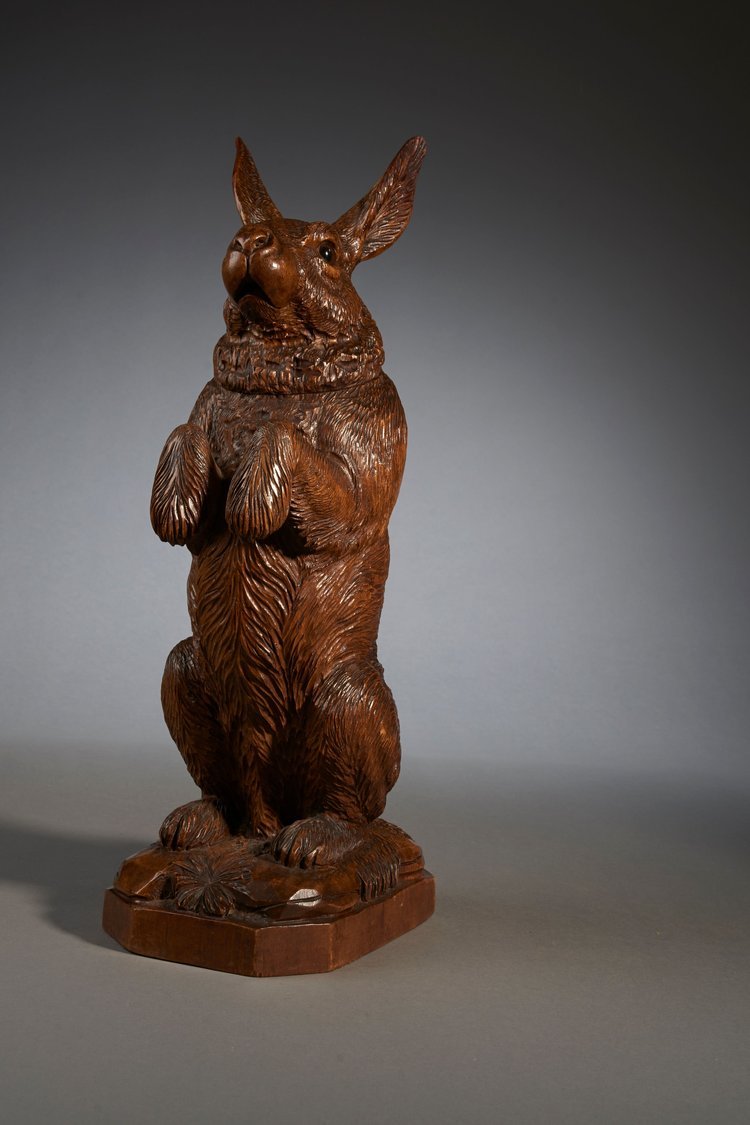
Powerfully carved in the round, this highly unusual umbrella stand takes the form of a begging long-haired terrier, its upright posture ingeniously adapted to serve both sculptural and functional purposes. The dog supports a carved tray, while the shaped base incorporates a drip well, demonstrating the inventive fusion of utility and artistry characteristic of the finest Swiss Black Forest carving.
The surface is richly worked with deeply undercut, flowing fur, creating a remarkable sense of movement and texture, and exemplifying the virtuosity of late 19th-century Brienz workshops. The expressive upward gaze and naturalistic stance further enhance the lifelike presence of the piece.
As illustrated in Swiss Carvings – The Art of the “Black Forest” 1820–1940 by Jay Arenski, Simon Daniels and Michael Daniels (see p. 101), such functional carvings represent a particularly sought-after category, produced for an international clientele and often exhibited at the great world’s fairs, where Swiss carvers achieved widespread acclaim.
A rare and sculpturally ambitious example, combining bold design, exceptional craftsmanship, and practical ingenuity—hallmarks of the finest Black Forest carving at the height of its development.
Powerfully carved in the round, this highly unusual umbrella stand takes the form of a begging long-haired terrier, its upright posture ingeniously adapted to serve both sculptural and functional purposes. The dog supports a carved tray, while the shaped base incorporates a drip well, demonstrating the inventive fusion of utility and artistry characteristic of the finest Swiss Black Forest carving.
The surface is richly worked with deeply undercut, flowing fur, creating a remarkable sense of movement and texture, and exemplifying the virtuosity of late 19th-century Brienz workshops. The expressive upward gaze and naturalistic stance further enhance the lifelike presence of the piece.
As illustrated in Swiss Carvings – The Art of the “Black Forest” 1820–1940 by Jay Arenski, Simon Daniels and Michael Daniels (see p. 101), such functional carvings represent a particularly sought-after category, produced for an international clientele and often exhibited at the great world’s fairs, where Swiss carvers achieved widespread acclaim.
A rare and sculpturally ambitious example, combining bold design, exceptional craftsmanship, and practical ingenuity—hallmarks of the finest Black Forest carving at the height of its development.

 Image 1 of 1