Winston S. Churchill (1874-1965)
Typed letter signed to Rubeigh James Minney on his inability to rouse the nation.
Chartwell, Westerham, Kent: 12 November 1938.
“I am afraid that making speeches in the country no longer has the old effect.”
Single sheet on Chartwell letterhead, typed on one side with autograph salutation and signature; together with a carbon copy of Minney’s letter to Churchill, 11 November 1938. Central folds were folded, lightly toned with a faint paperclip impression at the head; carbon copy with a paperclip rust mark and minor wear to the edges. Overall, in very good condition.
Writing in the immediate aftermath of the Munich Agreement, as Europe moved ever closer to war, Churchill laments that his efforts “to warn the country of what was coming” had been ignored and that his oratory no longer carried the influence it had before the First World War.
The present letter responds to an appeal from the journalist Rubeigh James Minney, managing editor of The Sunday Referee. Writing to Churchill on 11 November 1938, Minney expressed concern that the country had quickly lapsed back into complacency following the Munich crisis:
“The recent crisis has revealed how weak we are and now that the danger has passed the country is being lulled again into a state of apathy. It needs rousing, and I can think of no one who could rouse it so well as you.”
Minney urged Churchill to travel the country giving speeches several times a week, suggesting that if he followed the example of William Ewart Gladstone and spoke widely across the country, his views would attract large audiences and renewed prominence in the local press.
Churchill’s reply reflects his frustration with both the political climate and the limited effect of his warnings. He writes candidly:
“I am afraid that making speeches in the country no longer has the old effect. In the first place, they are not reported or replied to as they used to be before the War.”
He notes that in March and April, he had already undertaken several meetings intended to alert the country to the looming crisis that would culminate in Munich. These meetings attracted large audiences and cross-party platforms, yet:
“While the labour entailed was enormous, it did not seem to produce the slightest result.”
Churchill concludes that he has several speeches planned in his constituency, though this “is the best I can do with all my other work.”
The exchange vividly captures Churchill at the height of his political “Wilderness Years,” when his warnings about the danger posed by Nazi Germany were widely ignored within the British establishment, which remained committed to appeasement under Prime Minister Neville Chamberlain following his agreement with Adolf Hitler at Munich.
Provenance: Sotheby's, 22 July 1982, lot 153 (sold together with item 33), £330
Literature: The letter is quoted in Martin Gilbert, Winston Churchill, vol. V (1976), p. 1019.
Winston S. Churchill (1874-1965)
Typed letter signed to Rubeigh James Minney on his inability to rouse the nation.
Chartwell, Westerham, Kent: 12 November 1938.
“I am afraid that making speeches in the country no longer has the old effect.”
Single sheet on Chartwell letterhead, typed on one side with autograph salutation and signature; together with a carbon copy of Minney’s letter to Churchill, 11 November 1938. Central folds were folded, lightly toned with a faint paperclip impression at the head; carbon copy with a paperclip rust mark and minor wear to the edges. Overall, in very good condition.
Writing in the immediate aftermath of the Munich Agreement, as Europe moved ever closer to war, Churchill laments that his efforts “to warn the country of what was coming” had been ignored and that his oratory no longer carried the influence it had before the First World War.
The present letter responds to an appeal from the journalist Rubeigh James Minney, managing editor of The Sunday Referee. Writing to Churchill on 11 November 1938, Minney expressed concern that the country had quickly lapsed back into complacency following the Munich crisis:
“The recent crisis has revealed how weak we are and now that the danger has passed the country is being lulled again into a state of apathy. It needs rousing, and I can think of no one who could rouse it so well as you.”
Minney urged Churchill to travel the country giving speeches several times a week, suggesting that if he followed the example of William Ewart Gladstone and spoke widely across the country, his views would attract large audiences and renewed prominence in the local press.
Churchill’s reply reflects his frustration with both the political climate and the limited effect of his warnings. He writes candidly:
“I am afraid that making speeches in the country no longer has the old effect. In the first place, they are not reported or replied to as they used to be before the War.”
He notes that in March and April, he had already undertaken several meetings intended to alert the country to the looming crisis that would culminate in Munich. These meetings attracted large audiences and cross-party platforms, yet:
“While the labour entailed was enormous, it did not seem to produce the slightest result.”
Churchill concludes that he has several speeches planned in his constituency, though this “is the best I can do with all my other work.”
The exchange vividly captures Churchill at the height of his political “Wilderness Years,” when his warnings about the danger posed by Nazi Germany were widely ignored within the British establishment, which remained committed to appeasement under Prime Minister Neville Chamberlain following his agreement with Adolf Hitler at Munich.
Provenance: Sotheby's, 22 July 1982, lot 153 (sold together with item 33), £330
Literature: The letter is quoted in Martin Gilbert, Winston Churchill, vol. V (1976), p. 1019.

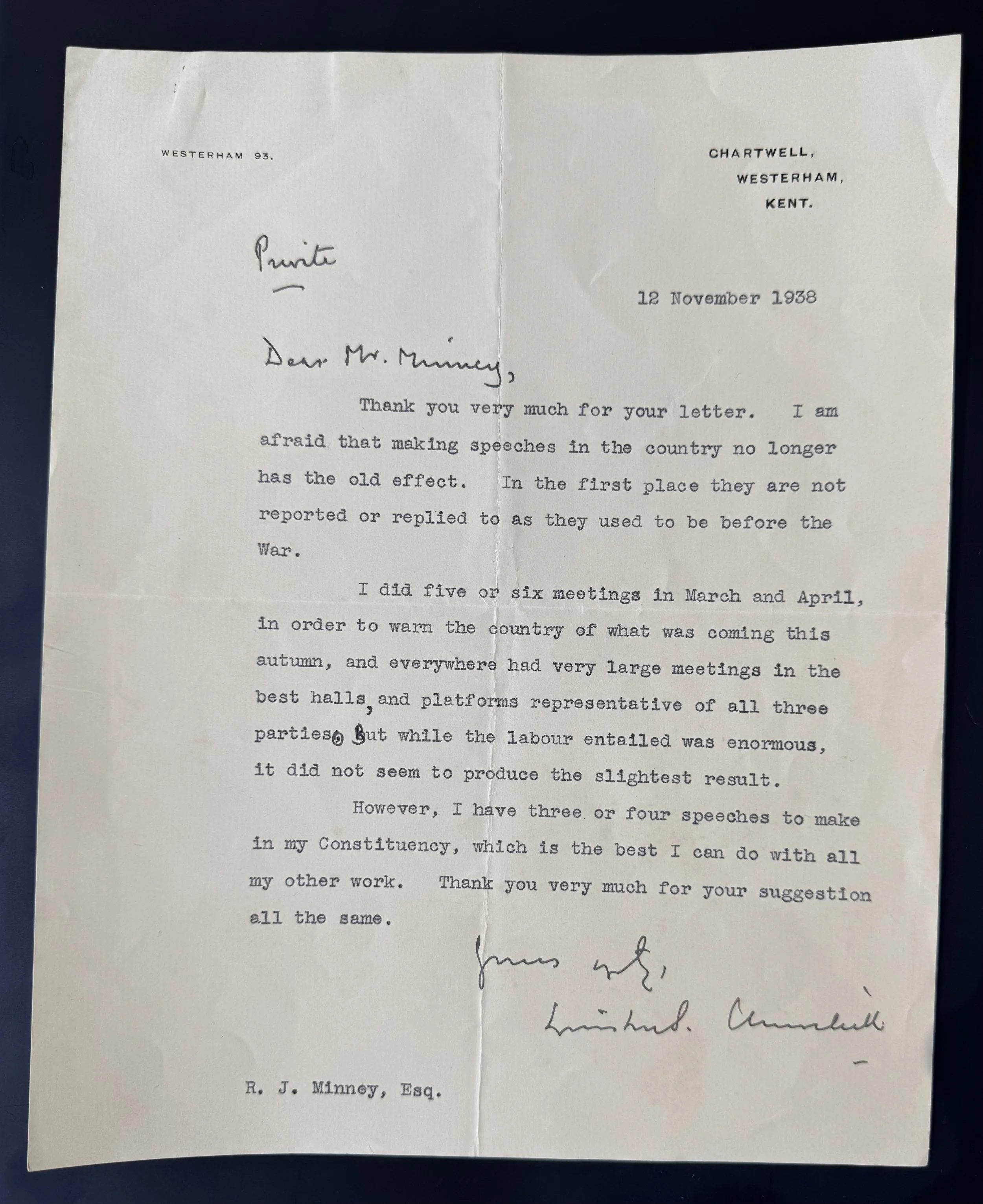 Image 1 of 2
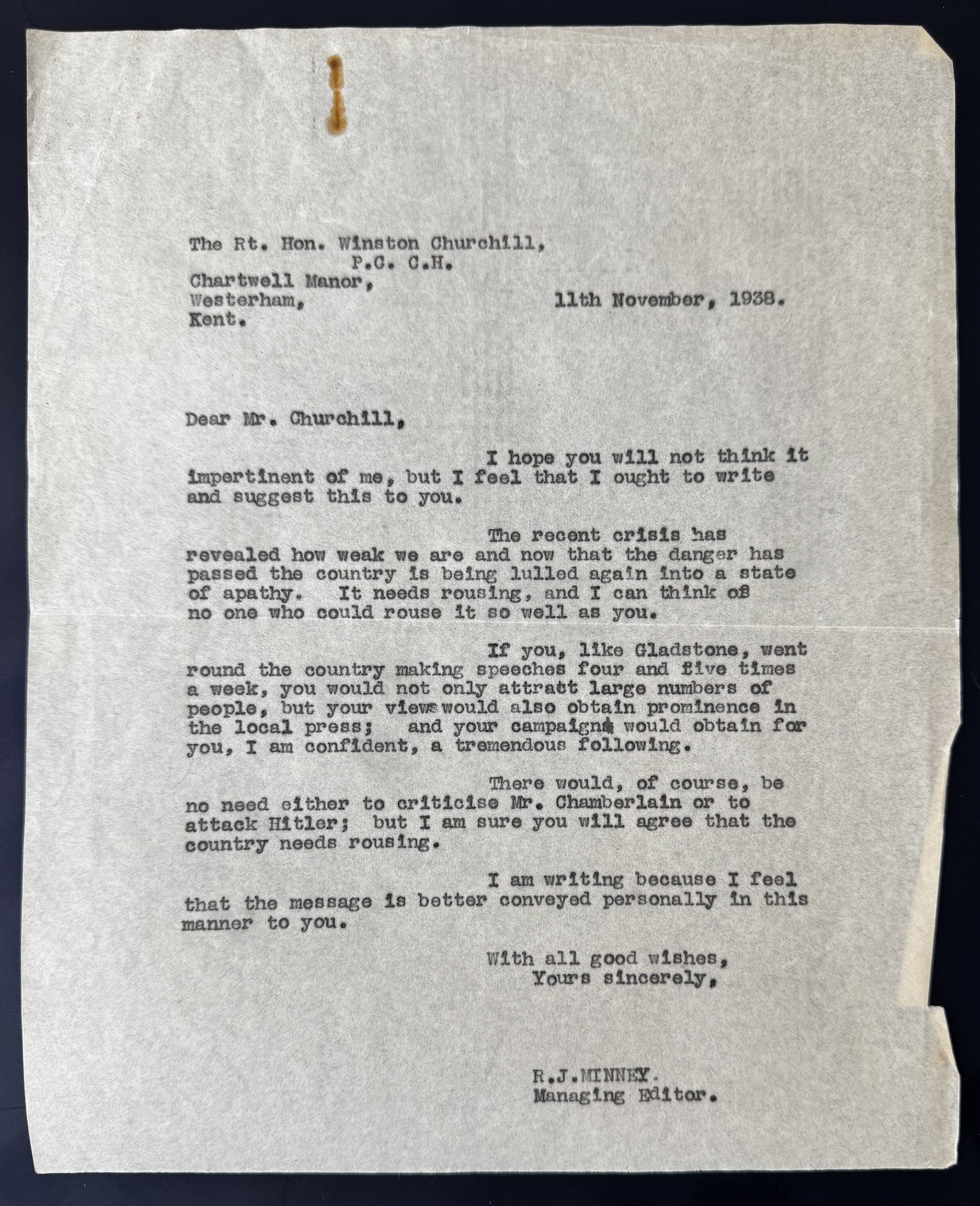 Image 2 of 2