Western Union Telegraph Company
Manufactured by Thomas A. Edison, Inc.
A brass-and-steel self-winding electromechanical stock ticker, dated 1915, with the mechanism stamped MFD. BY T.A. EDISON, INC., enclosed beneath a glass dome and mounted on a japanned base with printed Western Union service instructions.
This model was part of the nationwide ticker network operated by Western Union, receiving telegraphic impulses that transmitted stock quotations and printing abbreviated company names and prices on a continuous paper tape, providing brokers with near-real-time market information.
The self-winding system was developed by George B. Scott and W. P. Phelps, with subsequent refinements in 1903 by J. C. Barclay and Jay R. Page, resulting in a more compact and efficient machine. Although examples are frequently marked for Thomas Edison, this denotes manufacture rather than invention, as Edison’s involvement in ticker design had ceased decades earlier.
The present machine incorporates a later dual-roller ink system within a hinged enclosure, replacing the earlier single-roller arrangement and reflecting ongoing refinements made during service.
Nine principal variants of the self-winding ticker were produced—1-C, 21-C, 22-A, 30-A, 31-A, 32-A, 34-A, 35-A, and 41-A—though many machines were altered during service, and surviving examples often incorporate later components without corresponding changes in designation.
A refined and technologically mature example, illustrating the evolution of electromechanical market reporting systems that underpinned the expansion of modern financial markets.
Western Union Telegraph Company
Manufactured by Thomas A. Edison, Inc.
A brass-and-steel self-winding electromechanical stock ticker, dated 1915, with the mechanism stamped MFD. BY T.A. EDISON, INC., enclosed beneath a glass dome and mounted on a japanned base with printed Western Union service instructions.
This model was part of the nationwide ticker network operated by Western Union, receiving telegraphic impulses that transmitted stock quotations and printing abbreviated company names and prices on a continuous paper tape, providing brokers with near-real-time market information.
The self-winding system was developed by George B. Scott and W. P. Phelps, with subsequent refinements in 1903 by J. C. Barclay and Jay R. Page, resulting in a more compact and efficient machine. Although examples are frequently marked for Thomas Edison, this denotes manufacture rather than invention, as Edison’s involvement in ticker design had ceased decades earlier.
The present machine incorporates a later dual-roller ink system within a hinged enclosure, replacing the earlier single-roller arrangement and reflecting ongoing refinements made during service.
Nine principal variants of the self-winding ticker were produced—1-C, 21-C, 22-A, 30-A, 31-A, 32-A, 34-A, 35-A, and 41-A—though many machines were altered during service, and surviving examples often incorporate later components without corresponding changes in designation.
A refined and technologically mature example, illustrating the evolution of electromechanical market reporting systems that underpinned the expansion of modern financial markets.

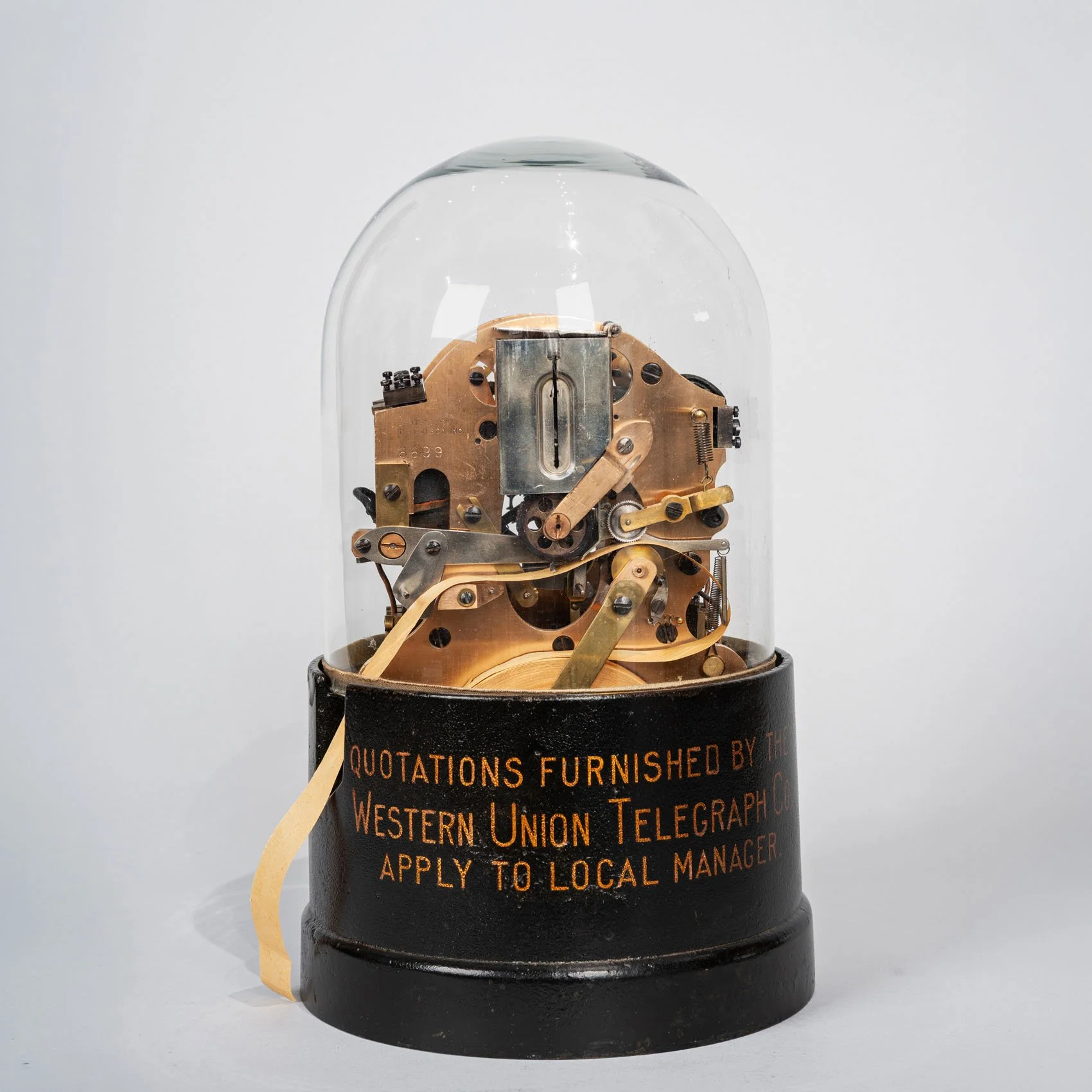 Image 1 of 2
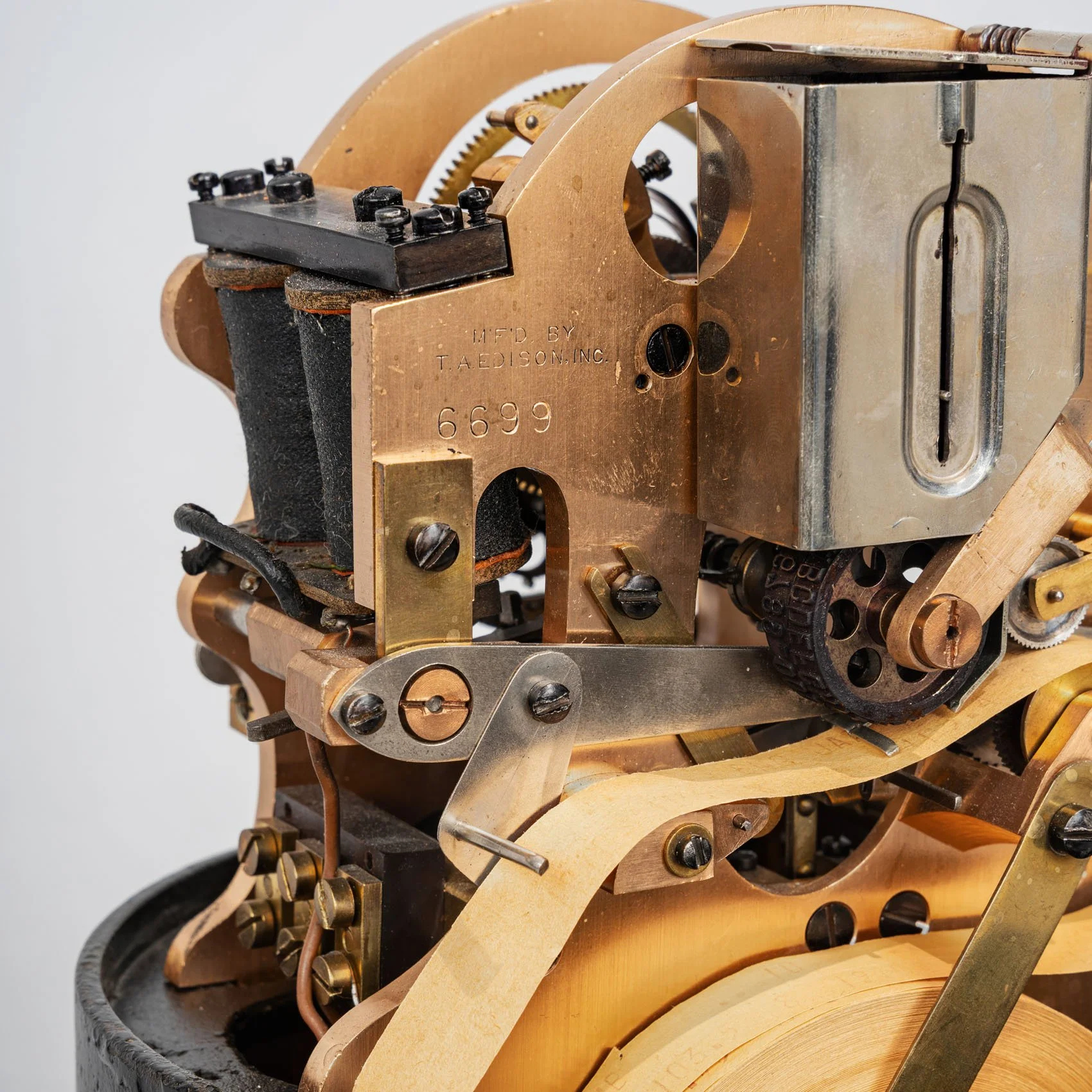 Image 2 of 2