Autograph letter signed (“W”), to Emanuel Shinwell
10 Downing Street letterhead, marked “SECRET.”
Dated 15 June 1944
A highly important wartime autograph letter by Winston S. Churchill, written from 10 Downing Street just nine days after the Allied landings in Normandy, reflecting on the success of D-Day and alluding to the imminent Soviet offensive.
Marked “SECRET,” the letter captures Churchill at a pivotal moment in the Second World War, as the Allied invasion of Europe had begun to decisively shift the balance of the conflict. Writing to Labor politician Emanuel Shinwell, a frequent yet patriotic critic of the government, Churchill responds with unusual openness and strategic clarity.
He writes:
“Very heavy fighting lies ahead in France, but I expect our power to reinforce is greater than the enemy’s – at any rate for some time to come. Meanwhile, Stalin is sure to get on the move.”
This passage is of particular historical importance, revealing Churchill’s confidence in Allied logistical superiority while simultaneously acknowledging the scale and uncertainty of the campaign ahead. His reference to Stalin directly anticipates the Soviet offensive agreed upon at the Tehran Conference, underscoring the coordinated global strategy of the Allied powers.
Churchill further acknowledges Shinwell’s supportive message:
“I know well that your patriotic sentiments have been profoundly stirred by the glorious events of the last fortnight.”
The exchange is especially notable given Shinwell’s role as a vocal critic of Churchill’s wartime government. That Churchill chose to reply—despite advice from his Private Secretary that no response was necessary—demonstrates both political sensitivity and an acute awareness of national unity at a critical juncture.
Signed simply “W,” as was customary in his correspondence, the letter embodies Churchill’s wartime leadership at its most immediate and personal—combining strategic insight with rhetorical precision.
A document of considerable historical weight, this letter stands among the most compelling surviving examples of Churchill’s wartime correspondence.
Literature:
Martin Gilbert, Winston S. Churchill, Vol. VII (1986)
Condition:
Single sheet on Downing Street letterhead, typed on one side. Hole punch, light toning, and handling wear. Overall, very good condition.
Autograph letter signed (“W”), to Emanuel Shinwell
10 Downing Street letterhead, marked “SECRET.”
Dated 15 June 1944
A highly important wartime autograph letter by Winston S. Churchill, written from 10 Downing Street just nine days after the Allied landings in Normandy, reflecting on the success of D-Day and alluding to the imminent Soviet offensive.
Marked “SECRET,” the letter captures Churchill at a pivotal moment in the Second World War, as the Allied invasion of Europe had begun to decisively shift the balance of the conflict. Writing to Labor politician Emanuel Shinwell, a frequent yet patriotic critic of the government, Churchill responds with unusual openness and strategic clarity.
He writes:
“Very heavy fighting lies ahead in France, but I expect our power to reinforce is greater than the enemy’s – at any rate for some time to come. Meanwhile, Stalin is sure to get on the move.”
This passage is of particular historical importance, revealing Churchill’s confidence in Allied logistical superiority while simultaneously acknowledging the scale and uncertainty of the campaign ahead. His reference to Stalin directly anticipates the Soviet offensive agreed upon at the Tehran Conference, underscoring the coordinated global strategy of the Allied powers.
Churchill further acknowledges Shinwell’s supportive message:
“I know well that your patriotic sentiments have been profoundly stirred by the glorious events of the last fortnight.”
The exchange is especially notable given Shinwell’s role as a vocal critic of Churchill’s wartime government. That Churchill chose to reply—despite advice from his Private Secretary that no response was necessary—demonstrates both political sensitivity and an acute awareness of national unity at a critical juncture.
Signed simply “W,” as was customary in his correspondence, the letter embodies Churchill’s wartime leadership at its most immediate and personal—combining strategic insight with rhetorical precision.
A document of considerable historical weight, this letter stands among the most compelling surviving examples of Churchill’s wartime correspondence.
Literature:
Martin Gilbert, Winston S. Churchill, Vol. VII (1986)
Condition:
Single sheet on Downing Street letterhead, typed on one side. Hole punch, light toning, and handling wear. Overall, very good condition.

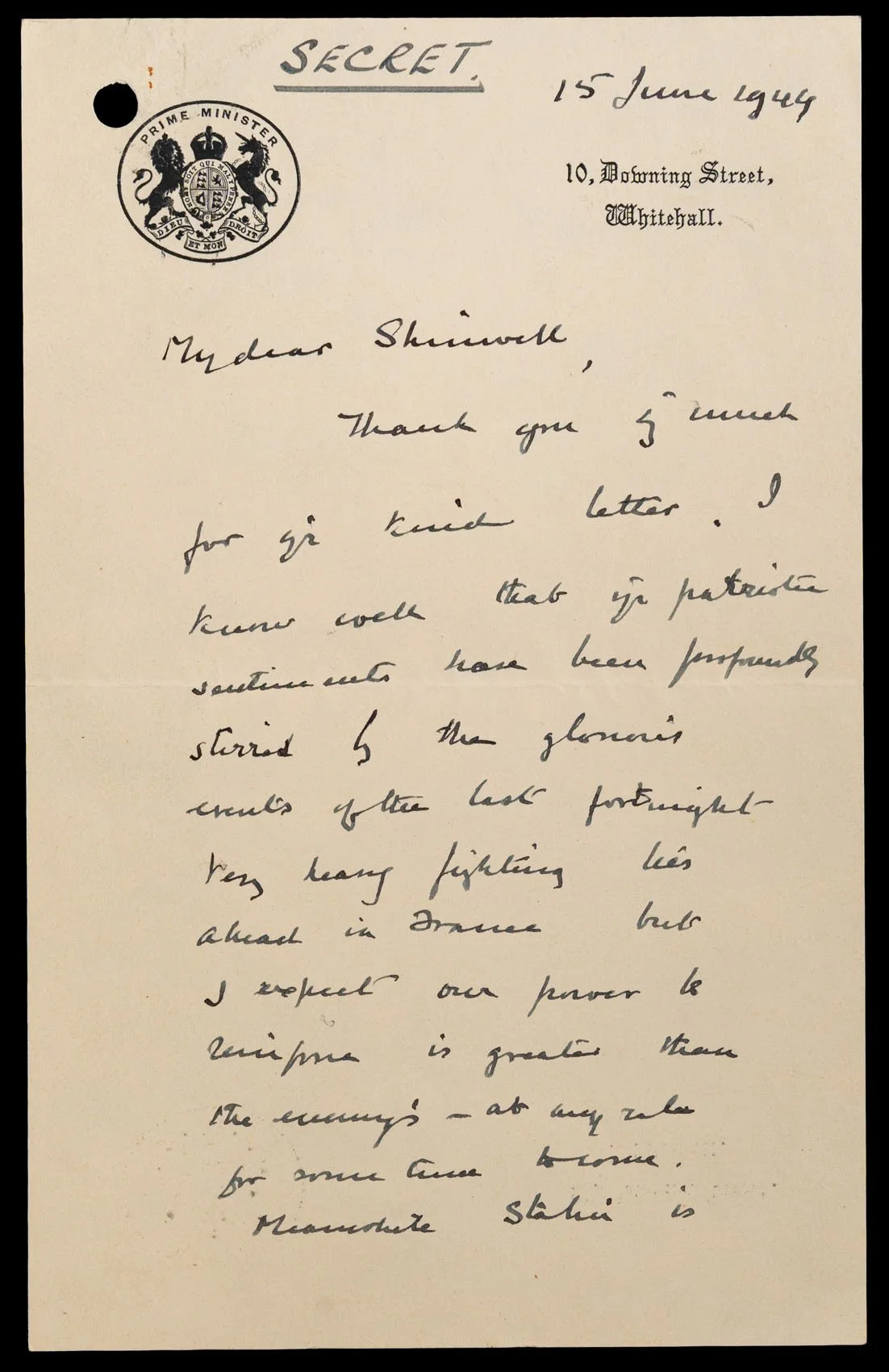 Image 1 of 2
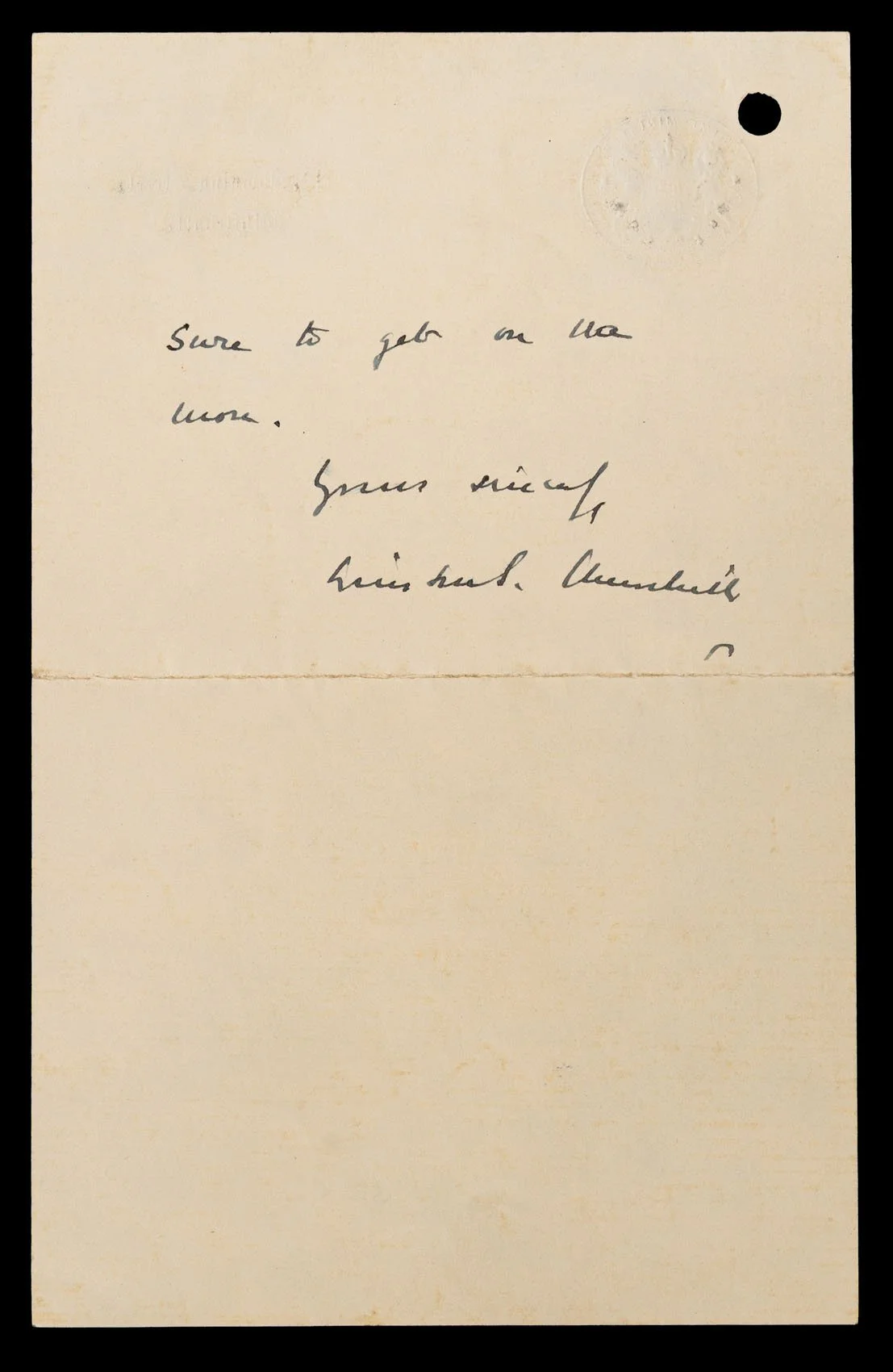 Image 2 of 2